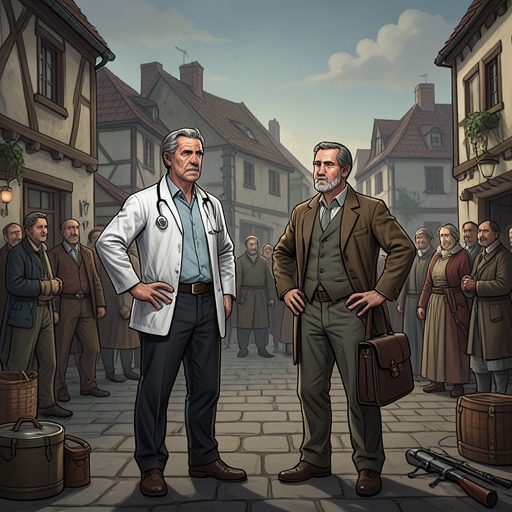
Henry's growing forgetfulness and physical frailty
The Chemistry of DeathHenry’s growing forgetfulness and physical frailty emerge during the aftermath of a break-in at his surgery, changing an apparent lapse in security into a troubling sign of decline. His uncertain memory of leaving doors open and finding a cabinet altered unsettles the confidence David Hunter had placed in him, while the physical signs David notices deepen his concern. The next morning, an empty wheelchair on a jetty leaves that concern suspended in an immediate, unresolved image.
The Lapses Behind the Break-In
The immediate occasion for Henry’s admission is a break-in on the one night he forgot to lock the surgery door. Mackenzie points out the coincidence; Henry reacts defensively, emphasizing that he has been a doctor for thirty years and that nothing like this had happened before. His account initially seems to reduce the event to an isolated mistake, but Mackenzie’s question about whether anyone had broken in before makes Henry hesitate. He cannot confidently confirm that this was the first intrusion.
Henry then recalls that, on a couple of recent occasions, he had got up and found the door still open. He says that he generally reminds himself to lock it, but acknowledges that lately he has been becoming forgetful. The details make the current break-in more than an ordinary security failure: a repeated task has become unreliable, though the passage does not establish exactly how often Henry has forgotten or whether any earlier open door led to an intrusion. The distinction matters because Henry himself has not yet formed a firm account of what has been happening.
Uncertain Memory and the Cabinet
Henry’s second recollection is less definite. On a couple of occasions he thought the surgery cabinet seemed rearranged, but he is unsure whether anything was actually missing. He considers that his memory might be playing tricks on him. The episode therefore offers no proof that someone entered the surgery before the break-in; it presents Henry’s uncertainty as part of the problem. His memory cannot reliably settle either the cabinet’s former arrangement or the history of the room’s security.
That uncertainty carries a personal cost. Henry glances at David Hunter with shame and apologizes for not mentioning his suspicions earlier. He had hoped that making more of an effort would be enough. His helpless gesture as he tries to explain, lifting his hands and letting them fall, conveys how little control he feels over a change he can recognize but cannot clearly measure. The passage does not name a diagnosis or say that effort can reverse the lapses; it stays with Henry’s halting recognition of them.
Frailty and David Hunter’s Guilt
David Hunter had been ready to answer Mackenzie on Henry’s behalf, assuming the break-in was the first. Catching Henry’s anguished expression stops him. The moment exposes a gap between David’s confidence in his friend and what Henry has been privately experiencing: David had not known about the repeated open doors or the possibly rearranged cabinet. Henry’s admission makes that confidence difficult to sustain, without making Henry’s recollections any more certain.
David also notices signs he had overlooked. Although Henry’s disability was familiar to him, he had thought of Henry as physically sound apart from it. In the early hours, he sees hollows beneath Henry’s eyes and loose skin around his silver-stubbled chin and neck; even allowing for the shock of the break-in, Henry looks ill and old. These observations distinguish a visible, established disability from the exhaustion and bodily deterioration David now recognizes. They do not explain its cause, but they change how he reads Henry’s recent condition.
David’s concern is sharpened by guilt. He has recently made Henry cover for him, and he worries that the extra work left Henry tired enough to forget to lock the door. This is David’s fear, not a confirmed explanation for Henry’s decline or the break-in. Mackenzie draws David aside, while Henry remains seated with tea made by a young policewoman. The contrast leaves Henry physically present but temporarily outside the private exchange about what his admissions might mean.
The Empty Wheelchair
The following morning, David wakes after only a few hours’ sleep feeling unexpectedly rested. He reflects on a dream, then sets off early for the laboratory intending to check on Henry because he had looked so unwell the previous night. David again feels responsible, now linking the work he had assigned Henry with the unlocked door. The effort to care for Henry and the self-reproach about having burdened him arrive together.
At the house, David calls out but receives no answer. He checks the kitchen, finds no sign of Henry, and tells himself that Henry may still be asleep. Then he sees the old wooden jetty projecting into the lake. Henry’s wheelchair is there, but it is empty. The detail does not establish where Henry is or what has happened to him; it closes the episode on absence rather than explanation. After a night in which a familiar door and cabinet became uncertain evidence, the wheelchair turns an ordinary object of support into a new, concrete reason for alarm.