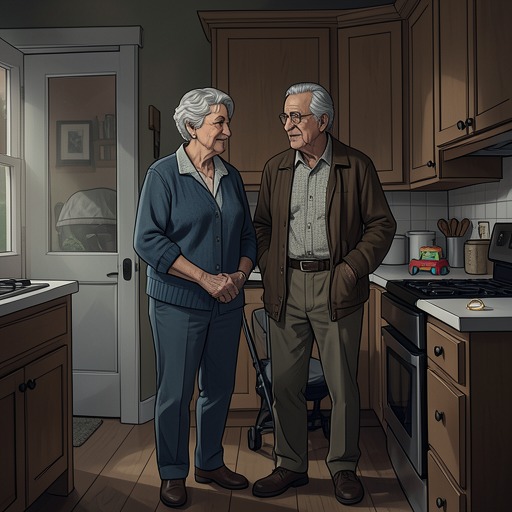
Lyn Metcalf—Marcus Metcalf
The Chemistry of DeathLyn Metcalf—Marcus Metcalf is the relationship between a murdered woman and her bereaved husband. The book gives little detail about their married life before Lyn’s death; its emphasis falls instead on the shock of her loss, Marcus’s difficulty speaking about it, and the way his grief becomes entangled with Manham’s growing fear and public response.
The Marriage in the Shadow of the Murder
Marcus is identified as Lyn’s husband, and her death is described as the loss of his wife. The narrative does not supply a broader account of their shared history, so the relationship is defined here less through domestic recollection than through the rupture caused by the killing. That restraint matters: Marcus’s grief is not presented as a complete portrait of the marriage, but as the visible consequence of an absence the story cannot repair.
Lyn’s death is confirmed as murder, while the condition of her remains prevents certainty about whether she was sexually abused. The distinction between what is known and what remains an assumption recurs in the investigation. The police consider the possibility that the same killer was responsible for Sally Palmer’s death, and David Hunter reasons from the estimated interval of about three days before Sally was killed that Lyn might still be alive. For Marcus, by the time he appears before the village, that uncertainty has ended in bereavement; for those investigating, the deaths remain part of an unresolved pattern.
Marcus’s Grief in Public
When Marcus enters the meeting hall, the room falls quiet. David Hunter observes that he looks diminished by grief, moves slowly, and seems dazed. On an earlier visit, shortly after the police had told him of Lyn’s death, Marcus had seemed barely aware of David’s presence and had declined a sedative. These details show grief not as a single public outburst but as a state that persists from the first private aftermath into the village gathering.
Reverend Scarsdale accompanies Marcus onto the stage and places a hand on his shoulder. David reads the gesture as potentially supportive but also proprietorial, and notices that Marcus is seated in the chair without a microphone. Scarsdale’s careful management of the setting makes Marcus’s presence part of the meeting’s argument before he speaks: the bereaved husband is visible beside the man urging the village to act.
Scarsdale invokes the losses of Marcus and Lyn’s family, then prompts Marcus to address the room. Marcus says that the killer must be stopped and that they should find him, but his voice falters and he begins to cry. His brief appeal carries the force of direct personal loss; it does not make him a leader of the search or establish that he endorses every part of Scarsdale’s speech. The scene preserves the difference between Marcus’s grief and the reverend’s use of it.
Private Loss and the Village’s Response
Scarsdale argues that two women known to the village have been killed and claims that someone from Manham is likely responsible. He presents the police as unable or unwilling to take the necessary steps, then directs the meeting toward collective action. By placing Marcus beside him and asking him to speak, Scarsdale gives this appeal the authority of a husband’s bereavement. David’s unease arises partly from that transformation: a personal loss is being made to support a public call whose consequences may extend beyond mourning.
The meeting therefore brings two responses to Lyn’s death into close proximity. Marcus’s halting words convey the immediate human demand that the killer be stopped; Scarsdale turns that demand into a broader accusation against the village’s supposed passivity. Marcus’s grief gives the gathering emotional weight, but the account does not suggest that grief itself can identify the killer or resolve the investigation. Instead, his appearance makes the cost of the murders unmistakable while exposing how easily that cost can be recruited into a communal campaign.
Significance in the Investigation
The relationship also anchors the consequences of the serial-murder inquiry in an individual loss. Investigators discuss the victims’ deaths through patterns and uncertainties, including the estimated three-day interval and the inability to establish sexual assault conclusively. Marcus’s presence resists reducing Lyn to evidence in that pattern: she is also the wife whose death has left a husband visibly in shock. The contrast does not settle what happened to her; it clarifies what the crime has done to someone who remains alive.
Later, as David fears for Jenny Hammond after her abduction, he imagines the suffering that may precede a victim’s death and feels the past return through the present. That parallel broadens the narrative’s treatment of loss and danger, but it does not provide further information about Marcus and Lyn’s marriage. Their relation remains sharply defined by what the story does establish: they were husband and wife, Lyn was murdered, and Marcus’s mourning became a public presence in a village struggling to respond.