Mackenzie
The Chemistry of DeathMackenzie is the police investigator who leads the inquiry into the attacks in Manham, a role that places him between the village’s growing fear and the incomplete, shifting evidence. He is neither an omniscient detective nor a mere authority figure: his investigation depends on gathering accounts, testing physical clues, and revising its working assumptions as the case changes. His professional partnership with David Hunter supplies the inquiry with forensic expertise, but the novel also shows the limits and pressures of that partnership as suspicion spreads and the search becomes more urgent.
Identity and Introduction
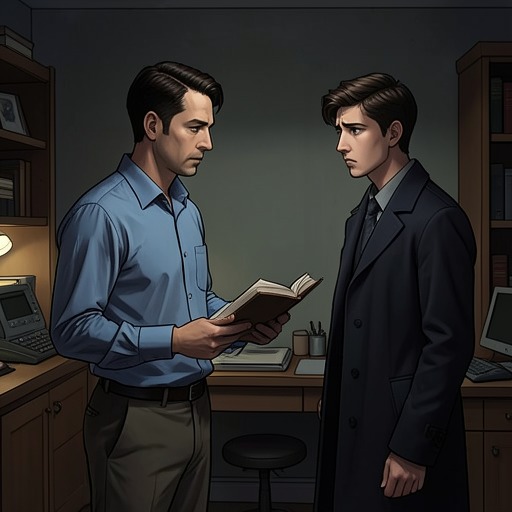
Mackenzie is introduced as an inspector whose arrival signals that the police regard Sally Palmer’s disappearance as a serious matter. He is a compact, physically distinctive man, with unusually broad shoulders and a build that David notices immediately; his impatient manner, however, makes a stronger impression than his appearance. Mackenzie and a plain-clothed sergeant initially approach the scene without visible haste, but the presence of a senior officer from the Major Investigation Team makes clear that this is no routine village inquiry.
His first direct business with David is to ask when David last saw Sally. The question establishes Mackenzie’s basic method in the early investigation: he gathers information from people who knew the missing woman, rather than treating her absence as an isolated or self-explanatory event. He has also made inquiries into David’s background. After learning of David’s professional record, he remarks on the contrast between an accomplished forensic anthropologist and a village general practitioner. This research indicates that Mackenzie is assessing not only what David knows about the case, but also what expertise he might bring to it.
Working with David Hunter
Mackenzie formally introduces David to the officers as a forensic anthropologist who will help identify the body. The moment defines a practical division of labor: Mackenzie directs the police investigation, while David contributes specialist knowledge of human remains. Mackenzie’s decision to involve him gives forensic observations a place in the inquiry, rather than leaving the identification and interpretation of the body solely to general police procedure.
At the scene, David explains how insect life cycles can assist in estimating the period since death. The larvae are mainly blowfly; with open wounds, insects could have been attracted quickly and begun laying eggs within an hour in daylight. David also explains the brittle, crumbly adipocere in the soil, connecting its condition with relatively rapid decomposition in hot weather and the presence of open wounds. The limited amount of adipocere is consistent with a death less than two weeks earlier. These details show the kind of evidence Mackenzie’s collaboration with David brings into the case: observations of insects, soil, and decomposition become part of a reasoned estimate, not a simple visual impression.
Mackenzie does not treat David as an unquestioned source of certainty. Their relationship is professional and cooperative, but it includes scrutiny and reserve. He researches David’s credentials, asks him for information, and draws on his expertise when the investigation requires it. In turn, David asks Mackenzie about developments and participates in discussions of physical evidence. The exchange makes their alliance useful precisely because their responsibilities differ: the police assemble witnesses and direct searches, while David can interpret forensic traces that may help distinguish one account of events from another.
Evidence and Changing Hypotheses
The investigation develops through accumulating absences and small, sometimes disturbing details. Mackenzie tells David that serious inquiries are under way after people report not seeing Sally since the pub barbecue. She had failed to collect a grocery order due the following day and had stopped her regular morning visits to the newsagent for her newspaper. The interrupted routines help establish that Sally’s disappearance is not merely a lack of sightings; it represents a break from habits others could identify and report.
A witness later supplies a detail about a dead stoat left on Sally’s doorstep. Mackenzie presents it as a possible lead, while acknowledging by his manner that its significance is not yet settled. The incident might be a sick joke, as Sally thought, but in the context of the inquiry it becomes another fact requiring explanation. The scene exemplifies the case’s investigative logic: an apparently peripheral occurrence can acquire weight when it is placed alongside other evidence, without becoming proof on its own.
Physical traces also resist easy consolidation. In a discussion of bone damage, a rough cut with ridges is distinguished from a smoother cut, and the difference is linked to the kind of blade that could have produced the pattern. Mackenzie’s broader task is to make room for such distinctions while the inquiry is still forming its account of events. When a separate killing complicates the case, he responds with frustration at the prospect of an unrelated murder and asks whether the victim’s throat shows the same kind of injury. That question reflects the need to test whether cases are connected rather than assume that resemblance or timing establishes a link.
The Search Widens
The disappearance of Lyn Metcalf changes the investigation’s scale. Mackenzie tells David that the situation has changed because another woman is missing. The village turns out to help search for Lyn, while the police concentrate on the woods and the area where she had gone running. What might under different circumstances have been considered a voluntary departure is now understood through the sequence of events: another woman has already been murdered, and the missing person is from the same community.
That sequence transforms the public understanding of the danger. After Sally’s death, some villagers could still think of her as an outsider who had brought her own misfortune into the village. Lyn, born in Manham and embedded in its shared history, cannot be framed in the same way. Her murder has a more immediate effect on the community, and the possibility that the threat is local becomes harder to evade. Mackenzie’s work therefore unfolds amid both police procedure and communal fear. The public search is an act of assistance, but it also marks a village trying to comprehend the possibility that someone familiar may be responsible.
Operations and Limits
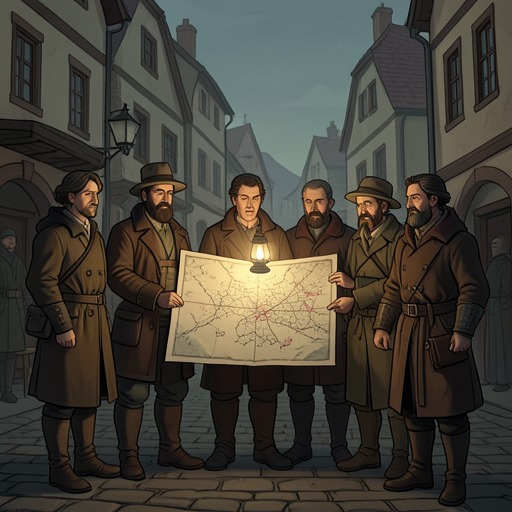
As the investigation turns toward possible suspects, Mackenzie shares confidential information with David, including the identification of Ben Anders as a person of interest in a police matter. Later, he is found coordinating officers around a map at the police incident room. A planned operation is designed to raid the old windmill, The Brenner house, and the cottage where Dale Brenner lives simultaneously. The purpose is to take both men into custody without giving them or their families time to warn one another, while improving the chance of recovering Jenny Hammond alive. The plan’s careful coordination reflects the stakes: timing and surprise matter because the police are trying to reach a captive person, not simply make arrests.
The plan does not unfold as intended. Mackenzie later explains its design to David, making clear that the simultaneous raids were chosen as the best available chance, not a guarantee. The distinction matters to his portrayal: he has to act amid uncertainty, and the consequences of an operation cannot be separated from the evidence and assumptions that informed it. Later clues lead David to reconsider whether Carl Brenner is the killer and to see George Mason as another possible fit. The black, sticky substance around a doorframe recalls material associated with a dead woman’s neck; David also notes that George Mason’s house contains his grandfather’s decomposing body. These observations belong to David’s developing interpretation, not to a final conclusion attributed to Mackenzie, but they illustrate how the investigation’s suspected explanations continue to shift.
Mackenzie remains part of the police response through the closing aftermath, when David’s position in Manham has become untenable. David leaves his work at Bank House and arranges for a locum, knowing he will not remain the village doctor. Former patients still regard him with reserve, in part because he had once been a suspect and because of his involvement in the events. The ending does not provide a separate account of Mackenzie’s later career or private life. Instead, it leaves him defined by his function in the inquiry: he has helped direct a response to danger, worked with David’s expertise, and operated within a community where evidence, fear, and belonging have become difficult to disentangle.