Manham’s climate of fear and suspicion
The Chemistry of DeathManham’s climate of fear and suspicion is the social breakdown that follows the murders of Sally Palmer and Lyn Metcalf. The village initially gathers to search for Lyn, but the possibility that the killer is local transforms that solidarity into unease: neighbours must consider that someone among them could be responsible. As fear spreads, the community’s response shifts from collective concern to suspicion, scapegoating, hostility toward outsiders, and vigilante patrols. Its crisis is not simply fear of violence, but the collapse of confidence in the people and customs that had made Manham feel self-contained.
From communal search to inward suspicion
Sally Palmer’s place in the village helps establish the divisions that the crisis will sharpen. She had moved to Manham a few years before David Hunter, lived alone on a small farm outside the village, and made her living as a writer. Although her inherited connection to a local family made her less of an outsider than David, her occupation still set her apart in the eyes of neighbours who regarded her with a mixture of awe and suspicion. Her murder therefore precedes a crisis in which belonging is already unevenly distributed.
When Lyn Metcalf disappeared, many villagers joined the search. Under other circumstances, people might have wondered whether she had left voluntarily; because her disappearance followed Sally’s murder, that possibility gave way to the fear that she had been abducted. People searched the woods and surrounding area, while David joined after finishing his evening surgery. The gathering carried a temporary sense of communal unity, but it also forced a more disturbing inference: if the two attacks were connected, the person responsible was probably not an outsider who had left after the first murder. The killer might be someone the villagers knew.
That recognition altered ordinary encounters. David found people watching him at The Lamb, and the room’s attention became expectant rather than openly condemning. When he challenged those present to speak plainly, they looked away one by one; Carl Brenner then rose to address him. The episode shows suspicion working before anyone has established an accusation: silence, scrutiny, and the anticipation of blame make social spaces feel like informal trials.
Scapegoating and the cost of silence
James Nolan had already been made a village outcast through a rumour whose exact basis was neither discussed nor, apparently, widely known. He was treated as someone children should avoid, and his isolation deepened as Manham complied with his wish to be left alone. After Sally’s body was found, he feared that this existing stigma might make him a convenient scapegoat. The episode exposes how little evidence a frightened community needs to turn an old prejudice into a perceived explanation.
One Saturday night, a group came to Nolan’s house, first mocking him and then becoming more threatening. Rather than attract attention by calling the Police, he opened the door when they demanded it. David later found him in the damaged house and could offer little more than immediate care while waiting for an ambulance. Nolan did not answer David’s question about what had happened. The episode’s aftermath is as revealing as the attack: the person who contacted David instead of emergency services used Manham’s only public phone box, leaving the caller untraceable.
David understood the call as a compromise. People had watched, or looked away, while Nolan was attacked; someone had been moved to seek help, but apparently not to intervene openly or involve outsiders. No one came forward as a witness. The incident makes the village’s self-containment look less like dependable mutual care than a means of keeping shame and responsibility within its own boundaries. Even help reaches Nolan anonymously, through David, who is himself treated as almost an outsider.
Lyn’s death and the escalation of fear
News that Lyn’s body had been found changed the emotional scale of the crisis. Sally had been popular, but was still regarded as an immigrant to the village; Lyn had been born in Manham, attended school there, and married in its church. Her death made it harder for residents to imagine that danger belonged to someone beyond their community. The village now mourned one of its own and feared that another woman might be at risk.
The murders also brought intense media attention. Manham’s resentment, initially directed less at the Police than at reporters, took practical forms over the following days: unattended equipment disappeared or was damaged, cables were cut, tyres slashed, and petrol tanks tampered with. One reporter was injured by a thrown stone and needed stitches. No one admitted to seeing anything. These acts gave the village an outlet for anger while reinforcing the same closed silence that had surrounded Nolan’s assault.
Beneath the hostility to the press, suspicion spread into everyday life. Old feuds acquired new force: a dispute between three generations of two families began over barbecue smoke drifting into the wrong garden. A woman called the Police in a state of panic about a supposed stalker who was actually a neighbour walking his dog. Bricks were thrown through two houses’ windows, one apparently in response to a perceived slight and the other for reasons no one could establish—or acknowledge. Fear did not remain confined to the search for a killer; it altered how neighbours interpreted ordinary grievances and movements.
Scarsdale and the turn toward vigilantism
Scarsdale became the most visible public voice of Manham’s anger. While others avoided the media, he spoke to cameras and microphones, condemning the Police for failing to catch the killer, the community’s supposed moral complacency, and the press for exploiting the tragedy. His growing support rested less on the reasonableness of his arguments than on the force with which he expressed feelings many residents shared. He then called a public meeting at the village hall on the Monday after Lyn’s body was found.
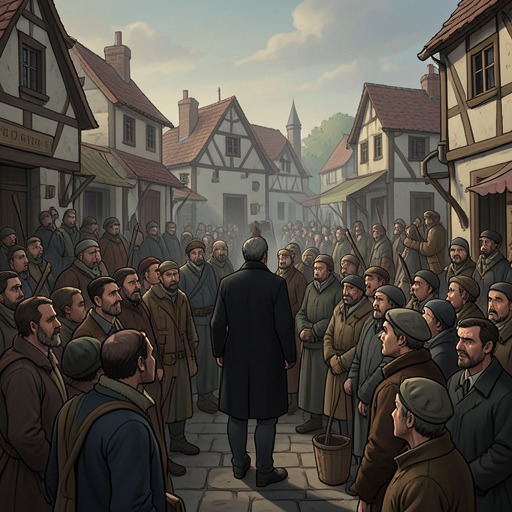
At the meeting, Scarsdale presented the murders as evidence that the village could no longer wait for the Police. He emphasized the loss suffered by Marcus Metcalf and Lyn’s family, then urged residents to protect themselves and root out the person responsible. The hall responded with applause and shouts of approval. The appeal converted fear into a proposed collective mission, but its demand for action carried a danger: suspicion of a killer from Manham could become permission to target people without proof.
That shift soon took an organized form. Carl Brenner, accompanied by Dale Brenner, approached Ben Anders at The Lamb to recruit volunteers and announce that a group was patrolling the village day and night. Carl explicitly connected the patrols to Scarsdale’s appeal and to his belief that the Police were doing too little. The patrols made the climate of fear visible as a community practice: residents who had once searched together for Lyn now set out to police one another.
Belonging and departure
The crisis leaves Manham’s idea of belonging exposed. Its residents can rally to search for Lyn, but the same communal closeness sustains rumour, discourages witnesses, and makes a newcomer an available object of suspicion. After the investigation, David did not return to work at the surgery, even after the Police had left Bank House. He arranged for a locum while patients either awaited a permanent replacement or registered with practices elsewhere. Many former patients remained reserved toward him, still seeing the newcomer who had once been a suspect.
David’s decision to leave gives the village’s suspicion a lasting consequence. He recognizes that his involvement in events has not erased his outsider status and that he does not belong in Manham. The climate of fear therefore outlasts the immediate search and public alarm: even after the crisis has passed, distrust has altered the community’s relationship with a doctor who had lived and worked among its residents. Manham’s self-reliance, once a source of solidarity, has become a boundary that excludes as readily as it protects.