Manham’s collective suspicion and panic
The Chemistry of DeathManham’s collective suspicion and panic are the social crisis that follows the attacks on Sally Palmer and Lyn Metcalf: once the possibility of an outsider grows less convincing, the village begins to treat its own neighbors as potential threats. The change turns ordinary familiarity into a source of alarm. Search parties and public displays of sympathy continue, but they coexist with rumor, public accusation, and calls for residents to take the investigation into their own hands.
From a missing neighbor to an inward threat
The unease begins with the discovery that Sally Palmer had disappeared from ordinary village routines without prompting anyone to report her missing. She had not collected a grocery order or her morning Guardian, yet people assumed she had gone away or was busy writing. The newsagent did not consider her a local. The delayed recognition of her absence exposes a gap between Manham’s reputation for closeness and the limited attention its residents paid to one another.
Lyn Metcalf’s disappearance changes the meaning of that earlier neglect. Coming after Sally’s murder, it cannot easily be treated as a private decision to leave. Most villagers turn out to help search, while Police concentrate on the woods and the area where Lyn had been running. The setting is a summer evening, and the search briefly creates a sense of shared purpose. But the second attack also makes the danger feel nearer: Sally and Lyn came from the same village, and the evidence suggests that whoever attacked them might belong to the community.
That inference fractures the search even as it begins. The volunteers comb grass and bushes, but Manham’s wild surrounding countryside is too extensive to cover completely. More unsettlingly, residents know that a killer could join a search, express sympathy, and appear to share the community’s grief. Their public cooperation therefore offers no reliable assurance about anyone’s innocence. The possibility that a familiar neighbor might be responsible introduces distance into everyday encounters; suspicion begins to undermine the solidarity that the search appears to display.
Rumor fills the silence
After the attacks, the village’s atmosphere changes before its physical conditions do. The heat continues, but the psychological climate turns colder as blame shifts from an imagined outsider toward Manham itself. Suspicion spreads gradually, like a contagion whose presence is not obvious until it has already reached new people. Those who are more vulnerable to the uncertainty become targets of talk, while the absence of reliable public knowledge gives speculation room to grow.
David Hunter experiences this process directly. Because he is away from the surgery and has been seen with Mackenzie, villagers begin saying that Police have arrested him and taken him away with the inspector leading the investigation. The rumor is not based on an arrest; it develops from his absence and his cooperation with Mackenzie. A person helping the inquiry is thereby recast as a possible suspect. David realizes that agreeing to assist has inadvertently made him a target, showing how quickly the village’s demand for an explanation can turn against someone whose actions are misunderstood.
The social consequences extend beyond gossip. As the crisis deepens, old feuds and minor grievances acquire a more threatening charge. A dispute between members of two families escalates after barbecue smoke drifts into the wrong garden. A resident reports a neighbor walking a dog as a stalker, and bricks are thrown through two houses’ windows, one over a perceived slight and the other for a reason no one can establish. These incidents differ in their immediate causes, but together they show fear loosening ordinary restraints and making suspicion an available explanation for conflict.
Reverend Scarsdale turns fear into a public cause
Reverend Scarsdale gains influence by giving the village’s fear a moral and political shape. After a church service, Manham largely refuses interviews: the tragedy remains too raw and private for many residents to discuss with the press. Scarsdale is an exception. He speaks to journalists, presenting the events as confirmation of his religious warnings. Henry Maitland sees the danger in this intervention, objecting that the village needs no invitation to paranoia and warning David that mud-slinging and finger-pointing will follow.
Scarsdale’s public standing grows as Manham’s relationship with the outside world becomes more guarded. Residents generally turn away from journalists, while he repeatedly addresses cameras and microphones. He criticizes Police for failing to catch the killer, condemns what he calls the community’s moral complacency, and attacks the press for exploiting the tragedy. The contradictions in this position do not prevent it from attracting support: his anger gives voice to feelings shared across the village, even when his claims exceed what the evidence establishes.
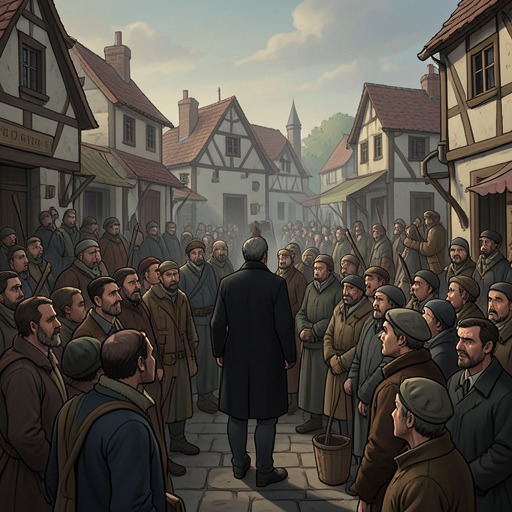
After Lyn’s body is found, Scarsdale calls a meeting in the village hall. He emphasizes that two women known to the community have been killed and argues that someone from Manham is probably responsible. He presents Police as unable or unwilling to take the necessary steps and casts local self-protection as a duty. By invoking Marcus Metcalf’s bereavement and warning that any resident’s wife, daughter, or sister might be next, he makes the threat intimate and immediate. The audience responds with applause and shouted approval. His appeal turns a community’s fear of an unknown offender into support for a collective hunt.
Vigilantism and the persistence of uncertainty
The consequences of Scarsdale’s call appear at The Lamb, where Carl Brenner arrives with Dale Brenner and tries to recruit volunteers. Their group has begun patrolling Manham day and night, presenting itself as a substitute for Police. Carl’s effort is explicitly linked to Scarsdale’s urging: the public appeal has moved beyond rhetoric into organized action. The patrols treat local residents not merely as people in need of reassurance but as a population from which the offender must be rooted out. In a village already strained by old animosities, that distinction makes ordinary disputes easier to interpret as evidence of guilt.
Yet heightened suspicion does not produce reliable certainty. Mackenzie learns that Sally had been annoyed by a dead stoat left on her doorstep, a detail that might connect to the animal remains associated with the attacks, but might also have been a children’s prank. The possible warning or marker remains an interpretation, not a confirmed explanation. Similarly, David notices that a cut in one bone is rough where another had been smooth, a difference that complicates rather than settles assumptions about the weapon. Each clue offers a new direction for thought while leaving room for competing accounts.
The investigation’s uncertainty is mirrored in the villagers’ shifting suspicions. Much later, David encounters evidence that the gardener’s grandson, Tom Mason, had tried to seal his grandfather George Mason’s bedroom door with bitumen. The smell and black residue recall material associated with a dead woman, and David revises his earlier conviction that Carl Brenner was the killer: Tom now seems to fit the pattern as well. But this remains David’s provisional inference at this point, not a settled conclusion. The sequence makes the village’s central fear more complicated: a person long overlooked may be suspicious, but the readiness to accuse has already shown how easily conjecture can masquerade as knowledge.
Manham’s panic therefore has two related sources: a real danger that may be hidden among familiar neighbors, and the community’s increasingly punitive response to not knowing who it is. Searchers can work together without trusting one another; public grief can coexist with self-appointed patrols; and attention to clues can alternate with rumor. The village’s apparent solidarity never fully disappears, but it is steadily compromised by the fear that the person standing beside the searchers—or the person they have already named—may be the threat.