Police
The Chemistry of DeathThe Police are responsible for investigating the murders and disappearances in Manham, but the inquiry unfolds in a landscape that frustrates searches and a community increasingly ready to judge the investigation for its failures. Their work combines witness inquiries, forensic examination, and controlled searches; the lack of decisive leads, however, leaves room for public anger and self-appointed patrols to grow alongside it.
The investigation and its constraints
The inquiry into Sally Palmer’s disappearance begins only after signs of her absence accumulate without prompting anyone to report her missing. She fails to collect a grocery order due the day after the pub barbecue and stops making her usual morning visit to the newsagent for the Guardian. Mackenzie tells David Hunter that nobody questioned so far has seen her since the barbecue. People assumed she had gone away or was busy writing, and the newsagent did not consider her a local. The delay exposes a gap between Manham’s reputation as a close-knit community and its failure to notice that Sally had vanished.
When Lyn Metcalf disappears, the Police restart the search, but Mackenzie describes a case with no suspect, witnesses, or known motive. Door-to-door inquiries yield nothing, and the search must proceed slowly because of traps. The terrain compounds the problem: parts of the area are swamp, while woods and ditches make it impossible to cover the whole district. Mackenzie fears that if the killer has hidden Lyn’s body well, it may never be found. He judges her survival unlikely, though he acknowledges that missing victims are sometimes recovered alive.
The investigation produces little conventional evidence. Forensic examination finds nothing useful either at the place where Lyn was abducted or where Sally’s body was found. Checks of criminal records and the Sex Offenders Register flag no one. The available profile—that the suspect is reasonably strong and fit, and knows woodcraft and hunting—does little to narrow the field in a rural community where hunting is commonplace. The Police therefore confront not simply a lack of information but a setting in which an apparently ordinary person can blend into everyday life.
Forensic work and emerging clues
At a body scene, Mackenzie waits for David, whose forensic knowledge can help interpret the evidence before the body is moved. The crime-scene team works in silence while officers and investigators attend the site. Elsewhere, David explains that blowflies attracted to open wounds may begin laying eggs within an hour in daylight. A larva close to pupation appears seven or eight days old; the absence of empty pupal cases, together with the blowfly’s fourteen-day life cycle, suggests the body has not been there that long. Some officers initially dismiss this kind of entomological evidence, but the others stop to listen as David explains how it can help estimate the time a body has been at a location.
The Police also pursue reports of animal remains as possible clues, without treating them as proof. A witness says Sally was annoyed that someone had left a dead stoat on her doorstep. Mackenzie considers whether it could have been a joke or a warning, and connects it tentatively with the swan wings found with Sally’s body and the mallard tied to a stone on the morning Lyn vanished. He says the killer already appears to use birds as a signature, while leaving open the possibility that other animals serve as markers too. The investigation thus tests a pattern without yet knowing what it means.
A further discrepancy arises when the cut in one bone has rough ridges unlike the smooth cut in a woman’s vertebra. David has previously explained that a serrated blade can leave a patterned cut. The difference prompts questions about whether the injuries were made in the same way; the evidence shown here does not establish the answer. Such distinctions matter because an apparently coherent pattern can still contain details that resist a single explanation.
Public confidence and rival authority
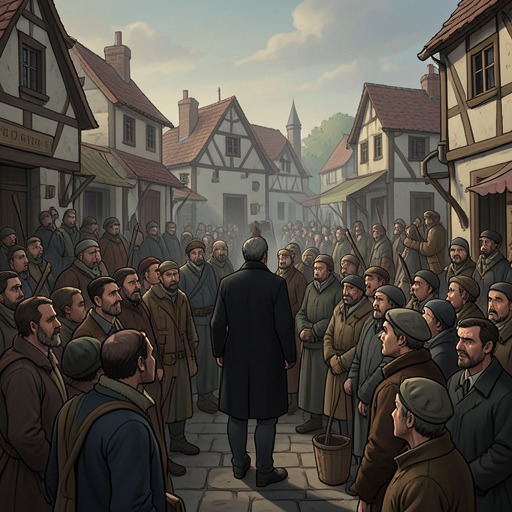
As fear spreads, the Police’s limited progress becomes a public target. Reverend Scarsdale appears before cameras and microphones, criticizes the investigation, and presents the murders as evidence of both police failure and village complacency. At a meeting in the village hall on the Monday after Lyn’s body is found, he tells residents that someone from the village is probably responsible and argues that they can no longer wait while women are kidnapped and murdered. He invokes the danger to residents’ wives, daughters, and sisters, then urges the village to protect itself and root out the killer if the Police cannot protect it.
The meeting gives collective anxiety a direction: residents applaud Scarsdale, and his public influence grows. The following night, Carl Brenner and Dale Brenner recruit for patrols already operating day and night under Scarsdale’s encouragement. Their stated rationale is that the Police are doing too little, so they must act themselves. The patrols are not a Police operation. Their emergence marks a consequential loss of confidence in official authority, while the investigation still lacks the evidence needed to identify a suspect.
Scene control and the limits of certainty
The Police retain responsibility for securing and examining crime scenes. After an intruder attacks David at the surgery, officers spend much of the day photographing the premises, dusting for fingerprints, and questioning him. Mackenzie presses him on how the intruder entered, attacked, and escaped without being seen; David’s answer is that it was dark. The account shows a thorough effort to document the scene, but no identification of the attacker in the evidence presented here.
When Jenny Hammond disappears, officers cordon off her house. A constable initially refuses David entry as children and neighbours watch from the street; Mackenzie intervenes and allows him inside, warning him not to touch anything. The half-eaten sandwich, radio, open garden door, displaced doormat, and replaced telephone receiver make the house readable as a scene of sudden interruption, but Jenny is gone. The contrast between the Police’s need to preserve evidence and David’s urgency to find her makes the cordon both a practical safeguard and an immediate obstacle to someone desperate to help.
The inquiry’s difficulty is also a problem of inference: animal remains, forensic differences, and the possibility of a hidden offender do not automatically disclose who is responsible. David later notices bitumen on a doorframe and remembers its connection to a dead woman’s neck, a clue that shifts his suspicion toward Tom Mason. That realization belongs to David’s investigation at that point, not to a confirmed Police conclusion in the evidence here. Across the case, the Police’s methods are necessary but cannot guarantee that the right explanation will emerge quickly—or that a frightened village will wait for it.