Sally Palmer's farm
The Chemistry of DeathSally Palmer's farm is the isolated home outside Manham where the investigation into her disappearance first acquires physical evidence. Its familiar rural details—a white farmhouse, a small herd of goats, and the dog Bess—become signs of prolonged neglect, revealing an absence that the village has not recognized and directing attention toward the crime behind it.
Setting and association
Sally Palmer lived alone on a small farm just outside the village, inherited from her uncle. She had moved to Manham from London a few years before David Hunter. Her goats and family connection gave her a stronger claim to local belonging than some newcomers, but her work as a writer still set her apart: neighbours regarded her with a mixture of awe and suspicion. The farm therefore reflects her double position in the community, rooted in a particular place yet not fully absorbed into village life.
The approach emphasizes the farm's separation from its surroundings. Trees border one side and marshland the others; a rutted track leads to an uneven courtyard, where only remnants of cobblestones remain. A tall corrugated-metal barn stands beside the farmhouse, painted white but peeling and faded. Bright green window boxes on either side of the door provide the building's most vivid color. In the hard summer light, the property is both conspicuous and cut off, a working home at the edge of the village rather than part of its daily center.
The discovery of neglect
David comes to the farm after Linda Yates tells him she has dreamed about Sally. He knows that visiting on the basis of a dream may seem irrational, and at first finds no clear indication that anything is wrong. The usual barking from Sally's Border collie, Bess, does not greet him, but the silent house and absent dog might each have an ordinary explanation. His personal history with Sally also complicates the visit: they had both moved from London, shared an easy acquaintance, and sometimes met for drinks at the pub.
On his way back to the vehicle, David realizes that the window-box plants are brown and dead. Sally would not normally have allowed them to wither. The soil is baked hard, suggesting that no one has watered them for days, perhaps longer. The unlocked front door sticks against a mound of accumulated mail, which spills as he enters. Inside, the cheerful lemon walls and rustic furniture remain, alongside city comforts such as an electric juicer, an espresso maker, and a well-stocked wine rack. The room's ordinary arrangement is undermined by stale air, rotting fruit, dead flowers, and a half-open drawer. These details do not establish what happened, but together they make the house feel abandoned rather than temporarily empty.
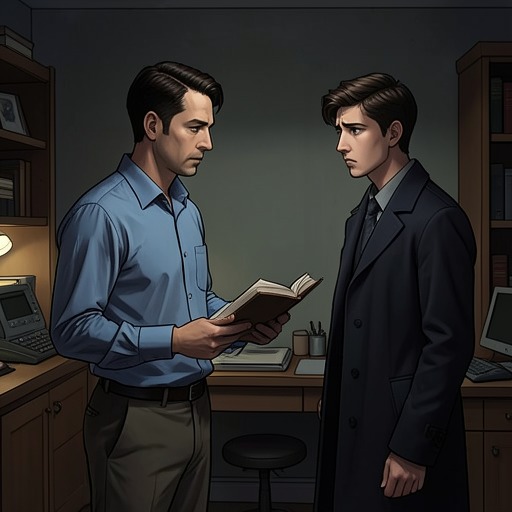
David considers searching the rest of the house, then stops because he is beginning to think of it as a possible crime scene and does not want to disturb evidence. That restraint marks a change in how he reads the property: it is no longer simply a friend's home he has entered out of concern, but a place whose details may need to be preserved and interpreted.
The animals and the investigation
Behind the farmhouse, Sally's goats are in a paddock that has been nearly stripped of grass. Several remain standing but are weak; most are lying down, unconscious or dead. The water trough is dry, although a hose lies beside it. David reconnects the water, and some of the surviving goats totter over to drink. He intends to call a vet after contacting the police, but poor mobile reception around Manham forces him to move away from the paddock before his phone finds a signal.
There, he notices Bess's body partly hidden behind a rusting plough. He sees that the dog has been killed and turns away. The discovery, following the neglected house and distressed herd, makes the farm's signs of absence impossible to dismiss as mere disorder. The animals' condition also extends the consequences of Sally's disappearance beyond the unanswered question of where she is: the household's dependent creatures have been left without care.
When police and forensic officers arrive, the courtyard fills with vehicles and the farmhouse becomes a working investigative site. The activity does not restore the sense of a living home; instead, the property takes on the quality of a time capsule, its recent past examined by uninvited visitors. The veterinarian reports that half the goats were already dead and that a couple of others had to be destroyed. The survivors had endured roughly two weeks without food or water, and another day or two would likely have finished them. Their condition gives the investigators a separate measure of how long the farm has been unattended.
Clues and narrative significance
The farm also becomes relevant through evidence gathered elsewhere in the investigation. Mackenzie learns that, shortly before her disappearance, Sally was annoyed by a dead stoat left on her doorstep and thought it might be a sick joke. Set beside the animal remains associated with other scenes, the incident raises the possibility that the stoat was a warning or marker. It remains a possibility rather than a settled conclusion, but it connects the farm to the inquiry's emerging questions about the killer's use of animals.
The farmhouse is not presented as the place where Sally's body is found. Its importance lies instead in the contrast between the home and the evidence that she may have been held and killed elsewhere. The neglected plants, uncollected mail, dying goats, and dead dog establish that her routines stopped and that no one promptly recognized the interruption. Mackenzie reports that people had assumed she had gone away or was busy writing; her missed grocery order and newspapers had not led anyone to report her missing. The farm thus records both the practical duration of her absence and the community's failure to notice it.
As the police take over the courtyard and rooms, the farm changes from a private home into a site read for signs: what has been left untouched, what has gone without care, and what the animals can reveal about time. Its quiet abandonment gives the investigation an initial, concrete measure of the human cost of Sally's disappearance, while exposing how easily an outsider's absence can pass unremarked in a supposedly close-knit village.