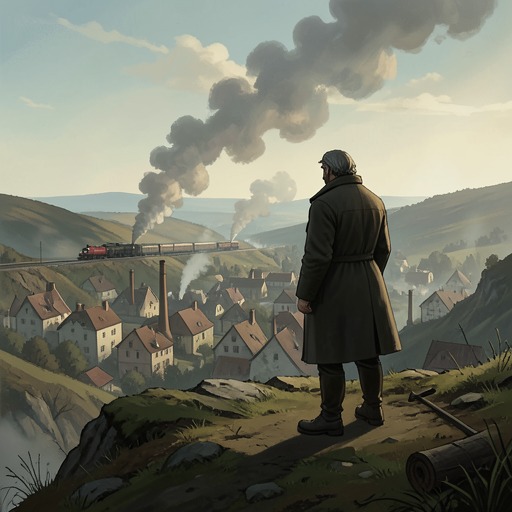
Scarsdale’s call for a village manhunt
The Chemistry of DeathScarsdale’s call for a village manhunt is the moment when Manham’s fear is turned into a public demand for self-directed action. At a meeting held after Lyn Metcalf’s death, Scarsdale presents the police as unable to protect the village, invokes the danger to local women, and urges residents to root out the killer themselves. Marcus Metcalf’s grief gives the appeal a personal face; the crowd’s approval gives it force. The meeting marks a shift from suspicion spreading through the community to organized patrols undertaken in the name of protecting it.
Causes and Background
By the time Scarsdale called the meeting, the investigation had already exposed how little the village had known about the people around it. Police inquiries into Sally Palmer’s disappearance established that she had missed a grocery order and stopped collecting her newspaper, yet no one had reported her absence. People assumed she had gone away or was occupied with her writing. That earlier failure to notice her disappearance made the idea of a hidden killer among familiar villagers especially unsettling, while also showing how fragile the community’s confidence in its own closeness had been.
The investigation had also raised questions about whether the killer used animals as warnings or markers. A witness recalled that Sally had been annoyed by a dead stoat left on her doorstep. Mackenzie considered that it might have been a joke, but also raised the possibility that it was connected to the dead birds associated with the murders. The theory remained uncertain. At the meeting, however, Scarsdale spoke as though the essential danger was plain: two known women had been killed, and the perpetrator was likely from the village. The contrast between unresolved clues and his certainty helps explain how fear could become a demand for action before the evidence had settled who was responsible.
Scarsdale’s growing public prominence formed another part of the background. While others in Manham avoided the media, he spoke to cameras and microphones, criticizing the police, condemning what he described as the village’s moral complacency, and accusing the press of exploiting the tragedy. The account presents a tension in that stance: he denounced publicity even as he repeatedly placed himself before the public. His denunciations nevertheless found an audience because their intensity echoed the community’s anger. He then announced a meeting in the village hall, extending his influence from media appearances into a gathering organized specifically around the crisis.
The Meeting and Its Participants
The meeting took place on the Monday after Lyn’s body had been found. A memorial service had been held in the church the previous day; Scarsdale had not allowed the media inside. David Hunter had wondered whether this exclusion reflected consideration for the bereaved family or a desire to make the press feel shut out. Approaching the village hall, he saw Scarsdale directing Tom Mason in its garden. The grounds had been carefully tended, and the village square was freshly mown around the horse chestnut and the Martyr’s Stone. These details frame the gathering as a prepared public occasion, rather than an impromptu exchange.
The meeting did not begin with Scarsdale taking the stage alone. Marcus Metcalf appeared first, and the room fell quiet. He looked diminished by grief, moved slowly, and seemed dazed. Scarsdale followed him onto the stage and placed a hand on his shoulder. David read the gesture as both supportive and proprietorial, recognizing that the presence of Lyn’s husband would lend greater credibility to whatever Scarsdale intended to propose. Marcus’s condition mattered to the meeting’s emotional structure: his loss was not an abstraction but the visible consequence of the murders.
Scarsdale addressed the room as a matter affecting every household. He said that two women known to the village had been killed and argued that someone from Manham was probably responsible. He accused the police of being unable, or perhaps unwilling, to take the necessary steps, and presented continued inaction as unacceptable while women remained at risk of abduction and murder. He then pointed to Marcus and widened the stakes from one family’s bereavement to the possibility that any resident’s wife, daughter, or sister might be next. The appeal made collective fear the basis for a collective response.
The Call to Action
Scarsdale invited Marcus to speak. At first Marcus appeared distant, staring down at the table; when prompted and given the microphone, he seemed to gather himself. He said that the killer had taken Lyn and that the killer had to be stopped, but his voice faltered and he began to cry. His plea for the killer to be found expressed grief and a desire for the danger to end. It did not, by itself, specify what villagers should do. Scarsdale took the microphone back and supplied that next step.
He described the village’s previous inaction as weakness and complacency that had allowed the killer to hide and act without restraint. He then urged Manham to show strength, declaring that if the police could not protect the community, residents should protect themselves and root out the perpetrator. The speech turned a complaint about police failure into a proposed alternative: action by the village. Its language also cast the unknown killer as an enemy concealed among neighbors, sharpening the division between the threatened community and the person it was being encouraged to find.
The appeal produced an immediate response in the hall. As Scarsdale sat back, people stood, applauded, and shouted their approval while cameras flashed and journalists called out questions. David, watching Scarsdale survey the crowd, understood the reverend’s expression as triumph as well as fervour. He left without joining the commotion and later objected that Scarsdale seemed to be stirring people up rather than calming them. The difference between the crowd’s enthusiasm and David’s alarm makes the scene’s central uncertainty plain: the meeting offered a feeling of decisive action, but did not establish that the people moved by it would identify the killer correctly.
Consequences and Significance
The meeting’s call did not remain confined to speeches. The following night, Carl Brenner arrived at The Lamb with Dale Brenner and tried to recruit volunteers. The two men belonged to a larger group that, encouraged by Scarsdale, had taken it upon itself to patrol Manham day and night. Carl framed the patrols as necessary because the police were not doing enough. Thus the meeting’s broad appeal was translated into an organized practice: villagers would watch the community and search for the person they believed was responsible.
That development gives the event its double significance. Scarsdale’s appeal answers a genuine crisis and draws force from Marcus’s bereavement, but it also magnifies suspicion by declaring that the killer is probably local and that ordinary safeguards have failed. The earlier investigation had shown both that people could overlook a neighbor’s absence and that apparently significant clues still admitted competing explanations. The manhunt therefore begins in an atmosphere where uncertainty remains, even as public rhetoric presses for certainty and action. The meeting exposes how quickly communal fear can be given a leader, a target, and a method—and how those things can feel like protection without guaranteeing that the search will be just or effective.