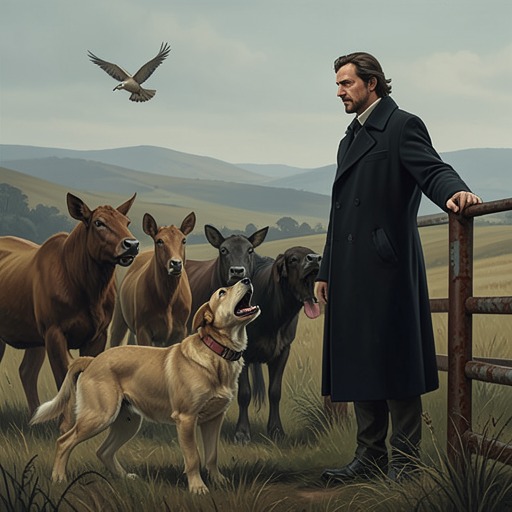
The murderer left animal remains
The Chemistry of DeathTrapped and mutilated wildlife forms a disturbing pattern around the murders in Manham, shifting from apparently isolated animal deaths to a possible signature and, ultimately, part of a hidden collection. The clues are unsettling not only because of how the animals have been used, but because their meaning remains uncertain long enough for warnings to be missed. A dead creature can be dismissed as the ordinary consequence of rural life; gathered together, the same evidence suggests deliberate staging and a killer’s sustained preoccupation.
Scattered signs and uncertain warnings
The earliest reported clues are easy to explain away. At the barbecue, a witness told Mackenzie that Sally Palmer had been annoyed by a dead stoat left on her doorstep. She regarded it as a sick joke, but there was no immediate proof that it was connected to her later murder. Mackenzie therefore kept open the possibility that children had been responsible, or that the animal had been intended as a marker or warning. The stoat’s significance lay in its resemblance to the more conspicuous animal evidence at the murder scenes, not in any certainty about who had left it.
A second possible warning concerned Lyn Metcalf. She had told her husband that she found a dead hare in the woods the day before she disappeared. That report, too, admitted an ordinary explanation: a dog or fox might have killed it. By the time the investigation considered whether the hare had been deliberately placed, the animal could no longer be examined. The sequence raised the possibility that the killer had marked out victims in advance, but David Hunter recognized that coincidence remained possible. The evidence suggested a pattern without establishing one.
The distinction matters throughout the investigation. The countryside supplies plausible explanations for dead wildlife, and those explanations make isolated incidents difficult to treat as warnings. Yet the reported stoat and hare acquire a different weight when considered alongside the animals associated with the victims. The objects are not self-interpreting: their force comes from recurrence, placement, and the increasingly difficult question of whether apparent accidents were part of a design.
Animals at the crime scenes
The animal evidence becomes more pronounced at the murder scenes. Swan wings were found with Sally Palmer’s body, while a mallard had been tied to a stone on the morning of Lyn Metcalf’s disappearance. These incidents made the earlier reports newly suggestive. Mackenzie acknowledged that the killer might use animals as well as birds as a signature, but he would not present the possible advance warnings as established fact. He also resisted releasing details publicly, arguing that the investigation did not know for certain whether the animals had been used to target the victims.
When Lyn’s body was found, the scene both continued and altered the pattern. She had been dead for several days, and her body bore the same broad kind of wounds observed on Sally Palmer, although fewer. But there were no swan wings. That absence is significant in its own right: the animal staging was not a fixed element repeated in precisely the same form at every murder scene. The case’s recurring animal imagery therefore works through variation as well as repetition, making the investigator’s task one of comparison rather than simple matching.
The examination of Lyn’s body supplied a further, more shocking connection. When the body was turned, baby rabbits were found among the objects concealed within it. Mackenzie and the crime-scene officers could not immediately identify what they had uncovered; recognition came only after the initial shock of the discovery. The rabbits made it harder to treat the killer’s relationship to animals as a matter of occasional symbolic gestures. They showed that animal remains had been deliberately incorporated into the arrangement of a victim’s body, though they did not by themselves settle whether earlier dead animals had served as warnings.
The hidden animal collection
The pattern takes on a larger scale when Jenny Hammond, held in a concealed space, peers through gaps in a plank wall into a basement or cellar. Beyond the partition she sees a long room with old shelves, a workbench, a vice, and tools. Its most alarming feature is the number of dead animals suspended from the ceiling. Jenny can distinguish foxes, birds, rabbits, stoats, and moles, as well as what appears to be a badger. Some are hanging by their necks and others by their hind legs; many have been kept long enough to deteriorate. She then realizes that animals are suspended above her own confined space as well.
This discovery changes the scale of the earlier clues. The stoat, hare, mallard, swan wings, fox, and rabbits are no longer simply separate incidents gathered together by investigators after the fact. The hidden room provides evidence of a substantial private collection and places animal remains within the same concealed environment as Jenny’s captivity. It does not prove the intended meaning of every animal found outdoors, but it makes a purely incidental explanation of the overall pattern much harder to sustain.
The room also gives the pattern a physical setting rather than leaving it as an abstract theory about a killer’s signature. The animals are not only brief traces left at particular scenes; they are accumulated and arranged in a concealed space. Their presence links the outward signs in the countryside to a hidden practice that Jenny can see but cannot safely escape. The discovery makes the wildlife evidence part of the immediate danger surrounding her, not merely material for the murder investigation.
The fox that went unreported
A dead fox outside Tina’s home shows how the pattern could remain invisible even when it appeared close to another person. The previous night, aware that a killer was still at large after two women had been murdered, Tina had heard something and cautiously checked the garden. She found nothing then. Only the following morning did she see the fox positioned in the middle of the lawn. Because she knew nothing about the swan wings, the mallard, or the other animals connected with the murders, she interpreted its wounds as the result of a dog attack or perhaps a collision with a vehicle.
Tina picked up the fox and put it in the dustbin. She did not tell anyone. She might have mentioned it to Jenny Hammond, but Jenny was away from home, and when the two next met their conversation turned to other matters. By the time the fox’s possible significance became apparent, the opportunity to treat it as a timely warning had passed. Its disposal is not presented as a failure of vigilance: without the concealed information linking animal remains to the murders, Tina had a reasonable explanation for what she saw.
That episode also clarifies the cost of the police decision to withhold details. Mackenzie had declined to publicize the possible connection because investigators could not confirm that the killer was using animals to identify or threaten future victims. David Hunter challenged that caution, pointing out the contrast between ordinary dead wildlife and animals deliberately tied to stones or incorporated into a murdered woman’s body. The fox makes the disagreement concrete: secrecy protects an unconfirmed investigative theory, but it also means a resident cannot recognize a new incident as part of a developing pattern.
Evidence, pattern, and limits
The animal remains have several roles in the investigation, and the narrative keeps them distinct. Some appear as possible advance markers, including the stoat and hare; others are attached to or incorporated into murder scenes; the animals in the cellar reveal a larger hidden practice; and Tina’s fox demonstrates how easily an apparent repetition can be discarded. No single clue proves the whole theory. Their cumulative force comes from the relationships among their species, placement, timing, and recurrence.
The pattern also depends on a tension between visibility and concealment. A dead animal on a doorstep or lawn is plainly visible, yet its significance is obscured by ordinary explanations. In the cellar, by contrast, the accumulation is unmistakable to Jenny once she sees it, but the collection itself is hidden from the community. The countryside is therefore neither simply a backdrop nor a reliable source of reassurance: its familiar abundance of wildlife supplies a ready excuse for ignoring what may have been staged.
By the time Jenny discovers the cellar, the animal remains have become more than a recurring detail in the murder scenes. They connect possible warnings, deliberate arrangements, and the killer’s concealed environment, while preserving uncertainty about the purpose of each individual animal. That combination makes them powerful but imperfect evidence: their significance emerges through the pattern, and the pattern becomes legible only after some of its warnings have already been missed.