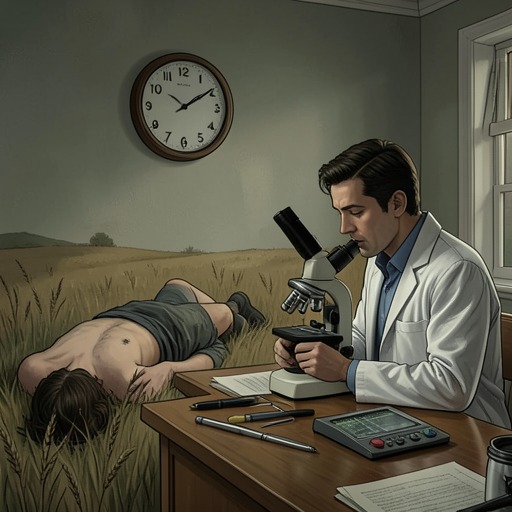
The summer of the Manham murders
The Chemistry of DeathThe summer of the Manham murders is more than a setting: its persistent heat alters the landscape, conditions the evidence, and makes the passage of time feel both oppressive and difficult to measure. As bodies and clues emerge, the weather becomes part of the investigation’s forensic record, while the village’s response turns from apparent indifference to suspicion.
A summer made endless
The investigation begins in the second week of July, during what seems to the people of Manham Village an unnaturally prolonged summer. Heat has drained colour from the trees and baked the ground hard. On a Sunday afternoon, Neil Yates and Sam Yates are walking toward a reed pond where they expect to swim with friends when Sam notices a trail of larvae leading into the marsh grass at the edge of Farnham Wood. Following it, the brothers discover what remains of Sally Palmer. A day intended for swimming becomes the beginning of a murder inquiry.
The discovery is narrated retrospectively by David Hunter, who imagines the brothers’ progress from boredom and irritation to alarm, then remembers treating Sam for hay fever and giving him a mild sedative. Neil, still shaken but recovering his composure, takes the lead in telling what happened. David anticipates that Neil will recount the discovery for years, identified with the moment that set events in motion. Yet the account immediately complicates that idea: the discovery did not create the danger; it revealed what had already been present in the community.
Heat as a forensic clock
The heat is not merely atmospheric. It affects how quickly remains change and therefore shapes David Hunter’s estimates of time since death. At Sally Palmer’s discovery site, he examines blowfly activity: flies may lay eggs within an hour when wounds are exposed in daylight, and the larvae’s development offers a preliminary interval. Their age and the absence of empty pupal cases help him estimate that the body has been at the site for less than two weeks, with a best estimate of about nine or ten days in the prevailing conditions. He cautions that this remains an estimate, not a precise timestamp.
The surrounding soil and plants provide a second kind of evidence. As muscle proteins break down, the resulting fatty material can form adipocere, an alkaline substance that kills vegetation. Its brittle, crumbly state fits rapid decomposition in hot weather; the limited amount present also supports a relatively short interval. In the novel’s forensic framing, decomposition begins within minutes of death, but the rate and signs that follow depend on the conditions around a body. The summer therefore accelerates change without making the evidence self-interpreting.
Insect activity also changes as decay progresses. At a later animal-carcass site, David finds larvae alongside a few beetles, which tend to arrive later than flies. Their relative abundance can help indicate a stage of decay, but he stresses that beetles are less reliable as a clock and that conditions vary. The season supplies a framework for interpreting these clues, not a fixed timetable.
Elapsed time and hidden histories
The hot weather helps explain why a later body is described as prematurely desiccated. David reasons that it could not have dried so quickly, even in the heat, without substantial blood loss; the low iron content of the soil at the discovery site also indicates that little blood entered the ground there. Together, these findings support the possibility that the victim was killed elsewhere and brought to the site. The weather affects the body, but differences between the body and its surroundings preserve evidence of movement.
Not every set of remains belongs to the same recent chronology. When a dog uncovers a skeleton, David establishes that it is not Lyn Metcalf: the remains have been in the ground since well before her disappearance, with no soft tissue left. Clothing still clings to the adult skeleton, which lies on its side, but the absence of tissue and odour distinguishes it from a recent death. The discovery broadens the village’s buried history while preventing the current disappearance from being used as a catch-all explanation.
The investigation also revises its readings of other clues as the summer proceeds. A witness reports that Sally Palmer had been annoyed by a dead stoat left on her doorstep; Mackenzie Detective considers whether it was a joke or a warning, especially alongside the birds associated with the crimes. A difference between a rough, ridged cut in one set of bones and the smooth cut on a woman’s vertebra further challenges the assumption that the evidence all fits one pattern. These details do not make the season itself a solution: they show how an extended investigation must keep adjusting its account of what happened and when.
From heat to a climate of fear
The weather remains hot and arid even as the village undergoes a psychological change. On the Thursday after events have turned suspicion inward, David Hunter describes a chill settling over Manham Village—not a drop in temperature, but a marked change in the community’s mood. Once blame can no longer be comfortably assigned to an outsider, residents begin scrutinizing one another. Against the unchanging heat, this new suspicion feels like a separate contagion spreading through the village.
The contrast is sharpened by Sally Palmer’s unnoticed absence. She was expected to collect a grocery order and usually visited the newsagent for her newspaper, but she stopped appearing at both. No one reported her missing; people assumed she had gone away or was occupied with writing, and one local reasoned that she was not truly part of the community. The long summer holds two different measures of time: the body’s changes, which David can estimate from physical evidence, and the days of absence that pass without anyone recognizing their significance.
Near the later investigation at the house where David finds evidence implicating Tom Mason, darkness has fallen and rain begins against the windscreen as thunder sounds. The shift from the prolonged heat to an approaching storm accompanies a new turn in the inquiry, but the evidence does not establish that the weather itself resolves the murders. Its narrative force lies instead in the contrast: a season that first seems endless and sun-baked eventually darkens, while the investigation moves from the visible traces of bodies toward the concealed history of someone living in plain sight.