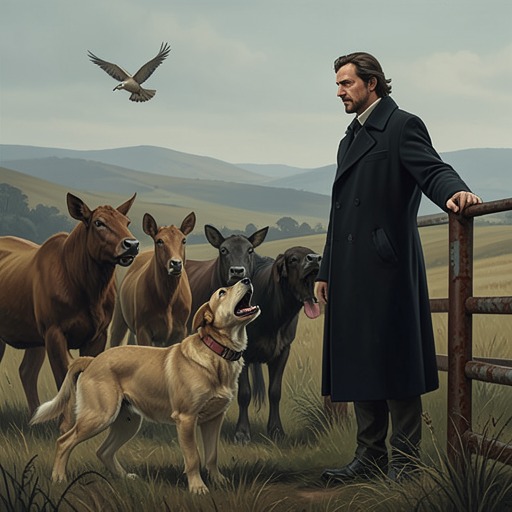
Trapped and mutilated wildlife
The Chemistry of DeathTrapped and mutilated wildlife is both a practical clue and a recurring part of the violence surrounding the Manham murders. The evidence points to two related but distinct uses of animals: birds and other creatures are trapped for a possible market, while animal remains are later identified as part of the killer’s ritual. That distinction matters. What first appears to be one shadowy pattern in the countryside proves to involve different people and purposes, complicating the investigation before helping expose its hidden connections.
Trapping and a possible trade
Scott Brenner eventually tells David Hunter that he and Carl Brenner have been trapping rare birds and animals, including otters. Carl does most of the trapping, and keeps it at the Old windmill, a derelict and isolated building that David had assumed was abandoned. Scott’s account suggests that the activity is not merely casual hunting: Carl believes live animals and eggs could be sold to collectors. The possible trade gives the traps an economic purpose, although the evidence does not establish how extensive the market is or whether any sale has actually taken place.
The confession also revises the meaning of an earlier encounter. Scott had stepped into a trap in the countryside, and he and Carl had offered an account of how it happened when they entered The Lamb. Carl had cut Scott off before he could say too much. Once Scott identifies Carl as the principal trapper and names the Old windmill, the earlier story becomes a sign of concealment rather than an isolated mishap. The landscape around Manham is not simply empty rural space: it contains hidden equipment and activity that villagers have not understood.
Animal remains as an uncertain warning
A witness tells Mackenzie that Sally Palmer had complained at the pub barbecue about a dead stoat left on her doorstep. At the time, she regarded it as a sick joke. The detail becomes more troubling beside other animal signs: swan wings found with Sally Palmer’s body and a mallard tied to a standing stone on the morning Lyn Metcalf disappeared. Mackenzie considers several explanations, including children, a warning, or a marker. He notes that the killer already uses birds as a signature, but does not treat the stoat as proven evidence of the killer’s involvement.
That uncertainty is important to the investigation. The same broad category of evidence—animals found dead, trapped, or displayed—can point toward different conduct. Scott’s account establishes trapping by Carl and Scott, with a possible commercial motive; it does not establish that they are responsible for the ritualized remains associated with the murders. Conversely, the stoat is suspicious in context, but Mackenzie’s initial alternatives remain open. The animal clues raise the possibility of a pattern before they identify its author.
The discovery at Tom Mason’s property
At Tom Mason’s house, David finds bitumen used to seal his grandfather’s bedroom. The material recalls a substance associated with a dead woman’s neck, turning an apparently domestic detail into a reason to reconsider the investigation. David had been convinced that Carl Brenner was the killer; the evidence at the house makes Tom Mason a competing suspect. The contrast between the two men’s concealed activity is central: Carl’s traps lead toward a possible trade, while the clues at Tom Mason’s property point toward the murder investigation.
A serrated clasp knife lies among tools at the property. David recognizes it as the weapon that killed Sally Palmer’s dog. Outside, he finds dozens of small animal and bird remains hung along a wire fence. The discovery brings the animal evidence into immediate proximity with the material clues against Tom Mason, but the chain of reasoning is cumulative: the knife, the fence, the bitumen, and the other findings at the property shift suspicion rather than each proving the whole case by itself.
David then enters an old air-raid bunker and finds a cellar where the ceiling is hung with animal remains, including foxes, rabbits, and ducks. Some are older and others more recent; the animals have been mutilated. Nearby, a workbench, rope, and a blood-soaked wedding dress place the display within the wider setting of the killer’s violence. The animals are not incidental traces of countryside life here. Their deliberate arrangement makes them part of a staged environment, though the full meaning of that staging is clarified only later.
The killer’s ritual and the distinction between causes
Henry Maitland later explains that the swan wings and baby rabbits were part of Tom Mason’s recurring ritual, as was the wedding dress. He says that the animals’ treatment occurred after the victims were dead. He also connects the killer’s three-day period of captivity to the first killing: the interval became a repeated practice after the first victim tried to escape and Tom Mason lost his temper. In this explanation, the animals belong to the ritual pattern surrounding the murders, not to the possible collector trade described by Scott.
The two strands nevertheless converge in their use of the same rural margins. Traps hidden at the Old windmill reveal a concealed operation; animal remains at Tom Mason’s property and in the bunker reveal a separate, more disturbing pattern of staging. Their overlap helps explain why the countryside’s signs are difficult to read and why an early clue can sustain competing interpretations. Wildlife in the novel is not a single, reliable signature: it can indicate exploitation for profit, serve as a possible warning, or become part of the murderer’s ritual. The investigation advances by separating these meanings rather than treating every trapped or dead animal as evidence of one cause.