1996 Everest blizzard
The ClimbThe 1996 Everest blizzard was the storm that transformed the May 10 summit attempt into a deadly crisis on the mountain. Its force was compounded by risks already embedded in the expedition: fixed ropes had not been put in place as expected, the summit-day leadership plan depended on intermittent radio contact, and the clients’ oxygen supplies were calculated around a return to camp by early evening. As visibility disappeared, those weaknesses became immediate dangers. The storm scattered climbers, obstructed rescue, and helped make a coordinated descent impossible.
Preparation and accumulated risks
The crisis unfolded against an ambitious acclimatization and summit plan. Mountain Madness intended to take its clients on four progressively higher excursions, beginning with a trip to 6,100 meters without an overnight stay. Clients would carry only their personal equipment to conserve strength; the Sherpas working under Lopsang Jangbu Sherpa would transport rope and supplies. After the first excursion, the team would return to base camp for rest and assessment. Later stages included an overnight at the first camp and training at 6,500 meters, where the Sherpas were establishing the next camp. The plan’s deliberate rhythm of ascent, rest, and observation contrasts with the fragile arrangements that governed the final summit push.
Those arrangements were under pressure before summit day. On April 26, Mountain Madness was expected to cooperate with other expeditions in fixing ropes between Camps III and IV. Its guides were not assigned to the work; instead, Sherpas were meant to contribute. But the Sherpas were exhausted after several days of labor, and sending them to establish Camp III and then rest would have left Mountain Madness unable to participate. Anatoli Boukreev was therefore sent in their place. The expedition feared that refusing to help would cost it a favorable position for a summit attempt, with May 10 circulating as a possible date. The decision secured participation in the shared work, but exposed how scheduling and scarce labor were already shaping safety choices.
A further failure awaited climbers higher on the route. Clients from the Fischer and Hall expeditions had understood that Ang Dorje Sherpa and Lopsang would leave Camp IV ahead of them to fix the ropes between Camp IV and the summit. Instead, neither sirdar nor other Sherpas had gone ahead. Lopsang later said that a member of the Montenegrin expedition had told him the ropes were already fixed. Jon Krakauer questioned that explanation, noting that Lopsang and Ang Dorje carried about three hundred feet of rope when they set out with their teams. The accounts leave uncertainty about what each guide knew, but establish the practical consequence: climbers reached the upper route expecting prepared ropes and found that the planned work had not been done.
Summit-day coordination and exposure
Fischer had no single, fixed turnaround time for his clients. His plan instead relied on Lopsang and the guides alternating at the front while Fischer brought up the rear and turned back stragglers as he caught them. If problems arose, he was expected to contact Lopsang by radio, who was assumed to be near the front. Neither Boukreev nor Neal Beidleman was issued a radio. The arrangement depended on leaders remaining in contact and in the positions assigned to them, precisely the conditions that deteriorating weather and a crowded route would undermine.
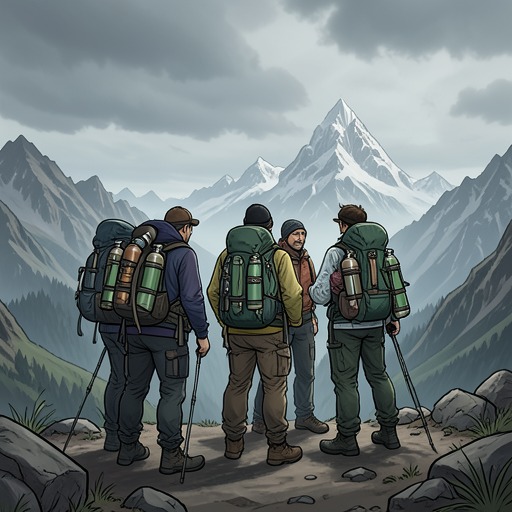
The clients’ oxygen schedule made time and communication especially consequential. Boukreev and Fischer had agreed that, if Boukreev were properly conditioned and acclimatized, he would guide without supplemental oxygen. Fischer planned to provide each client with three canisters, enough for about eighteen hours, for a midnight departure and a return to Camp IV by 6:00 p.m. The plan also made Boukreev a contingency: if clients had not returned by that hour, he could bring oxygen, hot drinks, and physical assistance to descending climbers. The storm did not simply arrive over a well-protected operation; it struck a system whose rescue capacity depended on a guide reaching camp, collecting supplies, and finding climbers before darkness and depleted oxygen made their situation fatal.
Communications from the mountain were circuitous. Dr. Ingrid Hunt said that messages passed through several Sherpas between Base Camp and Camp IV, and that information reaching her seemed incomplete or altered to make events sound better. Contact with Pemba was sporadic. Frustrated, Hunt moved between the Mountain Madness camp and Rob Hall’s camp, which she believed had better communications, while repeatedly asking for news over the radio. In the storm, the absence of a direct, dependable channel was more than an inconvenience: it made it harder to know who was in danger, where help was needed, and whether the people able to respond had received the warning.
Whiteout and the descent to Camp IV
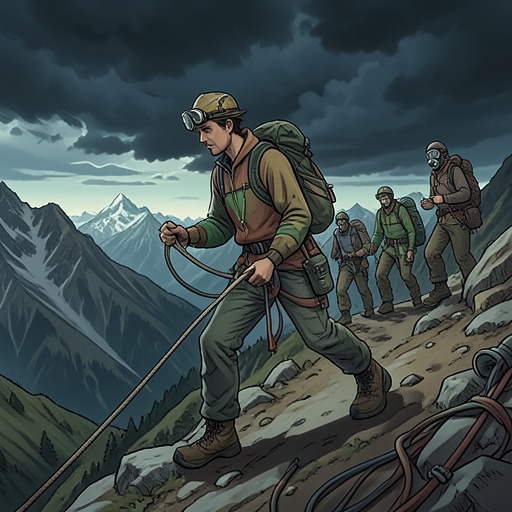
As the storm intensified, fresh snow and powerful wind closed in on the upper mountain. At about 8,200 meters, Boukreev encountered darkness and visibility so poor that his headlamp illuminated only a few meters. He tried using oxygen, then stopped because it did not improve his ability to see. The account describes him reaching an area near the Kangshung Face, changing direction, and finding oxygen bottles in the snow; he turned back and climbed slightly until he saw tents. Discarded canisters, ordinarily a trace of climbers’ passage, became a guide to camp when the landscape itself had vanished.
Boukreev’s return to Camp IV was a solitary passage through the storm. With no camp lights to guide him, he relied on memory and intuition to choose what he believed was the right direction across the South Col. The severity of the weather matched that of the previous night, and the conditions made it possible for him to become lost as well. Finding the oxygen canisters finally led him to his camp. The route back was therefore not a straightforward descent but a search through darkness, with a few abandoned objects serving as landmarks.
At Camp IV, Boukreev heard screams from a tent and found Beck Weathers alone, writhing in pain. He was exhausted and had narrowly escaped losing his own way in the whiteout; he went to his tent and collapsed rather than remaining with Weathers. The episode makes visible the limits imposed by the storm and exhaustion even on a rescuer who had made it back. Reaching camp did not mean that help was readily available to every person who had survived the descent.
Rescue and the storm’s consequences
Boukreev later described returning to Camp IV shortly after 5:00 p.m., gathering supplies and oxygen, and beginning a solo search around 6:00 p.m. as the blizzard set in. He found climbers lost and huddled together, resupplied them with oxygen, offered warming tea, and helped them physically toward the safety of camp. His account emphasizes the connection between his early descent and the rescue: he had returned in time to collect what he needed and go back out. He also argued that his decision to climb without supplemental oxygen was consistent with his established practice after acclimatization, and that Fischer had authorized it; he says he gave his own precautionary oxygen bottle to Beidleman at 8,500 meters because he was concerned about Beidleman’s supply.
The mountain’s poor visibility and the limits of available assistance remained central to Boukreev’s assessment of the risk. He believed that if he had not descended rapidly, he might have died with the clients he later found, or been forced to leave them on the mountain to seek help at Camp IV, where, in his account, no one else was able or willing to conduct a rescue. The storm thus created a brutal choice between remaining with people in danger and going for supplies or assistance that might make their rescue possible. His account presents the early descent not as withdrawal from responsibility but as a decision that enabled a return with aid.
The blizzard was not, in the book’s account, a single sufficient explanation for the deaths. Fischer’s deteriorating health, apparently compounded by a lack of oxygen, the time and place at which he became incapacitated, poor communications, the weather, and the condition and abilities of potential rescuers interacted. The account explicitly resists assigning one definitive cause, distinguishing the known combination of circumstances from a certainty no witness could claim. That caution matters because the storm made an already complex chain of decisions harder to reconstruct: people were separated, reports were incomplete, and the conditions that demanded rapid action also obscured what was happening.
The blizzard’s significance lies in this convergence. A summit plan built around scheduled oxygen, expected fixed ropes, and leadership by radio met a whiteout that erased routes and disrupted contact. Rescue then depended on individuals finding their way through the same conditions that had stranded the climbers. The storm was both a physical emergency and the force that exposed how thin the expedition’s margins had become.