1996 Mount Everest disaster
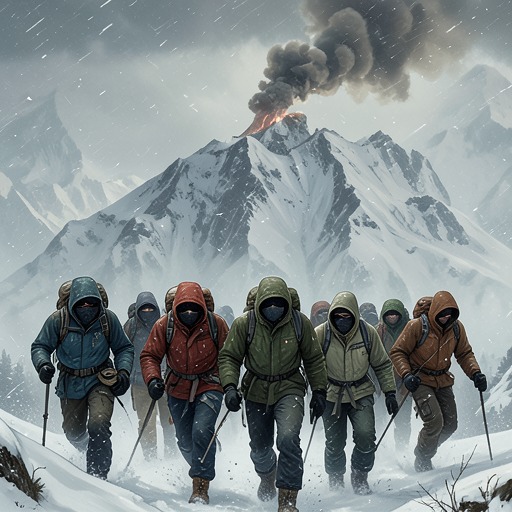
The ClimbThe 1996 Mount Everest disaster was a deadly crisis during the May 10 summit attempt, when a storm trapped climbers high above the South Col on Mount Everest. Its defining significance lies not in a single failure but in the convergence of hazards: severe weather, oxygen reserves calculated for a timely climb, congestion on the route, unclear operating arrangements, and communication problems. As climbers struggled to return to camp, survival depended on improvised decisions and rescue efforts in conditions that made even orientation uncertain.
Background and summit plan
The disaster took place during the 1996 climbing season, after several commercial expeditions had prepared routes and camps on Everest’s southern side in Nepal. Mountain Madness and Adventure Consultants, among others, had to coordinate their use of the upper mountain. An agreement between Scott Fischer, Rob Hall, Todd Burleson, Ian Woodall, and Makalu Gau called for teams to cooperate in fixing ropes between Camp III and Camp IV. Mountain Madness planned to send Sherpas rather than guides, but exhaustion among its Sherpas and the need to establish Camp III led the team to send Anatoli Boukreev to contribute to the rope work. The expeditions also had an incentive to cooperate: May 10 was circulating as a possible summit date, and losing their place in the climbing sequence risked delaying their attempt.
Mountain Madness’s acclimatization plan called for four excursions to progressively higher elevations. On the first, climbers would reach 6,100 meters, where Camp I was to be established, and return to Base Camp without staying overnight. Clients would carry only personal equipment, while Sherpas working under Lopsang Jangbu Sherpa carried rope and supplies. The plan’s staged progression was intended to conserve clients’ strength and allow the guides to observe their condition between climbs. These preparations formed the backdrop to a summit attempt whose safety depended on coordination, adequate reserves, and the expected timing of the route.
Oxygen, ropes, and the pressure to proceed
At Camp IV, Mountain Madness had sixty-two oxygen canisters: nine heavier Zvesda canisters reserved for sleeping and fifty-three lighter Poisk canisters set aside for the summit climb. Thirty-eight Poisk canisters went up the mountain with the climbers, leaving fifteen full ones at camp, along with what remained of the Zvesda supply. The reserve was too small to support an overnight delay and a second attempt on May 11. For several climbers, the plan was therefore effectively a single attempt: May 10 or no further bid.
The oxygen calculations assumed that each Poisk canister would last six hours at the recommended flow rate of two to two and a half liters per minute. Two bottles were expected to cover the climb from Camp IV to the summit and the descent to the South Summit, where a third bottle was to be cached. With that additional supply, climbers were expected to return to Camp IV if the climb proceeded on schedule and conditions remained favorable. This margin depended on the route being clear and delays being limited; it left little room for the combination of a slow ascent, congestion, and worsening conditions that followed.
The clients were told that Sherpas from the Fischer and Hall expeditions would leave ahead of them to fix the ropes, so that the climbers would not have to wait. In practice, neither Lopsang Jangbu Sherpa nor Ang Dorje Sherpa, nor other Sherpas, had gone ahead to do this. At the Balcony, members of the climbing groups began to bunch together, switching oxygen canisters and resting as the route narrowed. Climbers from both expeditions had expected the rope work to be complete; instead, they encountered delays on the way toward the summit. The gap between the plan and what was in place on the mountain turned a logistical problem into lost time at an altitude where oxygen and strength were finite.
The rules for turning around were also uncertain. Scott Fischer did not set a definite summit-day cutoff for his clients. Rather than give a fixed time, he planned to have Lopsang Jangbu Sherpa and the guides alternate at the front while Fischer followed behind, turning back stragglers as he caught up with them. Neither Boukreev nor Neal Beidleman had a radio. Hall’s clients remembered different possible deadlines—one o’clock, two o’clock, or a decision made on the mountain. This left climbers with an unclear shared standard at the very point when congestion and elapsed time were making the decision increasingly consequential.
Delays and the storm
By 9:58 a.m., Beidleman had reached the South Summit; Martin Adams followed about thirty minutes later. They waited there while climbers behind them struggled through a jam on the fixed ropes. Hall’s slower clients were mixed among Fischer’s climbers and members of the Taiwanese National Expedition, while the Sherpas carrying additional oxygen were also spread along the route. At 10:30 a.m., the climbers were still staggered between the Balcony and just below the South Summit. Under the recommended flow rate, many were already using their second canister, with only one or two hours of oxygen remaining before the unarrived third bottles were needed. The delay thus narrowed the margin for descent even before the storm became the immediate threat.
In the early evening, a severe storm arrived and remained over the highest elevations for more than ten hours. Twenty-three mountaineers who had climbed from the southern side could not reach the safety of their high-altitude camp. Above 8,000 meters, they were in the Death Zone, where prolonged exposure to cold and oxygen deprivation can rapidly become fatal. Visibility deteriorated, oxygen gauges fell to empty, and hypoxia impaired judgment. The danger was compounded by the difficulty of keeping track of other people and of finding the route back to camp.
Communications did not provide a reliable picture of the emergency. Messages between Ingrid Hunt at Base Camp and Scott Fischer and Lopsang on the mountain passed through a chain of Sherpa intermediaries, including Ngima at Base Camp, Gyalzen at Camp II, and Pemba at Camp IV. Hunt felt that reports reaching her were incomplete or presented in a more favorable light, while contact with Pemba was sporadic. Frustrated, she moved between the Mountain Madness and Rob Hall camps because Hall’s camp had better communications. As the situation escalated, the separation between climbers on the mountain and those trying to understand their condition below made it harder to coordinate assistance.
Rescue attempts and survival
Boukreev returned to Camp IV at about 5 p.m. He did not know how serious Fischer’s and Doug Hansen’s situations were. He understood that the Mountain Madness clients, who had not yet appeared, would soon run out of oxygen. Around 6 p.m. he began preparing to go up; by about 6:30 he had put on his crampons. He carried three oxygen canisters, a mask and regulator, an ice ax, and a ski pole. Shortly after he left camp, cloud descended onto the South Col and blowing snow reduced visibility. He continued toward the fixed ropes, using the lights at camp to orient himself, but the route was hard to locate and he recognized the danger of going off course. He eventually removed his oxygen mask when his glasses fogged and froze, limiting his ability to see.
Elsewhere on the South Col, Beidleman’s group struggled to maintain its bearings in the storm. The climbers were moving slowly, and oxygen had run out for at least some of them. Beidleman feared that anyone who left the group to find camp alone could become completely lost. After the group wandered in conditions that may have carried them toward the Tibetan side of the South Col, he urged the climbers to stay together and huddle. They formed a close group with their backs to the wind, checked one another’s consciousness and tried to keep each other awake and warm. When the snowfall briefly eased enough to reveal stars and the outline of the mountain, Klev Schoening recognized the direction of camp, offering the group a possible way to regain its bearings.
Boukreev’s search became a rescue attempt in conditions that restricted how far he could safely go. He used the lights from Camp IV as a reference while searching for the route and the climbers above. Later, after recovering oxygen canisters from a Sherpa tent, he went up again toward Fischer. Around 7 p.m., after reaching the area beyond the fixed ropes, Boukreev found Fischer. He saw no signs of life and judged that he could not move him to safety. He arranged Fischer’s pack and oxygen equipment around him as best he could, took Fischer’s ice ax and a few personal items for his family, and descended in worsening visibility. The account records the attempt as both a rescue effort and a failed effort to bring Fischer back alive.
Consequences and significance
The storm’s immediate consequences were fatal for several climbers, but the book resists reducing the disaster to one person’s mistake or a single cause. Scott Fischer’s deteriorating health, apparently compounded by insufficient oxygen, the hour and location at which he became incapacitated, communication failures, the weather, and the condition and abilities of potential rescuers all contributed. The account explicitly treats these factors as interlocking circumstances rather than claiming certainty about one definitive cause.
The disaster exposes how a plan’s safety margin can be eroded by interacting delays and uncertainties. The oxygen schedule relied on a timely climb; rope-fixing arrangements did not match what climbers encountered; summit-day turnaround expectations were not uniformly understood; and radio messages did not reliably convey the emergency. None of these conditions alone explains the outcome, but together they reduced the group’s ability to adjust once the ascent fell behind schedule and the storm arrived. The mountain’s physical hazards were inseparable from the expedition systems through which climbers shared route work, oxygen, information, and responsibility.
Fischer’s death also marked the loss of a prominent American high-altitude guide. Several clients who had disagreements with aspects of the expedition nevertheless said they trusted him and would have climbed with him again. The disaster therefore leaves two judgments side by side: the severe consequences of a plan vulnerable to delay and communication breakdown, and the enduring regard in which some of Fischer’s clients held him. It is remembered not as a simple morality tale but as a catastrophe in which human decisions, limited resources, bodily exhaustion, and weather converged beyond the ability of any one participant to control.