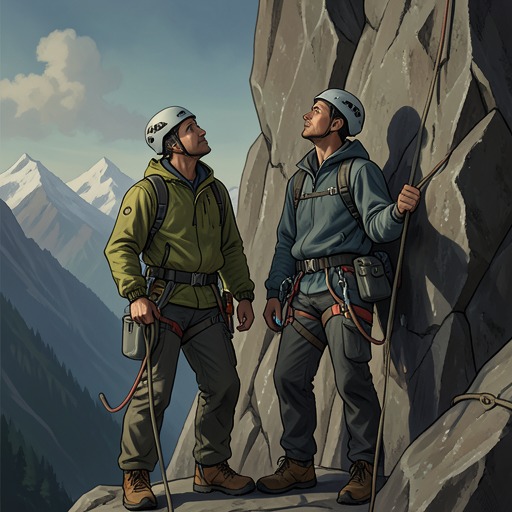
Anatoli Boukreev—Scott Fischer partnership
The ClimbThe partnership between Anatoli Boukreev and Scott Fischer was at once professional, trusting, and deeply personal: they worked together on Mountain Madness’s 1996 Everest expedition, but after Fischer died on the mountain, Boukreev’s relationship with him became a lasting burden of grief, responsibility, and remembrance. Their shared story turns on a painful reversal: the guide who had descended ahead of the clients in order to prepare for possible rescues could not bring Fischer back, and later returned to the mountain to give his body a respectful burial.
A guiding partnership on Everest
Boukreev and Fischer entered the 1996 Everest season as collaborators in a commercial expedition. Boukreev was an experienced high-altitude climber and guide; Fischer led Mountain Madness. Their roles depended on a division of judgment and responsibility, but not on a simple hierarchy in which every decision was dictated from above. In Boukreev’s later account, he understood Fischer to have approved his descent from near the Hillary Step, just as Rob Hall had agreed immediately before him. Boukreev said he told Fischer that the ascent was running slowly and that descending climbers might run out of oxygen before reaching Camp IV. His reason for going down was practical: he wanted to warm himself and gather hot drink and oxygen so he could return uphill if climbers needed help.
Boukreev believed the plan left capable people behind the clients. He expected Fischer, Hall, Neal Beidleman, and four Sherpas to bring the climbers down, and he recalled that no clear signs yet indicated how quickly the weather would deteriorate. The arrangement therefore rested on an assessment of the situation as it appeared at the time: Boukreev would get ahead to prepare assistance, while the guides and Sherpas remaining higher on the route would sweep the clients toward camp. The storm transformed that plan into a desperate rescue effort, but the account presents the descent not as an unexplained withdrawal but as a decision made in consultation with the expedition leaders.
The surviving accounts also show why their partnership became contested in retrospect. Boukreev maintained that Fischer had agreed to the descent; Jon Krakauer later questioned Boukreev’s recollections and whether Fischer had authorized such a plan. In his discussion of the dispute, G. Weston DeWalt reports that Boukreev’s English could make apparently conflicting formulations hard to distinguish: “Fischer says, ‘Okay, go down.’ ” DeWalt understood the phrase as both agreement and an instruction. This is not a final resolution of the disagreement, but it clarifies how the same exchange could be remembered and interpreted differently, and why the question of authorization became bound up with judgments about Boukreev’s conduct.
The disaster and its unresolved cost
Boukreev’s stated decision to descend was linked to what happened next. He reached Camp IV shortly after 5 p.m., delayed by the advancing storm, gathered supplies and oxygen, and began a solo effort at about 6 p.m. to find climbers separated from the route. He later said that he located lost, huddled climbers, supplied them with oxygen, offered warming tea, and helped them reach camp. That rescue work forms a stark contrast with the limit of his ability to help Fischer: Boukreev could find and assist other climbers, yet Fischer remained beyond his power to bring home.
The loss was not abstract for Boukreev. He described himself as devastated by Fischer’s death and remorseful that he had not been able to rescue Yasuko Namba. The expedition’s immediate aftermath did not settle that grief. When the Mountain Madness clients began descending from the mountain, Boukreev went on to climb Lhotse alone, fulfilling an expedition Fischer had packaged before Everest and for which Fischer had signed on Charlotte Fox, Tim Madsen, and Sandy Hill Pittman. At 5:46 p.m. on May 17, Boukreev reached the summit. From there he looked toward Everest and traced the descent route; at 8,350 meters, his attention stopped at the point where Fischer had gotten no farther. The summit was therefore also a vantage point on the failure that had defined the expedition: Boukreev could retrace the route, but could not undo its ending.
The public memorial for Fischer made the personal dimension of the partnership visible. Boukreev attended while feeling disconnected from the occasion and burdened by the knowledge that he had been unable to save Fischer and Namba. At a private remembrance the following day, Fischer’s parents and friends spoke about his life and work. Boukreev found it difficult to sit still and paced while looking at an exhibit of Fischer’s photographs. He remembered their similarities as well as their differences and misunderstandings, and expressed respect for Fischer both as a climber and as a man.
Boukreev feared that Fischer might eventually be remembered only by family and close friends. He hoped instead that what Fischer had brought to mountaineering would persist: his enthusiasm and energy in relationships with fellow climbers and clients, his love of life, strength, and benevolence. Boukreev regarded Fischer as more romantic than businessman, and said that Fischer’s example had awakened something in him. The remembrance thus turns the partnership into a source of self-examination. Boukreev did not claim that the two were alike in every respect; he hoped to carry some of Fischer’s qualities into his own way of living and climbing.
Return to the mountain and acts of remembrance
Boukreev’s decision to return to Everest as a consultant for an Indonesian team was tied directly to what he called unfinished emotional business. He wanted to revisit the site of the 1996 ordeal and to give respectful burials to Fischer and Namba. He also sought a role in commercial high-altitude mountaineering that accorded with his own beliefs about climbing, hoping to work as a coach and team leader. The return was consequently more than a professional engagement: it created the possibility of completing acts of care that the disaster had made impossible the year before.
During the Indonesian expedition’s descent, Boukreev went to approximately 8,400 meters to search for Fischer’s body. He had passed within about thirty meters of it in the dark during the ascent and had searched then without finding it. He carried a flag bearing farewells from Fischer’s wife and friends, intending to cover the body with it. Because he was unsure whether he could locate Fischer while continuing with the team, he left the flag at the summit. Once he judged the team’s situation stable enough, he returned to the task. Fischer was nearly covered by snow. Boukreev asked Evgeny Vinogradski to help; together they covered the body with snow and rocks and marked the place with the shaft of an ice ax they found nearby.
The act did not reverse the earlier failure, and Boukreev did not present it as a rescue. He described it as a final respect for a man whose smile and positive manner remained vivid to him. The farewell flag flew from the summit, carrying the words of Fischer’s family and friends above the place where he lay. In Boukreev’s account, burial and commemoration became a limited but concrete response to grief: he could not bring Fischer home, but he could return, find him, cover him, and mark his resting place.
That work also altered the meaning of the partnership’s final chapter. Fischer’s promise to arrange the Lhotse expedition had survived him as a plan Boukreev could carry out; the later Everest return allowed Boukreev to complete the burial he had wanted. Neither undertaking erased the unresolved questions surrounding the storm or the controversy over the descent. Instead, the book holds professional disagreement alongside affection and mourning. Fischer remains both the expedition leader whose judgment mattered in a crisis and the friend whose example Boukreev hoped to remember in his own life.
Testimony, memory, and the partnership’s afterlife
The relationship was reconstructed through testimony as well as through action. Five days after the disaster, nine climbers gathered at Mountain Madness’s Everest Base Camp and recorded their thoughts and memories. Boukreev drew on that debriefing, whose participants attempted to tell the truth and reflect on what had happened. The recording became part of the historical record and a source for later accounts of the disaster. Its importance lies not only in the details it preserved, but in the fact that those details were spoken by participants close to the events, before the later public argument had fully taken shape.
The book nevertheless makes clear that memory at high altitude can diverge. In one disputed recollection, Martin Adams identified Jon Krakauer as a climber he had seen slumped on the route, while Krakauer remembered no glissading and suggested Adams might have mistaken him for Namba; Adams insisted he had seen Krakauer. That disagreement is not itself a record of Boukreev and Fischer’s exchange, but it demonstrates the broader conditions under which accounts of the expedition were assembled: witnesses occupied different positions, recalled events differently, and later had to compare interviews and transcripts.
DeWalt’s challenge to Krakauer over the conversation near the Hillary Step makes that evidentiary problem central to the partnership’s afterlife. DeWalt revisited interview transcripts and spoke again with Adams, who said the exchange with Fischer had occurred outside Krakauer’s hearing and that Krakauer had not heard Boukreev tell Fischer he was going down with Adams. DeWalt also argued that Boukreev’s imperfect English could account for formulations treated as contradictory. The disputed authorization therefore survives not as a settled fact accepted by all accounts, but as a question shaped by who heard which words, how those words were expressed, and how later writers interpreted them.
The partnership endures in this double register. Its practical history concerns guiding, descent, and rescue under a rapidly worsening storm; its personal history concerns grief, respect, and the promise of a final act of care. Its documentary history remains more unsettled: the debriefing and interviews contribute evidence, but recollection and interpretation do not collapse into a single uncontested version. The result is a portrait of Boukreev and Fischer that does not reduce their relationship either to professional roles or to an uncomplicated story of friendship. Their collaboration ended on Everest, while the obligations and questions it left behind continued to shape how Boukreev remembered Fischer and how others judged the choices made on the mountain.