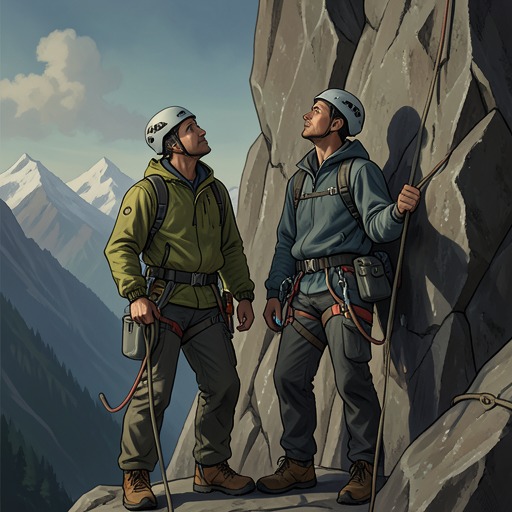
Anatoli Boukreev’s descent ahead to the South Col
The ClimbAnatoli Boukreev’s descent ahead to the South Col was a deliberate choice made in consultation with Scott Fischer, not simply a guide leaving clients behind. On the summit-day descent, Fischer told Boukreev to go down to Camp IV, prepare tea, and be ready in case the climbers above were delayed or encountered trouble. The decision later became controversial, but the accounts preserve its immediate logic as well as its limits: Boukreev and Fischer believed the clients looked well, while cold, dwindling oxygen, and the late hour made a reserve presence below valuable.
The decision near the Hillary Step
Boukreev recalled meeting Rob Hall first, perhaps fifteen or twenty minutes before he encountered Fischer. Hall was a little ahead of Fischer and said his condition was not a major problem; he thanked Boukreev for fixing the lines and declined help with the summit. Fischer, by contrast, was moving slowly and wearing a mask. Boukreev could not tell whether he was using oxygen, since the mask also protected against the wind. Fischer said he felt tired and perhaps a little sick, though Boukreev thought Fischer did not understand the seriousness of his condition.
Boukreev had already spent more than an hour on the summit and was beginning his descent in strong wind and severe cold. He asked Fischer about the plan. Fischer answered that there was still time to reach the summit and then descend, and instructed Boukreev to go ahead to the South Col, save himself, and prepare tea. Boukreev accepted the plan in part because someone needed to remain in reserve: he had not seen the Sherpas, and worried that Sherpas who had climbed to the summit might be tired and have used up their oxygen. He also did not know how strong the Sherpas already at the South Col were. The two discussed the matter for roughly ten to fifteen minutes before Boukreev went down.
A reserve at Camp IV
In a later account of the exchange, Boukreev said he told Fischer that the clients on the summit looked well, but that the cold and dwindling oxygen might create problems. Fischer considered the situation acceptable at that moment and thought the Mountain Madness climbers might still reach Camp IV before dark if the descent went well. Given the delays already accumulated and the hour, they agreed that Boukreev would be more useful at Camp IV, where he could stand ready if the clients above were held up or ran into difficulty. Boukreev later emphasized that the two men saw the situation similarly and that he was satisfied with their decision based on what they knew then.
This arrangement depended on Boukreev being below the climbers rather than alongside them. Neal Beidleman later said he knew Boukreev had gone down and had no objection, although he would have liked him to stay. Beidleman did not know at the time that Fischer had explicitly instructed Boukreev to descend. In retrospect, he supported the instruction: Boukreev’s presence below made it possible for him to collect people, whereas staying with the summit group would not necessarily have made their descent more effective.
The descent above him
Beidleman’s recollection places the decision within a crowded, prolonged descent. He had wanted to leave the summit earlier, but new climbers kept arriving, including members of his group; he felt he could not leave until they had reached the top. The group began descending in an initially celebratory mood, while Beidleman himself was anxious and intent on getting people down. At the Hillary Step, he followed Sandy Hill Pittman. The old ropes and tattered cords were tangled, and Pittman struggled to identify the correct line and negotiate the steps. A rappel proved impossible because the cords were knotted together by the wind, so she descended by hand with assistance.
The descent also unfolded amid diminishing oxygen. Below the South Summit, Beidleman saw Klev Schoening checking bottles: one was full or nearly full, while others held only an estimated three to five units of pressure. Beidleman believed he was close to running out, as were some of the clients; he took a bottle with a low remaining pressure and recalled that the fuller bottle went to Lene Gammelgaard. These details clarify the conditions behind the decision to establish a reserve at Camp IV: the descent involved tangled lines, exhausted climbers, and uncertain oxygen supplies, not merely a straightforward walk down from the summit.
Limits and retrospective judgment
After the disaster, Boukreev reconsidered the choice because his descent ahead of the clients became a subject of media criticism. He concluded that it had been the right decision given what he and Fischer knew when they met near the Hillary Step. But he also specified what would have changed his judgment: had he known Fischer was ill, and that Lopsang Jangbu Sherpa’s attention would be diverted to members of Rob Hall’s expedition, he would not have made a rapid descent. The later qualification does not erase their agreement; it shows how dependent it was on an incomplete picture of the danger and of who would be available to assist whom.
The episode therefore turns on the difference between a decision’s purpose and its eventual outcome. Boukreev descended to prepare for a possible emergency and to serve as a reserve below the summit route. Beidleman’s retrospective assessment supports the practical value of that position, while Boukreev’s own qualification acknowledges that undisclosed illness and the demands on Lopsang would have altered the calculation. The descent was neither a guarantee of rescue nor a choice made with full knowledge; it was a contingency plan whose meaning changed as the crisis unfolded.