Ang Dorje Sherpa
The ClimbAng Dorje Sherpa, the climbing sirdar of Rob Hall’s Adventure Consultants team, is one of the Sherpas whose work made the 1996 Everest summit attempt possible. He helped establish the route above Camp III, climbed among the intermingled summit teams, and worked with Neal Beidleman to fix ropes when the planned preparations had not been completed. Later, he joined an unsuccessful attempt to reach and rescue Hall. His story links technical skill and responsibility on the mountain with the larger question of who performs, directs, and benefits from the dangerous labor of commercial climbing.
Identity and Work
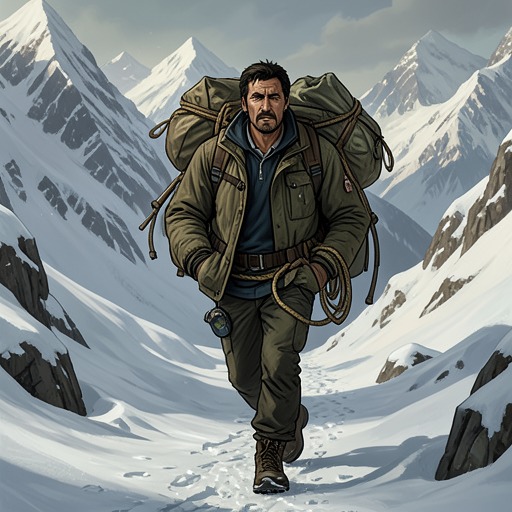
As climbing sirdar for Hall’s expedition, Ang Dorje was a senior member of the Sherpa team, not simply a porter accompanying foreign clients. His work included setting the route and installing fixed lines that climbers depended on to move through exposed terrain. In the approach to Camp III, he led the rope-laying effort above the camp. Boukreev exchanged places with him and took the lead for the remainder of nearly five hours of work, while Ang Dorje belayed him and other Sherpas passed rope up the mountain. They reached 7,550 meters, just below the Yellow Band.
That labor took place within a commercial system in which expedition clients paid for access to an established route, while Sherpas did much of the physical work needed to create and maintain it. At the South Summit, teams were also expected to have oxygen cached for climbers’ descents. Accounts of the Adventure Consultants cache differ: Jon Krakauer reported that at least six bottles remained when he reached the South Col, while Mike Groom described distributing bottles to climbers and taking two from the cache with Ang Dorje and another Sherpa. The conflicting accounts leave uncertain how much oxygen was available by the time Hall reached the South Summit, and the record does not establish precisely what Ang Dorje took or when.
Route Work and Summit-Day Delay
The two commercial teams had expected their climbing sirdars, Ang Dorje and Lopsang Jangbu Sherpa, to leave Camp IV ahead of the clients and fix the ropes so the ascending climbers would not have to wait. Instead, neither sirdar nor another Sherpa had gone ahead to complete that work. Lopsang later said that a member of a Montenegrin expedition had told him the ropes were already fixed; Jon Krakauer questioned this account, noting that Lopsang and Ang Dorje carried rope with them when they set out. The book presents the explanation and the criticism as disputed evidence, not as a settled account of why the planned preparation failed.
The delay became consequential above the Balcony. After climbers had waited for more than an hour, Beidleman decided to move forward to help with the ropes. In his account, he followed Lopsang and Ang Dorje over a rise, then found Lopsang bent over and vomiting. Beidleman took rope from Lopsang’s pack and, with Ang Dorje’s assistance, began fixing lines toward the South Summit. Some existing rope could be trusted; elsewhere they had to install new lines, making the work arduous. Boukreev, meanwhile, tried to get clients moving again. What had been planned as advance preparation by the Sherpas turned into emergency work amid an already slow summit ascent.
The debriefing record gives a more detailed account of the improvisation. Beidleman said he took two ropes from Lopsang, including a long white polypropylene rope, while Ang Dorje fixed one section and Beidleman installed another. Beidleman remembered reaching the South Summit at about 10:00 A.M., close to the cutoff time he associated with Hall’s schedule. He then waited near the rocks below the summit, where he watched the traverse and saw no other Sherpas from his own team. Boukreev’s recollection likewise emphasizes uncertainty over who would fix the lines and when: he had expected the Sherpas to do it, saw no one taking the initiative, and told Beidleman he would belay him while he moved forward. These accounts place Ang Dorje in the practical work of repairing a failed plan, while also showing that the climbers and guides did not share a clear, reliable picture of responsibilities as the day advanced.
Teams, Decisions, and Unequal Labor
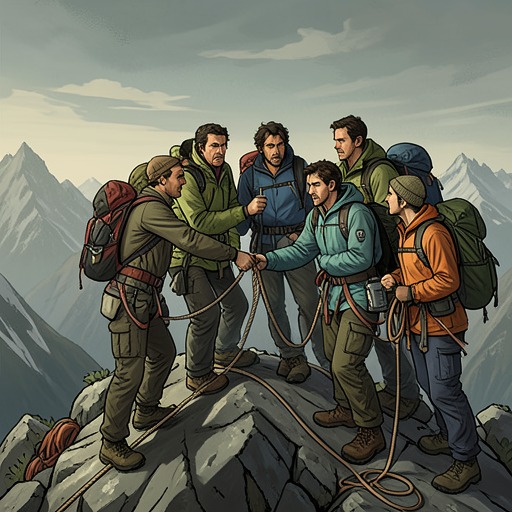
Ang Dorje’s presence on the route brought the Hall and Fischer expeditions into close operational contact. Hall’s climbers had left Camp IV thirty minutes before Mountain Madness, but within two or three hours the groups began overtaking one another. By 4:00 A.M. they were thoroughly mixed together, with members of the Taiwanese National Expedition following in their wake. The teams’ shared route made the Sherpas’ rope work a common dependency, even as the expeditions retained separate leaders, clients, oxygen supplies, and plans.
The wider arrangements for fixing routes were also contested. At Base Camp, expedition organizers disputed who would secure the work of fixing the Khumbu Icefall and receive payment for it. The Pangboche Sherpa Cooperative briefly lobbied to collect the contract, but Henry Todd and Mal Duff secured the work. Boukreev criticized a system in which leaders could collect substantial fees from teams using a route that other expeditions’ Sherpas had prepared. He imagined a future in which Sherpas would contract to fix the route all the way to the summit and Nepalis would control access to the mountain. He also cautioned against treating a weak Sherpa team as an individual failure: building a capable team, he wrote, required years of repeated ascents and consistent financial support. Ang Dorje’s work on Hall’s expedition is thus shown both as skilled individual effort and as part of a labor structure in which responsibility and control were not evenly distributed.
Rescue Attempt and Narrative Significance
After the summit-day disaster, Ang Dorje was among the Sherpas who made a determined but unsuccessful attempt to climb to Rob Hall and rescue him. He tried with Lhakpa Chirri Sherpa, whom Boukreev had also sought to recruit for a rescue of Yasuko Namba. The available account confirms the attempt and its failure, but does not provide enough detail to reconstruct the pair’s precise route or the circumstances that stopped them. The outcome nevertheless extends Ang Dorje’s role beyond route preparation: the Sherpas’ work continued into the effort to reach a stranded guide after the summit plan had broken down.
Across the season, Ang Dorje appears in brief, consequential actions rather than as the center of a continuous personal narrative. He belays Boukreev on the route, joins Beidleman in fixing ropes when the schedule is slipping, and later attempts to reach Hall. Those moments make visible the dependence of commercial climbing on Sherpa skill, while preserving the uncertainty and limits of the record: the reasons for the initial rope delay remain disputed, oxygen-cache accounts conflict, and the rescue attempt did not bring Hall back. His significance lies in this combination of expertise and constrained agency—he helps make the route climbable, but he does not control the expedition’s larger decisions or the mountain’s final outcomes.