Beck Weathers
The ClimbBeck Weathers’s survival is one of the stark reversals in the 1996 Everest disaster: after being told not to climb higher because of problems with his vision, he spent hours waiting for help, was left behind as the storm scattered the descending climbers, and eventually appeared at Camp IV under his own power. His return did not erase the cost: he suffered extensive frostbite and later lost extremities. In the competing recollections assembled by the book, his ordeal also becomes a measure of how little anyone could reliably see, understand, or do in the storm.
Identity and Position on the Mountain
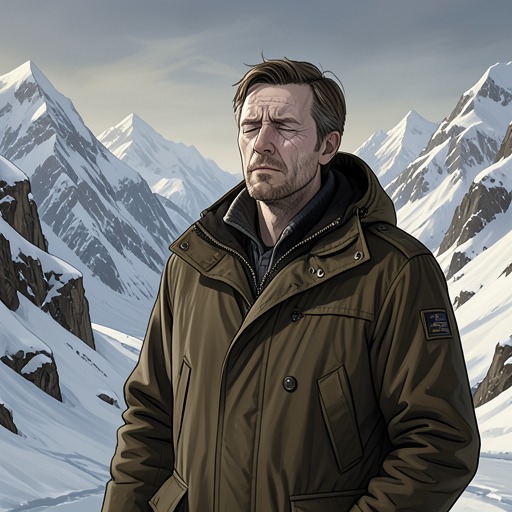
Weathers was a pathologist from Dallas, Texas, and a client on Rob Hall’s Adventure Consultants expedition. Hall had instructed him not to advance any higher because he had been having problems with his vision. Boukreev encountered him waiting for assistance down the mountain, but Weathers had already been there for more than eight hours. The instruction to stay put, intended to keep him from climbing farther, left him dependent on an escort who did not arrive promptly.
As the climbers descended, Weathers occupied a precarious position between the fixed route and the scattered parties moving through the storm. Adams recalled finding Jon Krakauer slumped near the South Summit without oxygen, while Boukreev urged Adams onward rather than let him stop. Further down, other members of the descending group came upon Weathers still waiting on the Balcony. The succession of encounters shows that several climbers saw him, but seeing him did not immediately translate into a coordinated descent.
Left Behind During the Descent
Mike Groom eventually tethered Weathers to his climbing harness and started him moving. The two proceeded slowly, and Yasuko Namba, who had been climbing with Groom earlier, apparently could not keep up and was left behind. By the time the storm had intensified, this small chain of improvised assistance had not reunited the climbers or brought the whole group safely to camp.
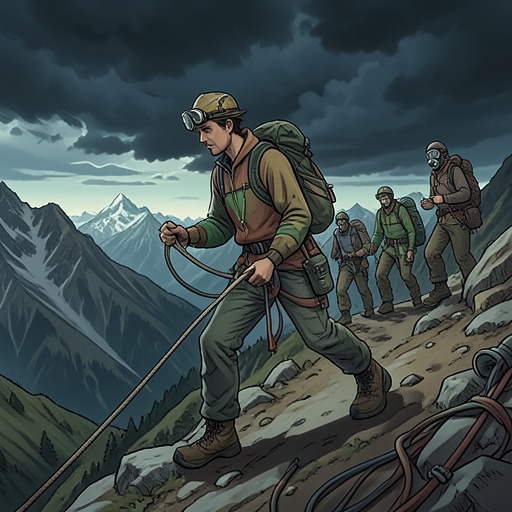
Beidleman’s account places Weathers among a larger, disoriented group near the end of the fixed ropes. The climbers followed headlights in wind and poor visibility, without an agreed leader or a clear shared direction. Beidleman tried to keep the group away from the Lhotse Face and its precipice, choosing a traverse intended to reduce the danger of walking off the slope. In his recollection, Weathers and Groom were ahead of the others, still tethered together and moving very slowly. Klev Schoening’s later recollection also placed them in the group gathered during the night, though the climbers’ accounts differ on exactly where people were and how the parties divided.
The storm eventually forced a separation between those who could move and those who could not. Tim Madsen, unable to carry Charlotte Fox to camp, brought Namba back to the small group with Fox and Sandy Hill Pittman, while Groom remained tethered to Weathers. Madsen told Groom, whom he presumed still functional, to go to camp and bring help. The five who stayed together—Madsen, Pittman, Fox, Namba, and Weathers—huddled to keep warm and tried to remain awake. Weathers’s slow progress had become part of a larger crisis in which even climbers who could move could not simply carry everyone else to safety.
The Storm and the Return to Camp IV
Boukreev’s recollection presents Weathers’s return as an astonishing sight. After leaving the tents at Camp IV and going a short distance, Boukreev saw a small moving figure coming down toward him. The person held his bare hands in front of his body, an image Boukreev likened to a surrendering soldier. He did not recognize Weathers at first. When asked whether he had seen Scott Fischer, Weathers replied that he had seen no one and said he never wanted to return to the mountains. Boukreev remembered the words as confused, almost delirious talk.
The encounter changed Boukreev’s immediate course. He had been preparing to go back up in search of Fischer, but seeing Weathers alive convinced him that a further attempt might still be worth making. He called for help, asking Burleson and Athans to take care of Weathers, and continued upward with oxygen as night began to fall and the blizzard strengthened. This was not a simple handoff after a successful rescue: Boukreev believed others would look after Weathers, while Weathers’s later discovery alone in a tent shows how uneven and fragile care remained at Camp IV.
On his return through darkness and severe wind, Boukreev navigated by memory and intuition, with no camp lights to guide him. Discarded oxygen canisters helped him find the camp. He heard screams from a tent and found Weathers writhing in pain, unattended by teammates. Exhausted and having narrowly avoided losing his way, Boukreev could not assist him then; he went to his own tent and collapsed. The episode preserves both the fact of Weathers’s survival and the limits of the people around him: rescue from the mountain did not mean immediate safety or continuous care.
Survival, Injury, and Conflicting Recollections
By the morning of May 12, hope for Hall, Doug Hansen, and Andy Harris had been abandoned, and the surviving members of Adventure Consultants began descending toward Base Camp. Weathers and Makalu Gau were evacuated to Camp I through the efforts of Todd Burleson, Pete Athans, Ed Viesturs, David Breashears, and members of other expeditions; from there, a helicopter flew them to Kathmandu. Weathers had survived the storm and reached the evacuation route, but he was among the survivors who suffered extensive frostbite and later lost extremities.
The book does not present every remembered detail as settled fact. In the debriefing discussion of the night, Beidleman recalled Weathers and Groom among the people in the huddle, while other participants filled in who was present and how they began to move again. Those accounts place Weathers in the group’s confusion without making every separation or movement certain. The book’s authors also draw on the May 15 Base Camp debriefing, recorded five days after the disaster, and acknowledge that recollections at altitude could diverge. Weathers’s story is therefore conveyed through other climbers’ observations: he is repeatedly seen, left behind, tethered, found moving toward camp, and found again in pain.
Narrative Significance
Weathers’s survival makes the boundary between rescue and abandonment difficult to draw. Hall’s earlier instruction kept him from climbing higher, but left him waiting for assistance; Groom eventually began moving him, yet the storm separated him from those who might have helped. Madsen’s decision to send Groom toward camp reflects the desperate arithmetic of the night: someone had to reach help, while the people unable to travel had to wait together in the cold.
His appearance before Boukreev also affects the narrative beyond his own rescue. Boukreev takes the sight of a survivor as reason to continue toward Fischer, even though he is exhausted and conditions are worsening. Later, the discovery of Weathers alone and in pain complicates any clean account of successful aid. The book’s return to Weathers through witnesses, recollections, and retrospective discussion makes him not merely a survivor count, but a human measure of the storm’s disorientation, the limits of expedition support, and the lasting bodily consequences of getting off the mountain.