Boukreev’s South Col rescue
The ClimbBoukreev’s South Col rescue was a sequence of hazardous journeys through the May 10–11, 1996 storm, in which Anatoli Boukreev located climbers stranded in the dark, shared scarce oxygen and hot tea, and led exhausted survivors back to camp. He rescued Charlotte Fox and later helped Sandy Hill Pittman and Tim Madsen, while Yasuko Namba remained near the group; his account also shows how unreliable communication, inadequate supplies, and the absence of other rescuers shaped what he could do. The rescue ended not with safety for everyone, but with Boukreev turning his attention to Scott Fischer, still missing above camp.
The Storm and the Decision to Go Back
After descending to the South Col, Boukreev waited in his tent as clouds obscured the mountain above 8,300 meters. From his position he could see toward the South Summit at 8,748 meters, but not through the cloud; at first he regarded the weather as a familiar afternoon pattern that might clear. The absence of climbers returning to camp gradually made that expectation harder to sustain. He hoped not to climb again after the summit effort, yet prepared a thermos of hot tea and asked for three oxygen bottles in case the situation above did not improve.
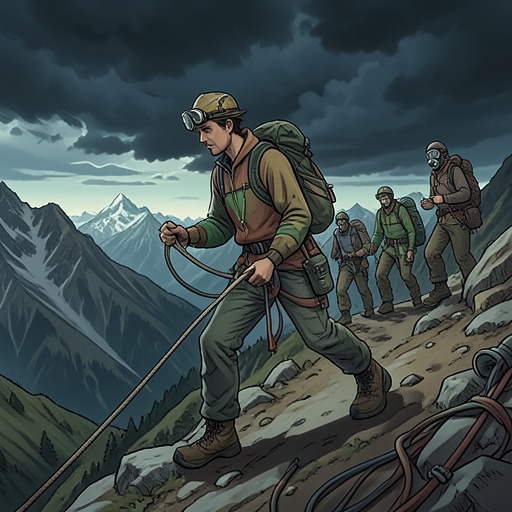
At about six in the evening, he decided to go up. By six-thirty he was putting on his crampons, although the weather at the South Col still seemed manageable. He carried three oxygen canisters, a mask, and a regulator, with an ice ax in one hand and a ski pole in the other, and headed toward the fixed ropes beginning at 8,200 meters. Within ten to fifteen minutes, the storm reached the South Col: cloud dropped over the camp, and snow driven by winds of at least forty to fifty miles per hour turned the sky from gray to white. The short distance from his tent to the route had become the threshold of a rescue in near-whiteout conditions.
Boukreev’s uncertainty was compounded by the scattered information available to him. Pemba had not told him about radio communication around 4:30 p.m. concerning whether he would carry oxygen uphill, nor had anyone told him of a possible emergency near the Hillary Step. Later, when climbers began reaching camp, reports arrived rapidly and unevenly. Boukreev understood that people were in trouble, but had to act without a clear picture of how many were stranded or where they were.
Camp Becomes a Rescue Base
As climbers returned, Boukreev asked Pemba to heat more tea and waited for the others he expected to descend. Lene Gammelgaard and Klev Schoening eventually found his headlamp while trying to locate Camp IV. Gammelgaard recalled that she and Schoening had been moving together while Neal Beidleman wandered nearby; once she saw a light, she identified it as camp and turned toward it. The light they followed was Boukreev’s, and the two reached his tent exhausted and iced over.
Boukreev helped remove Gammelgaard’s crampons and get both her and Schoening inside. Seeing the condition of the returning climbers, he gave them oxygen from the three bottles he had brought—one each to Martin Adams, Schoening, and Gammelgaard. He then tried to put his shoes back on and prepare to leave again. Gammelgaard told him that Pittman was dying and Fox might be too. The news made the need immediate, but the apparent direction of the advice around him was contradictory: Gammelgaard and Schoening told him there was no need to climb back up, while Pemba relayed that Lopsang Jangbu Sherpa had said he should go.
The conflict was not merely about which way to walk. Boukreev believed he was responsible for people’s lives, and the new reports overturned his earlier assumption that the climbers above were accompanied by guides or Sherpas and had oxygen. People were arriving frozen and unable to function; he understood that poor visibility was no longer the only problem. In his recollection, distress sharpened rather than diminished his determination. He knew he could not rescue everyone alone and made a quick round of nearby camps, including tents associated with Rob Hall’s clients and Sherpas and the Taiwanese, looking for assistance.
That search consumed time without producing support. Boukreev asked Pemba for oxygen, but was told the bottles were empty. He went among the Mountain Madness Sherpas’ tents and found the group silent and unwilling or unable to go back into the storm. He saw Lopsang using oxygen, despite having repeatedly said that he did not need it, and took the bottle from him for the rescue. The episode exposes the material limit behind the decision to help: Boukreev could not simply summon oxygen or a team, and had to take a canister from the climbing sirdar while the people who needed rescue remained outside.
Finding the Stranded Climbers
Boukreev went out again and searched by headlamp. Around two o’clock, he found the group close together: Madsen, Pittman, and Fox huddled in a circle, with Namba lying on the ground about two meters away and apparently unconscious. Beck Weathers was not there; Madsen later said that Weathers had wandered away from the group. The contrast between the huddled survivors and Namba’s position made the scene one of triage as well as rescue. Boukreev had one oxygen bottle and one thermos of tea, not enough to provide individual support to everyone.
He opened the thermos and gave tea to Fox, Pittman, and Madsen. He put the oxygen mask on Pittman’s face and tried to assess whether anyone could move with him. Fox agreed to go. Madsen and Pittman were too slow and impaired to accompany him, so Boukreev left them to share the single oxygen bottle while he took Fox. His decision separated the group according to what could be done at that moment: one person would be physically escorted, while the others would have to remain together and use the oxygen he left behind.
The return with Fox was slow and physically difficult. Boukreev held her hand as they moved across the South Col against the wind, stopping three or four times where stones gave her a place to sit. Standing her up from level snow was difficult; a small rock made it possible. Fox could say little beyond that it was too hard, and Boukreev described both of them as frozen, moving step by step. He estimated the crossing at about four hundred meters, but it took roughly forty-five minutes, longer than his own crossing, because Fox could only keep going slowly.
At about three in the morning, Boukreev brought Fox into camp. He removed her crampons and harness and helped her crawl into Beidleman’s tent. Beidleman was in better condition and had begun to recover while using oxygen. Boukreev took the mask from Beidleman’s face and put it on Fox, then asked him to help her. The rescue thus depended not only on Boukreev’s escort across the exposed col but on the oxygen available in a tent and the strength of another climber who had reached camp.
Returning for Pittman and Madsen
Boukreev went back into the storm rather than treating Fox’s arrival as the end of his effort. He checked the nearby tents and waited briefly for someone to help, but he was tired and understood that no one else could be counted on. He returned to the Sherpas’ tents, took another mask and oxygen from a Sherpa, put them in his pack, and went back out. By then dawn was approaching: he placed the time around four-ten or four-fifteen, with enough light beginning to show that the camp was becoming visible.
When he found Madsen and Pittman again, they had been using oxygen for perhaps an hour. They could speak, and Pittman was doing better than when he had left her. Boukreev asked about Namba, who was still close by, but his account emphasizes the limits of what he knew and carried: he had given the tea he had, and the single bottle had been shared among the three people in the group. He then helped Pittman in the same manner as Fox, moving her toward shelter while Madsen also needed assistance.
Boukreev recalled carrying a second bottle of tea and giving them some to drink before they started. As the light grew, he got Pittman and Madsen into a tent, helped them remove crampons, harnesses, and packs, and closed them inside. He placed a mask on Madsen, who had taken it off, and attended to both survivors. Around four-forty or four-forty-five, after bringing them in, Boukreev was exhausted and felt emptied of strength. The return was not a clean passage from danger to safety: it was repeated work with equipment, clothing, warmth, and shelter, done for people who could not manage those tasks unaided.
The Unfinished Rescue
With the clients in tents, Boukreev’s attention turned to Fischer, who had not returned. He believed Fischer was in a difficult situation, although he also thought that, as a guide, Fischer might be better able than the clients to survive. After drinking tea and reporting the situation to Pemba, Boukreev proposed sending two Sherpas uphill with oxygen to look for him. He asked Pemba to speak with Lopsang and the others and find oxygen for the attempt.
The account therefore leaves the South Col rescue suspended between an achievement and a new emergency. Boukreev had brought Fox, Pittman, and Madsen into shelter, but Namba remained unaccounted for in the immediate rescue narrative, and Fischer was still above. Boukreev slept briefly after the night’s work, but the danger had not been settled by reaching camp. The storm had turned a few bottles of oxygen, a thermos, a mask, and a headlamp into the means by which lives could be supported; at the same time, their scarcity defined the rescue’s limits. The episode’s force lies in that imbalance: one rescuer repeatedly went back into conditions that had already disabled others, yet neither his effort nor the resources he found could secure everyone on the mountain.