Boukreev’s early descent to Camp IV
The ClimbBoukreev’s early descent to Camp IV was not simply a guide leaving clients behind: according to Boukreev’s repeated account, he and Scott Fischer agreed near the Hillary Step that he should descend quickly, prepare help, and be available if delayed climbers needed it. The decision became consequential when the descent was overtaken by a blizzard and Boukreev went back out to find climbers. It later became a central dispute between Boukreev and Jon Krakauer, whose published account criticized the descent without including Fischer’s authorization as Boukreev described it.
The plan and its assumptions
The descent belonged to a broader expedition strategy in which the guides tried to manage effort and risk across a demanding summit bid. The acclimatization plan that Boukreev and Fischer developed called for four excursions. On the first, climbers would reach 6,100 meters, where Camp I would be established, but return to Base Camp the same day. Clients would carry only their personal belongings and equipment to conserve strength; Sherpas working under Lopsang Jangbu Sherpa would transport rope and supplies. The schedule relied on staged ascents, rest, and observation of the climbers’ condition rather than a single uninterrupted push.
A separate practical pressure arose when several expeditions agreed to cooperate in fixing the ropes between Camps III and IV on April 26. Mountain Madness planned to send Sherpas rather than guides, but if its Sherpas first established Camp III and then rested, it would have no Sherpas available for the shared work. The team also risked losing its place among the first expeditions to make a summit attempt, with May 10 circulating as a proposed date. Boukreev was therefore assigned to contribute in the Sherpas’ stead. These arrangements show the expedition balancing preparation, scarce labor, recovery, and its place in the summit schedule; they form the operational context for a later plan that depended on a guide being able to move quickly and independently.
Before the expedition, Fischer and Boukreev agreed that Boukreev would guide without supplemental oxygen if he was properly conditioned and acclimatized. Fischer planned three oxygen canisters—eighteen hours’ supply—for each client, with the party leaving Camp IV at midnight on May 10 and expected to return by 6:00 p.m., before nightfall and the depletion of oxygen. Fischer had hired Boukreev for his ability to conduct rescues, bringing oxygen, hot drinks, and physical assistance to clients descending late. In this arrangement, Boukreev’s early return to Camp IV was part of a contingency: if the clients were not back by the expected time, Fischer could call on him to help.
A summit-day decision
Boukreev’s account places the decision just below the summit and above the Hillary Step. He said he had remained on the summit from 1:07 to about 2:30 p.m., waiting for other climbers, but only Klev Schoening and Martin Adams, both Mountain Madness clients, reached the top during that interval. Without a radio link to climbers below, and concerned that the others were not arriving, he decided to descend. On the way down he encountered Rob Hall, who appeared to be in good shape, then passed four Mountain Madness clients and four Sherpas, all still ascending and appearing all right.
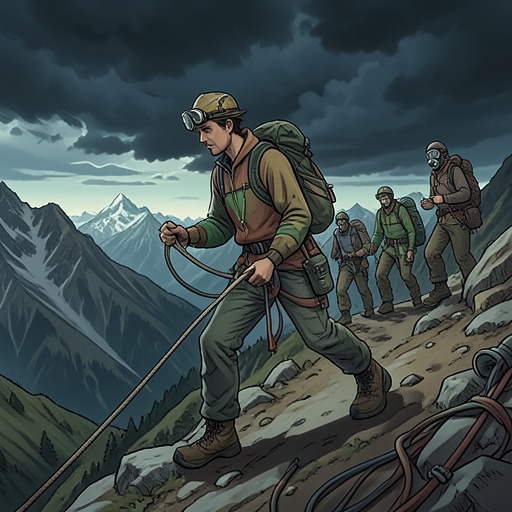
Above the Hillary Step, Boukreev met Fischer. Fischer was tired and laboring, but told him he was merely slow. Boukreev said there was no clear sign of difficulty, though in retrospect he suspected Fischer’s oxygen might already have run out. Boukreev explained that the ascent was proceeding slowly and that descending climbers might exhaust their oxygen before reaching Camp IV. He wanted to get down quickly, warm himself, and assemble hot drinks and oxygen so he could return if assistance was needed. Fischer agreed. Hall had also accepted the plan immediately before; Boukreev understood that Fischer, Hall, Beidleman, and four Sherpas would remain behind to bring the clients down. At that point, he said, there were no clear signs that the weather would deteriorate as rapidly as it did.
The descent thus rested on a division of roles: Boukreev would reach camp first and prepare support, while the leaders and Sherpas behind him would bring the clients down. The plan’s logic depended on the expectation that the people still ascending were in manageable condition and that the weather would not change abruptly. The storm transformed the precaution into a more urgent task. Boukreev estimated that he reached Camp IV shortly after 5:00 p.m., slowed by the approaching storm; after gathering supplies and oxygen, he began a solo effort around 6:00 p.m. to find stragglers. He later described locating lost climbers huddled together, resupplying them with oxygen, offering warming tea, and giving them the physical support needed to reach camp.
Disputed accounts of authorization
Krakauer’s September 1996 article in Outside framed the descent differently. He wrote that Boukreev returned to Camp IV at 4:30 p.m., before the worst of the storm, having hurried down without waiting for clients, and called this extremely questionable behavior for a guide. Krakauer proposed that climbing without bottled oxygen and wearing relatively light clothing plausibly explained why Boukreev needed to descend quickly. The criticism made the descent appear to be an individual choice that left clients without their guide, rather than a contingency agreed with Fischer.
Boukreev’s explanation, as reported by G. Weston DeWalt, was consistent across repeated interviews in early June 1996: above the Hillary Step, Fischer agreed that Boukreev should descend quickly to Camp IV and stand by to assist clients if they returned late and needed help. DeWalt said he asked Boukreev on at least three occasions to reconstruct the sequence, and received the same account. Boukreev’s own later explanation also stressed that Fischer had authorized the descent and that the clients’ oxygen supply—not Boukreev’s lack of supplemental oxygen—was the immediate concern. The divergence was therefore not only about the physical act of descending, but about whether the descent should be read as abandonment or as preparation for a possible rescue.
The wording used in recounting Fischer’s assent became part of the disagreement. DeWalt recalled Boukreev explaining, “Fischer says, ‘Okay, go down.’ ” DeWalt interpreted this as both agreement and an instruction. He also considered whether Boukreev’s imperfect English could account for differences in how he described the exchange, especially where saying Fischer had approved the descent and saying Fischer had told him to go down might not have carried a meaningful distinction for Boukreev. Krakauer acknowledged to DeWalt that the language problem placed Boukreev at a disadvantage, but the interview transcripts Krakauer said he possessed were not shared with DeWalt or with Boukreev, who was then alive and willing to respond.
Rescue readiness and the limits of communication
The contingency depended on Boukreev reaching camp with enough time and equipment to act. He described returning shortly after 5:00 p.m. despite the advancing storm, collecting supplies and oxygen, and setting out alone roughly an hour later. His account links the earlier decision directly to this capacity to respond: the descent allowed him to prepare on the ground before attempting to locate climbers who had become lost in the blizzard. The practical elements were specific—oxygen for climbers whose supply might be exhausted, hot tea, warmth, and physical assistance—rather than an abstract promise of rescue.
Communications during the emergency were unreliable. Dr. Ingrid Hunt said messages between Base Camp and the mountain passed through a chain of Sherpas: she gave information to Ngima at Base Camp, who relayed it in Nepali to Gyalzen at Camp II and then to Pemba at Camp IV; messages coming down followed the reverse route. Hunt felt she was not receiving complete or accurate information, and believed reports were sometimes amplified to present events in a better light. Communication with Pemba was also sporadic. Because Rob Hall’s camp had better communications, Hunt moved between that camp and Mountain Madness’s, repeatedly asking Ngima for news. This fragmented relay helps explain why the availability of radios and the flow of information mattered to a rescue plan that assumed someone at camp could be alerted and equipped.
The accounts of the descent therefore sit within a larger failure of coordination: the plan relied on clear communication, clients returning before their oxygen ran out, and the storm holding off long enough for the group to descend. The evidence presents those assumptions as increasingly fragile, not as guarantees. The descent itself produced the means for Boukreev to go back up, but it could not ensure that every delayed climber would be found or brought to safety.
The descent’s disputed meaning
Boukreev defended climbing without supplemental oxygen as a considered practice grounded in acclimatization and experience. He said that, for him, climbing without oxygen after proper acclimatization avoided the sudden loss of acclimatization that could occur when an oxygen supply ran out. He also stated that Fischer was comfortable with the choice and had authorized it. That defense did not erase the danger facing clients whose own oxygen supply was finite; rather, it clarified why Boukreev and Fischer had assigned different roles to guide and clients, and why a rapid descent to assemble rescue supplies had been built into their plan.
The controversy turns on the gap between action and interpretation. Seen without the reported agreement above the Hillary Step, a guide descending ahead of clients could look like a breach of responsibility. Seen through Boukreev’s and DeWalt’s account, the same movement was a planned return to Camp IV, accepted by Fischer, to prepare for precisely the delay that made help necessary. The storm made the distinction consequential: descending first was both the subject of later criticism and the condition that allowed Boukreev to set out again with oxygen, tea, and other assistance for climbers stranded in the darkening mountain environment.