Camp II
The ClimbCamp II serves as a staging point between Base Camp and the higher camps, joining the practical work of acclimatization to the expedition’s fragile systems of equipment and communication. From its tents, climbers moved upward toward Camp III, rested when weather held them back, and relayed news about health and emergencies—but the camp’s role as a communications link did not ensure that information reached the right people clearly or in time.
Position on the Route and Acclimatization
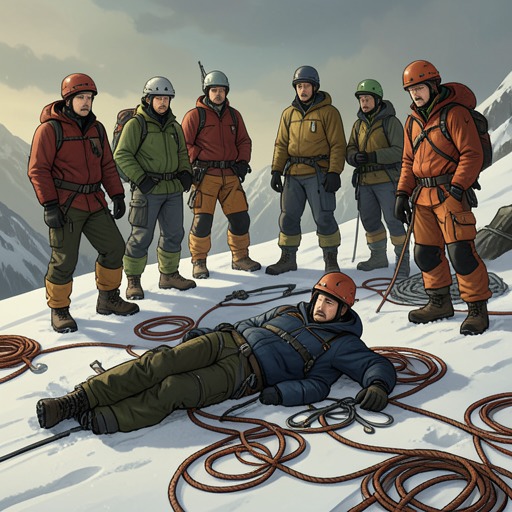
The camp lay below Camp III on the route toward the summit. After working on fixed ropes above Camp III, Anatoli Boukreev descended there expecting to see activity around the tents or Mountain Madness clients advancing toward camp; instead, no one was in sight. The clients had spent much of the day resting in their tents because bad weather had pinned them down. The contrast captures Camp II’s dual function: it was a waypoint in a planned progression to higher elevations, but also a place where weather could interrupt that progression and force climbers to wait.
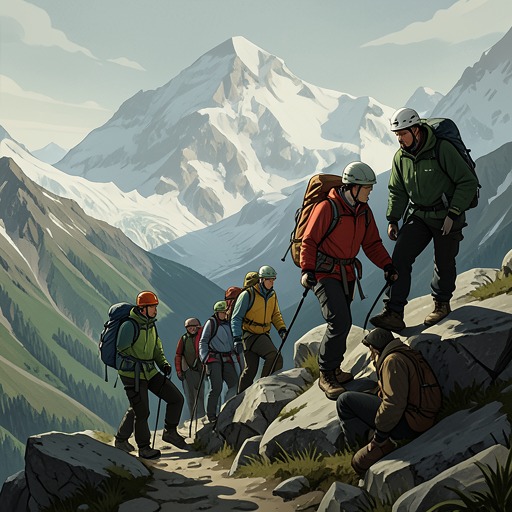
That progression was part of the expedition’s acclimatization plan. Team members first remained at Base Camp while their bodies adjusted, then made excursions to successively higher camps before retreating to elevations to which they had become accustomed. Camp II was one step in this staged ascent, not simply a destination: climbers’ movement through it was bound to the larger effort to prepare for a summit bid while managing the risks of altitude.
Arrivals, Rest, and Decisions to Descend
Five of Scott Fischer’s eight clients—Lene Gammelgaard, Klev Schoening, Martin Adams, Sandy Hill Pittman, and Dale Kruse—reached Camp III from Camp II while Boukreev was away working on the route. Their arrival initially reassured him; they appeared strong after the climb. But his own memory of a difficult first night at altitude made him wary of treating apparent strength as proof that they would remain well.
The next morning, reports by radio said that Scott Fischer and Neal Beidleman had advanced to Camp II and planned to climb to Camp III for acclimatization. Boukreev, meanwhile, was concerned about Kruse, whose withdrawn and apathetic manner suggested to him that altitude was affecting the climber more seriously than it was affecting the others. Boukreev encouraged the group to follow Martin Adams down. On the descent, he closely controlled Kruse’s movements, particularly through the Icefall, to reduce the risk that he would make a dangerous mistake. Camp II thus belonged to a route of ascent, but the decisions made around it also included retreat when a climber’s condition called for a lower altitude.
Communications and Expedition Logistics
The radios carried by Fischer’s expedition were an early source of concern. Martin Adams criticized the old ten-channel models as antiquated and inadequate beside lightweight radios that, in his view, every climber should have carried. Radios were supposed to connect Base Camp with climbers moving toward the summit, carrying information about weather, medical problems, equipment needs, and emergencies. Their limitations mattered particularly across a route divided among camps, where a message from one point might have to pass through several people before reaching its destination.
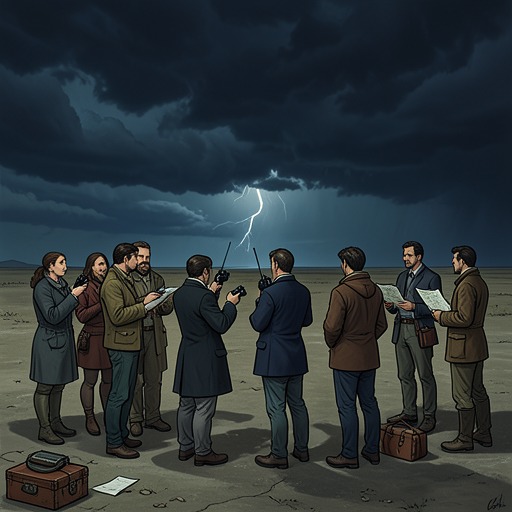
That vulnerability became evident during the emergency above Camp IV. Dr. Ingrid Hunt described a relay in which she passed a message to the Base Camp sirdar, who translated it into Nepali for the person at Camp II, who then relayed it to Camp IV; messages coming down followed the chain in reverse. Hunt believed that information from Base Camp was being altered to make circumstances sound better, while contact with Camp IV was sporadic. Camp II was therefore not merely a place to sleep or acclimatize: it formed a link in a communications chain whose indirect, unreliable operation could leave people at different camps with different understandings of a developing crisis.
Supplies, Route Work, and the Summit Push
The expedition’s limited oxygen supplies were organized around the climb from Camp IV. Of the oxygen purchased from Henry Todd, 51 percent by volume was on hand for the summit bid. The nine heavier Zvesda canisters were reserved for sleeping before the attempt; fifty-three lighter Poisk canisters were allocated to the May 10 climb. Six climbing Sherpas took twenty-one bottles between them, while the clients and guides carried seventeen. Together they carried thirty-eight Poisk canisters, leaving fifteen full ones at Camp IV, plus what remained of the Zvesda supply. There was no margin for an overnight delay and a second attempt on May 11: the available oxygen made the plan a one-day push.
The route above Camp II also depended on fixed ropes and coordination between expeditions. Members of the Fischer and Rob Hall teams expected the climbing sirdars to leave Camp IV ahead of the clients and prepare the ropes so that climbers would not have to wait. Instead, neither Lopsang Jangbu Sherpa nor Ang Dorje Sherpa nor another Sherpa had left early to fix them. The accounts of why differ: Lopsang later said he had been told by a member of a Montenegrin team that the ropes were already fixed, while Jon Krakauer questioned that explanation and noted that both sirdars carried rope. The disagreement underscores how expectations about work on the upper route could diverge even as the climbers moved through a shared sequence of camps.
Narrative Significance
Camp II links the expedition’s abstract plans to the changing realities of the mountain. It is a stage in gradual acclimatization, a refuge when weather prevents progress, a point from which climbers may be urged either higher or down, and an intermediate station in an imperfect communications network. The book’s photographs also orient the reader to this geography: one caption identifies an oxygen cache near the South Summit, while another marks the Camp IV site and the locations where climbers were found during the storm. Against that upper-route map, Camp II’s importance lies in the systems it helps connect—and in how readily those systems can fail to keep teams, supplies, and information aligned.