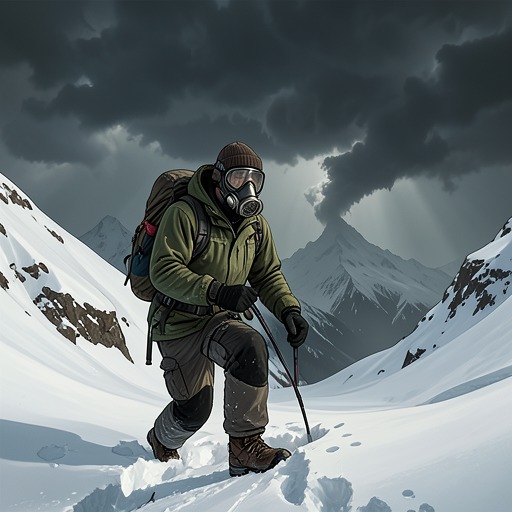
Camp V tent
The ClimbThe Camp V tent was planned as an emergency shelter for the Indonesian-led expedition’s summit descent, but it was not established as intended. When the team reached it late in the day, the tent was missing two pole sections and offered only a limited refuge at 8,500 meters. That night, it held six climbers while their leaders rationed oxygen and kept water going; by morning, the team could begin its descent. Its story is therefore one of both organizational weakness and improvised cooperation: a compromised piece of equipment became the shelter around which survival depended.
Purpose and preparation
The expedition’s plan treated Camp V as a crucial safety provision, not merely a convenient stopping place. During a week’s rest at Deboche, Anatoli Boukreev asked the military liaison officer, Captain Rochadi, to arrange for the camp to be supplied with two tents, ten oxygen bottles, sleeping bags, and mats. The equipment was to be put in place during the team’s absence, in coordination with Apa Sherpa and the expedition Sherpas.
That preparation was compromised by the condition and organization of the Sherpa team. Only eight of its sixteen members were fit to work, and Boukreev considered the team’s limited strength a continuing threat to both the assault plan and its backup safety arrangements. He did not assign blame to one person, noting that a capable, cohesive Sherpa team takes years of repeated ascents and dependable financial support to develop. In this context, the missing and incomplete camp supplies were not an isolated inconvenience: they exposed how much the safety plan depended on a support structure with insufficient capacity.
The camp that was—and was not—ready
Before the summit attempt, Boukreev knew Camp V had not been established. Apa assured him it would be supplied as the team ascended. The plan also included emergency support from the Russian Lhotse team, radio-carrying climbers on the ascent, and Sherpas at South Col with a radio. Camp V, positioned at 8,500 meters, was meant to address the team’s expected slow progress by providing a higher place of refuge and support.
The Indonesian summit team reached the site at about 7:30 p.m., after a slow descent. The shelter waiting there was a tent with two sections of its poles missing, which Boukreev described as functioning like a large bivouac sack. Its contents were modest: a stove, pots, gas, a Karrimat, and two full oxygen bottles. The gap between the planned two tents with ten bottles and the single compromised shelter with two bottles made the Camp V tent a concrete measure of the expedition’s logistical shortfall.
A shared refuge through the night
Six climbers crowded into the tent as the temperature fell. The absence of wind made the shelter more tenable, but it did not remove the danger of their exhaustion or the scarcity of oxygen. Apa wanted to descend with Dawa Sherpa; Boukreev allowed him to go, with the expectation that they would maintain radio contact in the morning.
Inside, the remaining climbers made limited supplies work through cooperation. Evgeny Vinogradski began preparing hot water and continued through the night. Boukreev and Vladimir Bashkirov took turns changing the oxygen mask among the three exhausted Indonesian summiters, stretching the two bottles across the group. The account presents the tent less as a dependable piece of infrastructure than as a small working space: people took turns, shared the oxygen, and persisted together until daylight.
Morning and the meaning of the shelter
By morning, the team emerged into calm conditions and began its descent cautiously. They had used all their oxygen, but Boukreev reports that the Indonesians were moving, and that none had frostbite. The night’s reprieve was not a complete triumph so long as the climbers remained above the lower camps; the account measures its success by whether everyone could continue down to Base Camp.
The Camp V tent thus marks a sharp contrast between planned safety and actual provision. The summit team had expected a prepared emergency camp, but reached a damaged shelter with only two oxygen bottles. Its inadequacy reflects the expedition’s broader difficulties in organizing support, while its use reveals a different kind of reliability: the practical care of people working in turns under constrained conditions. The shelter did not eliminate risk; it gave the team a place to endure the night and make a descent possible.