Charlotte Fox
The ClimbCharlotte Fox, a highly experienced Colorado climber and Mountain Madness client, entered the 1996 Everest expedition as a trusted, self-sufficient team member. On the summit push, she reached the top with Tim Madsen, but the descent left her unable to walk without support; after becoming separated from the larger group in the storm, she was carried and guided toward camp by fellow climbers, and Anatoli Boukreev ultimately brought her to safety. Her trajectory—from capable climber to a person dependent on others for each step—embodies the expedition’s abrupt reversal from ambition to survival.
Identity and preparation
At thirty-eight, Fox lived in Aspen and was a friend of Neal Beidleman. She joined Mountain Madness as a climber Fischer regarded as a genuine asset: experienced, unassuming, secure, able to work with a team, and accustomed to looking after herself in the mountains. She had already summited two 8,000-meter peaks and climbed all fifty-four of Colorado’s 14,000-foot peaks. Her record made her one of the expedition’s more qualified clients, not an inexperienced visitor relying on a guide to manage every difficulty.
Fox signed on with her friend Tim Madsen, a fellow ski patroller at Snowmass Ski Area. Madsen had good experience on lower peaks and was in excellent physical condition, but he lacked Fox’s high-altitude experience. The two recognized that Everest demanded more preparation and trained extensively in the Canadian Rockies before the expedition. That preparation is an important counterpoint to what followed: Fox’s crisis on the descent did not erase her competence or prove that she had entered the mountain casually. Instead, the account shows how conditions at extreme altitude could overwhelm even a capable climber.
From the Icefall to the summit bid
Fox’s experience crossing the Khumbu Icefall illustrates both her composure and the physical hazards facing the clients. The ladders lashed across crevasses could sway above deep openings, and climbers had to negotiate them in crampons without losing their balance or their attachment to the route. Martin Adams remembered that Fox and Sandy Hill Pittman were among the best-balanced climbers on the ladders and did not appear intimidated. Fox sometimes crossed by scooting across on her seat, a method she found less frightening than balancing on crampons while looking down into an ice crevasse. She was due to turn thirty-nine on May 10 and was keen to reach that birthday.
As the teams acclimatized, Fox’s progress was watched alongside the other clients’. Scott Fischer believed that her successful experience on two previous 8,000-meter expeditions, together with Madsen’s athletic ability, might serve them well. The guides nevertheless knew that fitness and experience could not guarantee a safe response to altitude. When Fox and the other climbers reached Camp III, Boukreev encouraged clients to descend rather than spend another night high; he considered rest and recovery more important than gaining additional altitude. The expedition’s assessments of Fox remained hopeful, but the mountain’s effects were not predictable from her résumé alone.
On summit night, Fischer asked whether anyone was ready to leave with Lopsang Jangbu Sherpa, who was prepared to start. Pittman volunteered and set off on a short towline behind him. Fox left Camp IV soon afterward, at Beidleman’s urging, beginning her thirty-ninth birthday on the climb. She was among the Mountain Madness clients who reached the summit: Tim Madsen later placed their arrival at approximately 2:20 or 2:25 p.m., within minutes of one another. The ascent was a substantial achievement, but it did not mark the end of the danger. Their hardest struggle came as the storm and exhaustion overtook climbers on the way down.
The descent and loss of mobility
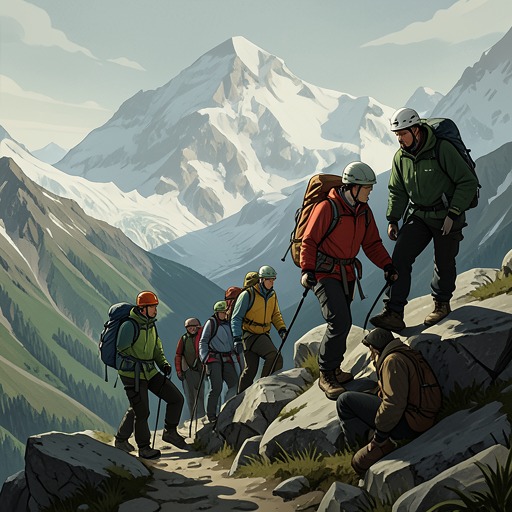
On the descent from the Hillary Step, Beidleman saw Pittman having trouble identifying which of the tangled, wind-tattered ropes to clip into and negotiating the steps. He assisted her down; behind him were Fox, Madsen, and Lene Gammelgaard. At the South Summit, the group encountered Klev Schoening, who had stopped to test discarded oxygen canisters for any remaining supply. By then, the climbers’ needs were changing rapidly: reaching the summit had become secondary to getting exhausted people down through the storm.
In the later debriefing, Schoening recalled that Fox and Yasuko Namba could stand, but could not walk unsupported. He first tried to help Fox while others supported Namba, but he was repeatedly on his knees trying to get the women back up and realized he could not manage both. He had to leave Namba, and Madsen then took Fox. The scene turns Fox’s earlier independence into a stark physical limit: she was still able to stand, but not to move safely on her own.
Beidleman also described Fox’s declining condition during the descent. At the Hillary Step, he was more concerned about Pittman, but later saw Fox standing over Pittman with a broad grin and a needle in her hand. Fox had just given Pittman a dexamethasone injection, while Pittman appeared profoundly out of it. Beidleman then tried to motivate Pittman to descend, using the fixed ropes and, if necessary, a controlled slide on her seat. He also arranged for Pittman to exchange her low-pressure oxygen bottle for a fresh one from Gammelgaard, who was moving faster. Fox’s brief act of assisting another climber occurred within a descent in which she herself would soon need intensive help.
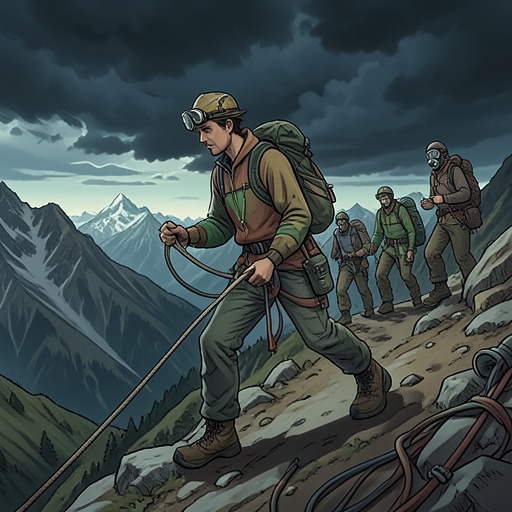
As the storm scattered the climbers, Fox, Madsen, Pittman, Namba, and Beck Weathers became part of a group that could not simply walk back to camp. Madsen later recalled that he had Fox on his arm, back, or head but could neither see where to go nor summon the strength to carry her all the way. Fox refused or was unable to walk. The group sat down, and when Madsen heard Namba moan nearby, he went back to bring her to the others. With five people together, they tried to stay awake and keep warm while hoping someone would return for them. Fox’s condition was thus part of a shared emergency, not an isolated failure of will: the group had lost its route in the dark and storm, and several members were too weak to make their own way to camp.
Rescue and aftermath
Boukreev eventually found the stranded group after one or more attempts to locate them. According to Madsen’s recollection, he first carried Fox back to Camp IV, then made a second trip with tea and another oxygen bottle, returning for Pittman; Madsen followed and believed he was the last member of the group to reach camp. The accounts also preserve the bodily detail of Fox’s arrival. Boukreev said she could manage only a few words, including that it was too hard; she moved like a robot, and crossing the South Col took her roughly forty-five minutes. Around three in the morning, he got her out of her crampons and harness. She crawled into Beidleman’s tent, where he placed an oxygen mask over her face and asked Beidleman to help her. He then went to the Sherpas’ tents to ask for assistance with Namba, who was also in grave danger.
Fox survived the storm, and the expedition’s clients began descending from Base Camp on May 16. On May 22, the final clients left Kathmandu. Fox was walking with a slight limp; this was among the most serious lasting cases reported in the group. Madsen and Gammelgaard had frostbitten fingers, and Boukreev had frostbite on his hand, nose, and lips, but none of the clients suffered injuries requiring amputation. In the account’s reckoning, the group had come away lucky: all retained their fingers and toes, and their lives.
Narrative significance
Fox’s story is told through several kinds of evidence rather than a single continuous personal account: descriptions of her mountaineering record, other climbers’ memories of her on the route, the May 15 debriefing, and Boukreev’s account of bringing her into camp. This layered testimony makes her changing condition especially visible. On the ladders she is balanced and unafraid; at the Hillary Step she can still give Pittman an injection; in the storm she can stand but cannot walk unsupported; by the time she reaches the tent, she can barely speak and must crawl inside.
The contrast is not simply between strength and weakness. Fox’s experience and preparation establish her as a capable participant, while the events expose the limits of individual ability under extreme altitude, cold, exhaustion, and disorientation. Her survival depended on a chain of assistance—Madsen’s efforts to support her, the group’s attempt to shelter together, and Boukreev’s return to carry her to camp. The account does not present the rescue as a solitary triumph detached from the others’ suffering: Fox’s arrival is followed by Boukreev’s renewed search for help for Namba, who would not survive. Her passage from summit success to rescue therefore registers both the uncertainty of survival and the collective labor required to bring climbers down.