Climber self-reliance
The ClimbClimber self-reliance is the capacity of an alpinist to judge personal limits, respond to danger, and take appropriate action without continuous direction from a guide. In the account of Mountain Madness’s Everest expedition, it is not a rejection of guiding but a condition of safety: at high altitude, guides cannot hold every client’s hand, and no expedition plan can make another person’s body or judgment fully legible to them. The principle becomes a practical test of both the clients’ preparedness and the expedition’s competing expectations of its guides.
A different model of guiding
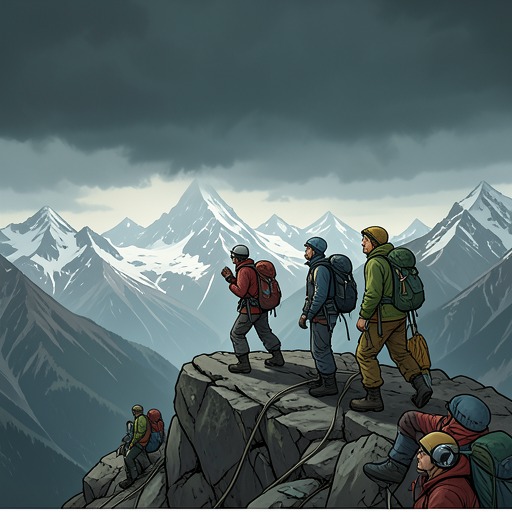
Anatoli Boukreev explains the principle to Scott Fischer while discussing the risks shared by Everest and K2. High-altitude climbing, he argues, requires qualified guides who know the mountain, careful screening of clients, and climbers able to shoulder the responsibilities of the environment. It cannot be guided in quite the same sense as a lower, more manageable mountain: the guide cannot supervise every situation or replace the climber’s judgment. The distinction is not between help and abandonment, but between assistance that supports capable action and a promise of protection no guide can reliably fulfill.
The disagreement also reflects different training traditions. Boukreev had learned in the Russian High-Altitude Mountaineering School, where collective effort and teamwork took precedence over personal ambition, and where climbers developed over time, progressing from lower mountains to 8,000-meter peaks when ready. Commercial guiding reversed that sequence in his view: instead of preparing climbers for the mountain, he had been hired to prepare the mountain for the clients. Self-reliance therefore names more than an individual virtue. It marks a structural tension in the expedition, whose commercial purpose is to serve clients even as its terrain demands that they become active participants in their own safety.
The Icefall as a test
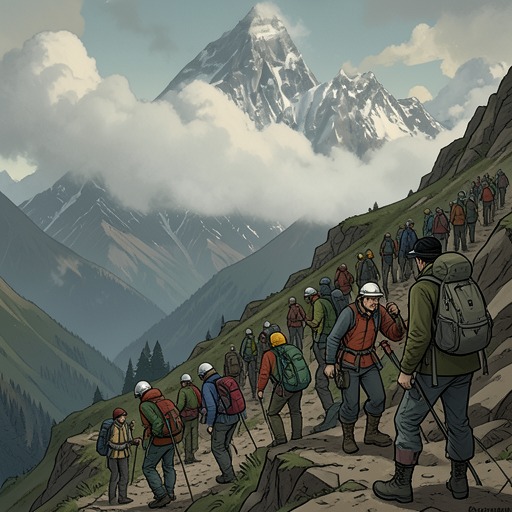
Fischer set a concrete qualification for climbing higher: clients had to cross the Khumbu Icefall from bottom to top in less than four hours. Every climber met the time requirement, and Boukreev was generally pleased with the result. Yet the successful crossing exposed a concern that the stopwatch alone could not measure. Several clients, he thought, lacked the self-reliance to move through the route without almost constant attention from a guide. Passing the test did not necessarily mean they could manage the next crisis without someone watching over them.
The Icefall’s physical hazards gave that concern its force. Climbers crossed crevasses on ladders lashed together over deep openings; a missed step or a failure to clip in properly could turn a crossing into a fall. The route itself shifted and groaned, with the possibility that a crevasse might open beneath a ladder or an ice formation collapse onto the passage. In such terrain, a guide’s presence cannot eliminate the need for each climber to stay attentive and act competently. Boukreev’s question after the team’s successful passage was what would happen when no guide was there to hold a client’s hand.
That question fed into his broader assessment of the expedition. The guides, clients, and Sherpas all formed part of what he called the Mountain Madness equation; a safe return depended on health, adequate acclimatization, good decisions, coordinated effort, and favorable weather. But the calculation also depended on whether clients could look after themselves when guides were not looking over their shoulders. Their appearance of fitness and fighting spirit could offer reassurance, yet it could not settle whether they would respond appropriately in a critical situation.
Knowing one’s limits
The expedition’s acclimatization discussions made self-reliance a matter of bodily judgment as well as technical competence. Guides could monitor clients, but only each climber could know the interior truth of their own condition. At altitude, familiar sensations and reactions could become unreliable; early symptoms of high-altitude cerebral edema or high-altitude pulmonary edema might be mistaken for ordinary acclimatization discomfort. A misunderstanding could be fatal, so clients were urged to communicate clearly with the guides and to monitor their condition rather than assuming that someone else could identify every warning sign for them.
Boukreev connected that vigilance to conserving a reserve. Climbers were warned not to exhaust themselves completely and to take seriously the moment when they could no longer continue. His instruction was direct: stop, turn around, and save your life. Self-reliance here is not simply the ability to press on alone; it includes recognizing incapacity and making the decision to retreat. The difference between independence and recklessness rests on whether a climber can read a limit as a reason to stop, rather than as an obstacle to be overcome at any cost.
Competing expectations of the guides
On an excursion to Camp II, Boukreev’s understanding of his professional role collided with Fischer’s. Fischer told him that he had done his work poorly because he had not helped clients set up their tents. Boukreev explained that he had arrived before them, worked with Sherpas on the mess tent, and rested; he believed the clients appeared not to need help and that work on the route would benefit their acclimatization. Fischer saw the omission differently. The episode made clear to Boukreev that client comfort and personal attention might matter as much as, or more than, the safety-focused work he had understood as his main responsibility.
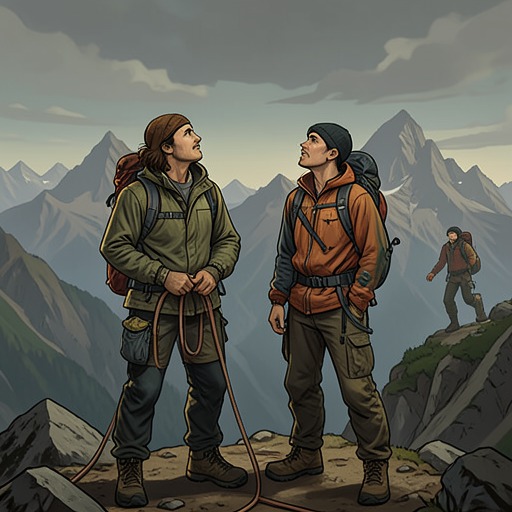
Boukreev discussed the conflict with Neal Beidleman. Beidleman observed that many members were at high altitude for the first time and wanted guides to hold their hands through basic tasks. Boukreev considered that expectation unreasonable and insisted that encouraging self-reliance and preparing the route were both essential guide contributions. Beidleman, by contrast, thought there were enough Sherpas to handle route preparation. Boukreev feared that the expedition was falling behind in establishing its high-altitude camps and that its acclimatization routine could be compromised. Their difference was not merely about bedside manner: it concerned how the guides should allocate time between looking after clients directly and building the conditions that would make the ascent safer.
The question was also visible in the expedition’s practice on the Icefall. Fischer and Boukreev agreed that clients could sometimes proceed without a guide immediately beside them, with the guides following at a distance. Other guides and climbers noticed and disapproved, but the two leaders shared the view that independent action was important. Boukreev objected to tightly regimented expeditions in which clients moved like tin soldiers. Drawing on his experience as a trainer and coach in cross-country skiing and mountaineering, he believed that climbers should be encouraged to act independently, not merely to follow instructions while under constant observation.
The limits and significance of the principle
Self-reliance does not erase the guide’s responsibility. The expedition’s plan depends on guides who assess readiness, monitor clients, prepare routes, and recognize dangers; it also depends on clients communicating honestly and acting on their own perceptions. Boukreev’s concern is that these responsibilities cannot be collapsed into a guarantee of constant personal supervision. A client who expects the guide to control every situation may be least prepared for precisely the moments when the guide cannot be present.
The principle thus exposes a contradiction at the heart of commercial high-altitude climbing. Clients hire professionals to supply expertise and increase their chances of success, but the mountain makes total dependence on those professionals impossible. For Boukreev, the answer is not to withdraw teamwork, but to build clients’ capacity to participate in it: to understand their condition, conserve strength, communicate, and turn back when necessary. The Icefall qualification showed that clients could meet a visible standard; their reliance on continual monitoring showed why speed alone could not prove readiness. Self-reliance is the less measurable requirement beneath the timed one—and, in Boukreev’s account, part of what makes a safe return possible.