Dale Kruse’s descent from Camp III
The ClimbDale Kruse’s descent from Camp III was a high-altitude evacuation, not simply a planned move between camps: as Kruse’s condition worsened, Anatoli Boukreev feared that he could fall and that Boukreev might be unable to get him safely down alone. Scott Fischer joined the descent, and the two men roped Kruse between them. At lower altitude Kruse’s coordination returned; the episode nevertheless foreshadowed a recurring concern, as he again appeared unwell during a later descent through the Icefall and Fischer escorted him to Base Camp.
Warning signs at Camp III
On the morning of April 28, Boukreev was keeping a close eye on Kruse, whose manner stood apart from the other clients. He seemed apathetic, withdrawn, and distant. Boukreev judged that he was in trouble and urged the climbers to follow Martin Adams’s example and descend after spending a night at Camp III. The concern was not merely that Kruse felt poorly: as Boukreev discussed the climbers’ plans, he saw Kruse’s situation deteriorating and began pressing him to prepare to go down. Other clients, increasingly worried by Kruse’s decline, joined the effort.
Kruse eventually agreed and started packing and dressing. Watching him move turned Boukreev’s concern into alarm: Kruse was wobbly and had trouble standing, and was not fully controlling his movements. He was also much larger than Boukreev. At that altitude, a fall could leave Boukreev unable to lift him and bring him safely to Camp II. The decision to descend had therefore become an immediate safety measure, with the practical difficulty of moving a severely unsteady climber shaping the rescue from its outset.
Roped descent with Fischer
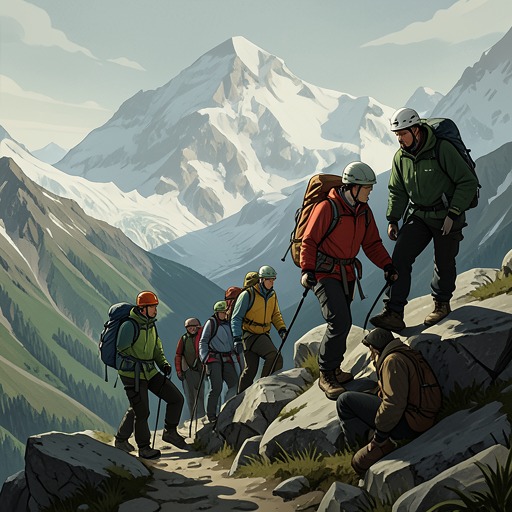
Boukreev had difficulty getting Kruse onto the fixed ropes. He later described uncertainty about whether the problem came from Kruse’s condition or from difficulty making himself understood; either way, explaining how to clip on and descend with him took considerable effort. Just as the descent began, Fischer and Neal Beidleman came into view. Fischer saw Kruse’s condition and immediately assisted. The plan was for Fischer and Boukreev to take Kruse down while Beidleman remained at Camp III to spend the night required for acclimatization.
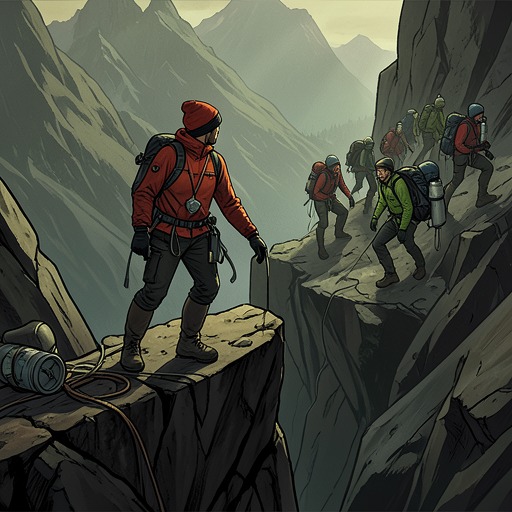
The arrangement placed Kruse between the two guides: Fischer secured a rope to Kruse’s climbing harness and led, while Boukreev was attached behind them. Lene Gammelgaard followed the three men. Sandy Hill Pittman, despite Boukreev’s encouragement and advice, chose to remain at Camp III. This rope system converted a descent Kruse could not reliably manage by himself into a controlled group movement, but it also required the guides to remain responsible for his balance and progress along the route.
At approximately 6,900 meters, Kruse began to rouse and regain control of his movements. The change was gradual enough to be noticeable during the descent, rather than assumed in advance. By about 5:00 p.m., the party had reached the foot of the Lhotse slopes and entered the Western Cwm, the route onward to Camp II. Kruse then seemed back to normal, and the three men removed their connecting ropes so they could travel independently. The descent thus moved from a situation in which a fall seemed capable of becoming a disaster to one in which Kruse could continue without being tethered between the guides.
At Camp II and the descent to Base Camp
Once Kruse was moving ahead of them across the glacier, Fischer and Boukreev talked as they continued down. Their conversation ranged beyond the immediate evacuation: Fischer described problems he had been managing at Base Camp, including the serious condition of Ngawang Topche Sherpa, the costs of arranging his rescue, oxygen supplies that were running low, and the failure to prepare Camp IV and carry oxygen there. Boukreev raised concerns about the strength and leadership of the Mountain Madness Sherpa team. Their agreement to assess the team after the expedition placed Kruse’s rescue within the wider strain on the expedition, where staffing, supplies, and a sick Sherpa were also demanding Fischer’s attention.
On April 29, Fischer and Pete Schoening began climbing toward Camp III, while Boukreev continued down to Base Camp with Kruse and Gammelgaard. Kruse had improved since the previous day, but Boukreev kept securing and controlling his movements for much of the route. He remained concerned that Kruse might make a mistake, particularly in the Khumbu Icefall, and wanted to prevent another problem on the descent. The escort therefore continued after the apparent recovery in the Western Cwm: seeming normal at a lower altitude did not immediately remove the danger of an error on exposed, difficult terrain. Reaching Base Camp brought relief, while six continuous nights above it and his work on the fixed ropes left Boukreev in need of rest.
A recurring concern on the mountain
The later account of Kruse’s descent from Camp I shows that his earlier trouble was not an isolated moment of concern. On another ascent, Adams found Kruse resting inside a tent at Camp I, although stopping there was not the plan. Kruse said that he felt bad and might spend the night before catching up the next day. Adams alerted Tim Madsen and Charlotte Fox, who also thought Kruse seemed out of it; after hearing their assessment, Fischer and Beidleman went down to tell Kruse that he had to descend. With no radio supplied to Boukreev and no way to coordinate with him on the route, Fischer headed down himself.
Boukreev met Fischer and Kruse as he emerged from the Icefall onto the Western Cwm. He offered to take Kruse down, but Fischer preferred to do it himself, and he safely returned to Base Camp with Kruse. Pete Schoening later recalled Fischer joking, having a beer, and wanting Kruse to have one too; Dr. Hunt saw nothing that suggested Fischer was ill. In the larger pattern, the Camp III evacuation stands out for its explicit tethering and visible loss of coordination, while the later incident repeats the basic warning-and-descent decision under different conditions. Together, the episodes show how the guides’ assessment of Kruse’s condition repeatedly turned acclimatization travel into a matter of immediate safety.