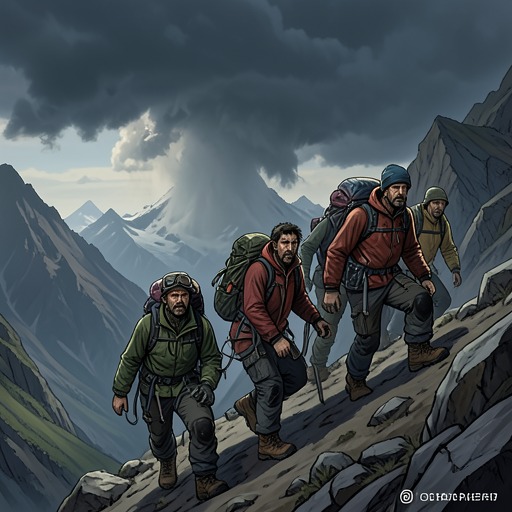
Day of the Mount Everest Summit Storm in 1996
The ClimbThe 1996 Everest summit-day storm transformed a difficult summit attempt into a cascading emergency: climbers became separated, lost their bearings, and struggled to reach Camp IV as wind, snow, darkness, and oxygen depletion converged. The storm’s danger was not only its force. It exposed how dependent the expedition’s plans were on timely rope-fixing, clear communication, and climbers arriving back before their oxygen ran out—and how little margin remained when those expectations failed.
Preparation and accumulated vulnerabilities
Before the summit attempt, Scott Fischer and Anatoli Boukreev had arranged four acclimatization excursions. On the first, clients were to climb to 6,100 meters and return to Base Camp the same day, carrying only personal equipment while Sherpas carried ropes and supplies. The plan emphasized saving clients’ strength, resting between climbs, and observing their condition before proceeding higher. It was a carefully staged preparation, but it could not remove the uncertainties that later converged on summit day.
One immediate pressure was the work still required to prepare the route. On April 24, with Camp III not yet established and Sherpas close to exhaustion after several consecutive days of work, Boukreev proposed that four Sherpas set up the camp and then descend to rest. But Mountain Madness had agreed with other expeditions to help fix ropes between Camps III and IV on April 26. Rather than send Sherpas who would then be unable to contribute, the team decided Boukreev would take their place. The work was laborious, and Boukreev wanted the route ready and safe before the summit bid; contributing also helped preserve the expedition’s position among the early teams attempting the summit.
The approach to the storm also revealed a weakness in the summit-day plan: expectations about who would fix the ropes above Camp IV did not match what happened. Clients understood that Lopsang Jangbu Sherpa and Ang Dorje Sherpa would leave ahead of them to prepare the route, so the climbers would not have to wait. Neither sirdar nor any other Sherpa had departed early to do that work. Lopsang later said he had been told by a member of a Montenegrin expedition that the ropes were already fixed. Jon Krakauer questioned that account, while the book also notes that fatigue, difficult conditions at Camp IV, and incomplete information offered a plausible explanation for how the plan may have gone awry. The evidence presents the failure as contested, but its practical consequence on the mountain was clear: the expected prepared route was not ready when the ascending climbers reached it.
Warning signs at Camp IV
By late afternoon on May 9, the wind at Camp IV had intensified. Boukreev saw the worsening weather as a threat to the summit bid and grew concerned when Fischer and Sandy Hill Pittman had not arrived by 5:00 P.M. He consulted Rob Hall, who thought the weather might settle after the squall. Hall planned to wait another day if conditions had not cleared by midnight, and to descend if they remained bad on the second day. Boukreev did not share his optimism: he considered stabilization unlikely and expected that the team would not climb the next day.
Boukreev conveyed his concerns to Fischer and suggested considering a descent. Fischer agreed with Hall’s conditional approach: if the weather cleared, they would climb. In the tents, however, doubts persisted. Martin Adams recalled that the wind made climbing seem unwise and that the group felt they had lost their chance. Lene Gammelgaard likewise worried about setting out after a major storm. In Rob Hall’s tent, Lou Kasischke recalled that three of the four occupants favored waiting for a full day of good weather. These were not differences over whether the weather was rough; they were disagreements about whether the lull that might follow would be enough to make a summit bid safe.
The wind had died by around 10:00 P.M., and the teams began to organize for the climb. Boukreev woke to the sudden absence of the wind but felt no desire to make the assault and lacked his usual anticipation before a climb. The change in conditions proved deceptive as a sign of what lay ahead: the Mountain Madness team’s original schedule called for departure from Camp IV at midnight, and the climbers soon set out.
Summit, descent, and the storm’s arrival
On summit day, the climbing parties converged at the Balcony, where climbers paused to change oxygen canisters, drink, and rest. They had expected the ropes between Camp IV and the summit to be fixed in advance. Instead, the failure to prepare the ropes as expected contributed to waiting on the route. Fischer’s summit-day strategy did not set a definite turnaround time for his clients. He had planned for Lopsang, Boukreev, and Neal Beidleman to alternate at the front while Fischer brought up the rear and turned back stragglers; neither guide was issued a radio. The account notes that climbers under Hall had varying understandings of whether their turnaround time was one o’clock or two.
The first signs of deteriorating weather were not interpreted alike. On the summit, Klev Schoening did not see evidence of worsening conditions, and Pittman felt anxiety about the late hour rather than about an approaching storm. Gammelgaard, however, saw a whiteout advancing from the valleys and wind increasing over the summit. She noticed it before climbing over the Hillary Step, as she and her companions began their descent. Her observation foreshadowed the danger that would soon overtake climbers still high on the mountain.
About fifteen minutes after leaving the South Summit, Boukreev encountered declining visibility, with light snow blowing across the fixed ropes, although Camp IV remained clearly visible below. He continued down while monitoring conditions and did not yet judge the weather a serious problem. Around 5:00 P.M., he reached Camp IV. At that point he did not know the full extent of the difficulties Fischer and other climbers were facing above. He expected more climbers to follow and asked for tea to be prepared.
Boukreev soon understood that the Mountain Madness clients might run out of oxygen before reaching camp. Around 6:00 P.M., he prepared to climb back up, carrying three oxygen canisters, a mask, and a regulator, along with an ice ax and ski pole. Within ten to fifteen minutes of leaving his tent, clouds descended onto the South Col. Wind-driven snow struck him in lateral gusts estimated at forty to fifty miles per hour, and visibility fell from gray to white. He began using oxygen himself, tried to maintain his bearing on the lights at Camp IV, and moved carefully over steep ice while searching for the fixed ropes. Losing his way on that slope could mean falling down the Lhotse Face.
His glacier glasses fogged and froze when warm breath escaped around the oxygen-mask seal, leaving him nearly blind. He removed the mask to recover what visibility he could, but moving even a short distance could make the camp lights disappear; stepping down could bring them back into view. With his safety and ability to help others both at stake, he eventually judged that continuing upward in those conditions was too dangerous. He returned to camp with the possibility of trying again after recovering, rather than risk becoming another climber in need of rescue.
Disorientation near Camp IV
Above, the storm intensified as climbers reached the bottom of the fixed ropes. Beidleman recalled getting one last sight of a light at Camp IV before losing it. Charlotte Fox remembered that the camp lights and tents had still been visible when the group reached the bottom of the ropes. Some climbers had spent forty to fifty-five minutes on the summit before beginning their descent, time that might have been useful once the weather closed in. In darkness and heavy snow, communication became difficult even at shouting distance. Beidleman was walking arm in arm with Yasuko Namba and could not get his headlamp from his pack; he believed Klev Schoening and Gammelgaard had moved ahead toward camp, while Mike Groom and Beck Weathers were somewhat in front of him.
Beidleman tried to guide the group across a side slope toward the South Col’s rocky band, which he believed could lead them down toward camp. But he could not reach the front while accompanying Namba, and he had not yet brought out his headlamp. The party traversed too far; once the slope was lost, he no longer knew which direction they were walking. The group wandered together, trying to keep everyone from separating. Beidleman believed they may have crossed onto the Tibetan side of the South Col. With his oxygen exhausted and the others staggering, he found it difficult to interpret the terrain or the wind. Gusts estimated at forty to eighty miles per hour repeatedly knocked people off their feet.
The group came to difficult ice broken by rock. Beidleman saw a rise ahead and judged that the terrain beyond it was dangerous and unlike anything they should be approaching on the South Col. He returned to the others and urged them to stay together and huddle rather than try to find camp individually. He hoped the storm might briefly let up, as it had before the climb, allowing them to see stars or mountains and recover their bearings. During the night, the snow eased briefly on a couple of occasions. The group saw stars, and at one point someone identified the Big Dipper and the North Star; a companion said Everest was visible, but Beidleman could not tell whether the mountain was Everest or Lhotse.
The party was less than twenty meters from the Kangshung Face and about four hundred meters from Camp IV. Under clear conditions, that distance could have been covered in ten to fifteen minutes. Instead, the climbers were lost in the storm and unable to make their way to camp. The contrast between their proximity to shelter and their inability to reach it makes the storm’s central danger especially stark: distance alone no longer measured safety.
Communications, rescue, and significance
The information reaching Camp IV and Base Camp was also incomplete. Dr. Ingrid Hunt relayed messages through several people: from Base Camp to its sirdar, then through Camp II to Pemba at Camp IV, with reports traveling back through the same chain. Hunt believed that the information she received was not always complete or accurate and might have been presented in an overly favorable light. Radio contact with Pemba was sporadic, and she moved between the Mountain Madness encampment and Hall’s camp because she could obtain more information at the latter. The account does not suggest that poor communications alone caused the storm crisis, but it shows how difficult it was to understand an emergency that was unfolding above the camps.
Boukreev’s attempts to find the climbers were shaped by this uncertainty. From Camp IV, he initially expected the clients to be descending behind him. Later, when he went back up, the storm made the route and the fixed ropes hard to locate. Meanwhile, Martin Adams reached the tent with ice covering his face and little ability to report where the others were. Boukreev helped him remove his crampons, put him in a sleeping bag, and give him oxygen. Pemba brought tea and said he had seen lights approaching camp, but Boukreev’s further search outside found no one. By then it was dark and the storm was severe enough that his headlamp did not help.
The storm’s significance lies in the way it turned separate weaknesses into a single emergency. The rope-fixing plan had failed; summit-day turnaround expectations were not consistently understood; Fischer’s guides lacked radios; and communications between camps did not reliably convey what was happening. At the same time, the climbers were descending late, oxygen supplies were becoming critical, and the weather erased the visibility needed to navigate. Boukreev’s account of his descent and return uphill also belongs to the later dispute over why he had climbed without oxygen and why he went down ahead of clients. He argued that the arrangement had been agreed with Fischer before the expedition: clients were expected to have three canisters, enough for an attempt that would bring them back by 6:00 P.M., and Boukreev could then bring oxygen, hot drinks, or physical assistance to anyone still descending. On May 10, however, the separation between plan and events left him trying to respond in a storm without reliable knowledge of where the clients were or what had become of them. The storm was not merely a change in weather; it was the condition that made every gap in timing, equipment, communication, and route preparation consequential.