Death Zone
The ClimbThe Death Zone is the region above 8,000 meters where subzero temperatures and oxygen deprivation make extended exposure potentially fatal. In the 1996 Everest disaster, the term identifies more than an altitude band: it describes the conditions that stripped climbers of time, reliable judgment, and room for error, and frames the danger against which Anatoli Boukreev undertook a rescue in the storm.
Definition and Physical Conditions
The book defines the Death Zone by elevation and its combined effects: it begins above 8,000 meters, where prolonged exposure to cold and lack of oxygen can kill quickly. Its danger is cumulative. Climbers high on the mountain were not simply tired or slowed; as exposure continued, their ability to think and act reliably was itself under pressure.
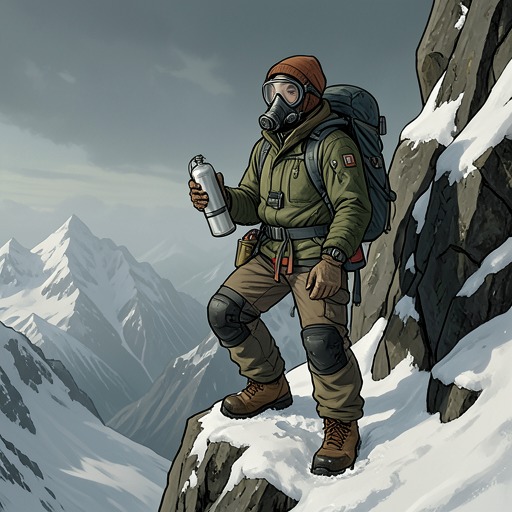
During the May 10, 1996 storm, visibility could shrink to little more than an arm’s length. Climbers sometimes had ropes to follow or secure themselves to, but their oxygen gauges were falling toward zero, and hypoxia compromised rational calculation. Frostbite threatened to turn an already dangerous descent into a lasting physical consequence. The account conveys how the Death Zone makes ordinary tools and decisions precarious: a rope can guide movement, but it cannot restore visibility, oxygen, or sound judgment.
The Summit Route and Its Narrow Margins
The Death Zone figures prominently on the route between Camp IV and Everest’s summit. At the Balcony, around 8,500 meters, climbers from the Hall and Fischer expeditions gathered to rest, change oxygen canisters, drink, and take photographs if they had the strength and coordination. The pause was a practical necessity, but not a safe refuge. The climbers were already in a region where, as Martin Adams put it, they were moving from being barely able to think to being unable to think at all.
The account’s logistical details show how thin the margin was. Mountain Madness had 62 oxygen canisters at Camp IV: nine heavier Zvesda canisters reserved for sleeping and 53 lighter Poisk canisters set aside for summit day. The climbing Sherpas carried 21 bottles up the mountain; the six clients, Scott Fischer, and Neal Beidleman carried 12 between them, while Boukreev carried one. In all, the climbers took 38 Poisk canisters, leaving 15 full ones at Camp IV, in addition to whatever remained of the Zvesda supply. That reserve was not enough to support an overnight delay followed by a second summit attempt. For some clients, the plan had been expressed plainly as a single try, with no second attempt.
Other vulnerabilities met this oxygen constraint. The expeditions’ clients understood that the fixed ropes above Camp IV were supposed to be in place before they arrived at the Balcony, allowing them to continue without waiting. Instead, neither Lopsang Jangbu Sherpa nor Ang Dorje Sherpa nor another Sherpa had left early to fix them. The accounts differ over why the ropes were not ready, and the book presents the dispute rather than resolving it as a certainty. In the Death Zone, however, the practical consequence of a delay was clear: the climbers’ limited oxygen and strength were being spent while the route remained unfinished.
The 1996 Storm
In the early evening of May 10, a severe storm struck Everest and remained at high elevations for more than ten hours. Twenty-three climbers who had ascended from the Nepal side could not reach the safety of their highest camp. Above 8,000 meters, wind and poor visibility compounded the hazards already built into the Death Zone. The climbers were trying to descend through conditions that made orientation difficult while their oxygen supplies and physical reserves dwindled.
The storm turned the region’s defining risks into an immediate crisis. Gauges reached zero; hypoxia made rational decisions harder; and the prospect of frostbite made survival inseparable from the possibility of serious injury. The account emphasizes the climbers’ urgent bargaining for life, but its larger point is structural: above the camps, a delayed descent could expose people to several interlocking threats at once, without reliable time or strength to overcome them.
Rescue and Narrative Significance
Below the descending climbers, Boukreev was at a high-altitude camp trying to persuade others to help search for those lost above. He then decided to enter the storm alone and attempt a rescue, an action some later characterized as suicidal. The book reports that his effort became what mountaineer and writer Galen Rowell called one of the most remarkable rescues in mountaineering history. The Death Zone is therefore the setting not only for the climbers’ peril but also for the decision to go back into that peril to help them.
The phrase also gives the narrative a way to connect altitude with responsibility. Earlier in the expedition, Boukreev worried about clients whose preparation and condition differed from his own, and about whether available oxygen left enough reserve for emergencies. Summit-day provisions had been planned around clients returning to Camp IV by 6:00 p.m., before night and before their oxygen ran out; Boukreev’s oxygen-free guiding was understood in connection with his role in bringing assistance to clients who needed it. These arrangements did not remove the dangers of the Death Zone. Instead, the storm exposed how plans, equipment, communications, and human judgment could all be tested together.
The book’s chapter sequence makes the term a structural threshold as well as a geographic one: “Into the Death Zone” leads directly to “To the South Summit” and “The Last Hundred.” Once the climbers enter this region, the summit bid is no longer only an ascent toward a goal. It becomes a struggle to manage the consequences of limited oxygen, delays, and deteriorating conditions—and, for Boukreev, a setting in which the expedition’s rescue obligations became urgent.