Ed Viesturs
The ClimbEd Viesturs was an American high-altitude climber, Everest veteran, and guide with the MacGillivray Freeman IMAX/IWERKS Expedition, whose choices and observations offered a clear counterpoint to the pressure to continue climbing during the 1996 Everest season. His expedition chose patience over a deteriorating weather window, and his later warnings about late climbers and oxygen underscored the practical stakes of the summit attempt.
Identity and Background
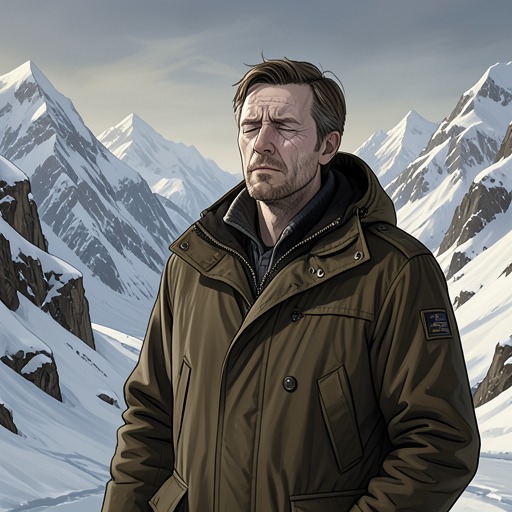
At thirty-seven, Viesturs was working both as a guide and as on-camera talent for the IMAX/IWERKS expedition, headed by climber and filmmaker David Breashears. The documentary was a major production, intended for release in 1998 as a large-format theater film. Its wraparound screens and state-of-the-art sound were designed to offer audiences an immersive, armchair experience of Everest. Viesturs thus occupied two roles at once: an experienced climber responsible for judgment on the mountain and a participant in a project that would carry the mountain to viewers far from it.
The book presents him as a respected high-altitude mountaineer rather than merely a film crew member. Anatoli Boukreev regarded Viesturs as one of America’s finest climbers. He noted that Viesturs had climbed nine of the world’s fourteen 8,000-meter peaks without supplemental oxygen, and compared the respect he felt for him with the respect he held for Scott Fischer. Earlier in the season, Viesturs’s blunt assessment of the crowded Everest scene was that many people had come to the mountain who should not have been there. His status as a seasoned climber gave that criticism weight amid the commercial expedition boom.
The IMAX Expedition’s Decision to Wait
On the approach to base camp, Boukreev encountered Viesturs and Breashears with their IMAX crew at a waterfall on the Dudh Kosi. He maneuvered out of their panoramic shot rather than spoil the filming. Later, in Pangboche, he visited with Viesturs. The meeting linked two different kinds of expedition work: a commercial climbing team moving toward its summit attempt and a film crew documenting the mountain while making its own decisions about risk and timing.
The teams met again as Boukreev climbed toward Camp III and passed descending climbers on the fixed rope. Viesturs was among them, calm and apparently not winded. He told Boukreev that his team was coming down because it disliked the unstable weather and would wait several days to see whether conditions improved. Their descent was not a response to an immediate emergency; it was a deliberate decision to preserve the chance of climbing later under safer conditions.
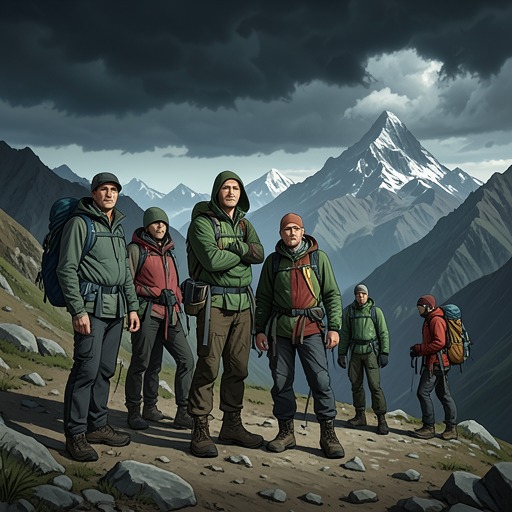
Viesturs later explained the expedition’s competing considerations. For filming, the team wanted a relatively empty summit ridge; for safety, it did not want to share the ridge with roughly forty other climbers. The plan had been to attempt the summit a day before the larger groups, but a windy night at Camp III and continued wind high on the mountain changed their assessment. Viesturs and Breashears concluded that the expected weather window had not arrived. They had time to descend, wait, and return when conditions were more stable, so they did not press on simply because other teams were ascending.
The choice carried social pressure. Viesturs remembered that members of the IMAX team felt somewhat embarrassed as they greeted Boukreev and wished him luck while descending. Around them, other climbers were moving upward with cheerful expressions, while the film team was turning back. Their unease did not overturn their decision: Viesturs described it as their own judgment, made despite the visible momentum of the other expeditions. The scene sets collective enthusiasm against a choice to wait, and shows how a prudent retreat could feel difficult even before its consequences were known.
Watching the Summit Attempt
The IMAX team’s retreat placed Viesturs among the observers at Camp II while other climbers made their summit push. Through a telescope, he and others followed the route from the South Summit toward the Hillary Step. At 2:00 p.m., climbers were still moving upward, slowly, as streamer clouds passed over the summit. Viesturs judged the hour dangerously late. His concern was concrete: climbers might run out of daylight, and the oxygen supply could also become insufficient for the return journey.
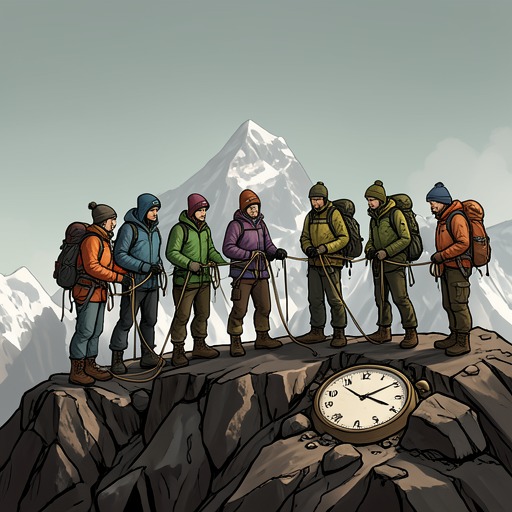
His reasoning turned on the narrow margin built into the climb. If climbers had to assume a twelve-hour ascent and had only eighteen hours of oxygen, the descent allowed roughly six hours of reserve. Seeing people still on the route so late, he feared that this margin was being consumed before they had even reached the summit. His view was formed from the vantage point of an experienced climber watching the route, not from inside the climbers’ immediate decisions. The distance made the scene visible as a pattern: slow progress, a late hour, changing weather, and a dwindling allowance for the descent.
That observation later became part of a disagreement about whether oxygen had been a problem. Jon Krakauer dismissed the idea in an interview, while Viesturs’s account of watching the climbers conveyed his expectation that they could run short of both oxygen and daylight. The contrast is important because it preserves two different assessments of the same risk rather than treating the availability of oxygen as an uncontested fact. Viesturs’s statement records what he believed could happen as he watched the ascent; it does not, by itself, settle the wider dispute over oxygen use and supply.
Evacuation and Testimony
By the morning of May 12, hope for Rob Hall, Doug Hansen, and Andy Harris had been abandoned, and the remaining members of the Adventure Consultants expedition began descending toward base camp. At the same time, a rescue effort enabled Beck Weathers and Makalu Gau to be evacuated to Camp I, where a helicopter could land and take them to Kathmandu. Viesturs was among those named as contributing to that effort, alongside Todd Burleson, Pete Athans, David Breashears, and members of other expeditions. The account places his work after the summit attempt’s fatal turn, in a broader effort that crossed the boundaries between teams.
Viesturs also became a source in the later public record of the disaster. In a January 1997 interview in Salt Lake City, he spoke with Krakauer; Krakauer stated that he had the interview’s audiotape and transcript and had quoted from it in his book. That clarification mattered because Krakauer was answering accusations that he had never contacted or interviewed Viesturs. His testimony therefore appears both as an account of what he witnessed on the mountain and as evidence in the dispute over how the disaster had been reported.
Narrative Significance
Viesturs’s role is defined by a recurring contrast between movement and restraint. The IMAX team was capable of attempting the summit, but its leaders judged the weather and crowding unacceptable and descended while others continued up. Later, from Camp II, Viesturs watched those climbers move slowly toward the summit after 2:00 p.m. and assessed the consequences in terms of oxygen and daylight. The parallel gives his earlier decision to wait a retrospective force without implying that he could control what happened to the other teams.
The film expedition also complicates the distinction between observer and participant. Viesturs was helping make a documentary for distant audiences, yet he was not detached from the real decisions and hazards unfolding on the mountain: he chose to retreat, monitored the summit attempt, and joined the work that helped evacuate survivors. His observations also entered the contested record of the disaster. In that way, he connects three forms of evidence—the climber’s judgment, the observer’s view through a telescope, and the later interview—while remaining a witness whose statements illuminate the risks without resolving every disagreement about them.