Evgeny Vinogradski
The ClimbEvgeny Vinogradski was a Soviet champion climber, high-altitude instructor, and sports physician recruited by Anatoli Boukreev for the Indonesian national Everest expedition. His credentials mattered on the mountain, but the book’s most vivid account of him is practical and immediate: at Camp V, he brewed hot water through the night while the team rationed oxygen to exhausted Indonesian climbers, then helped Boukreev cover Scott Fischer’s body. His character emerges through work sustained under pressure and through a quiet act of remembrance.
Identity and Background
Vinogradski was fifty years old when Boukreev described assembling the expedition’s training staff. He had been a seven-time champion climber in the Soviet Union and had more than twenty-five years of experience as a high-altitude climbing instructor and sports physician. His record included more than twenty summits above 7,000 meters and eight above 8,000 meters, two of them on Everest, including one as a personal guide.
Boukreev’s confidence in Vinogradski was rooted in their prior experience together: they had shared an 1989 traverse of Kanchenjunga, and Boukreev counted him as a personal friend. He called him the Old Eagle, a name that joined long experience to the steadiness Boukreev valued. Vinogradski’s gentle good humor and steely calm in severe situations, as Boukreev characterized them, complemented the technical expertise that made him an essential member of the instructional staff.
Role on the Expedition
Boukreev sought a technically strong staff with deep experience in high-altitude rescue and medical support. He wanted associates whose judgment he could trust in critical situations, whose expertise could balance his own difficult personality, and whose strength and flexibility would let them work on the mountain with or without oxygen. Vinogradski’s combination of climbing instruction and sports medicine answered that need: his role was not limited to technical climbing but included the capacity to support a team facing altitude and exhaustion.
The expedition’s division of labor placed substantial duties on its Sherpa staff, including fixing rope above the Icefall, establishing and supplying camps, and carrying extra oxygen for summit day. Against this larger logistical structure, Vinogradski belonged to the experienced instructional group Boukreev assembled to address the climbing team and difficult conditions on the route. The later crisis at Camp V shows the value of that preparation in direct, hands-on care.
Camp V and the Night of Survival
After the 1997 summit push, Boukreev’s group reached the South Summit at 5:00 p.m., moving painfully slowly over old ropes that Apa Sherpa had pieced together for the traverse. At Camp V, the tent was missing two sections of its poles and functioned more like a large bivouac sack. Six people crowded inside with a stove, pots, gas, a sleeping mat, and two full oxygen bottles; the cold was increasing, though there was no wind.
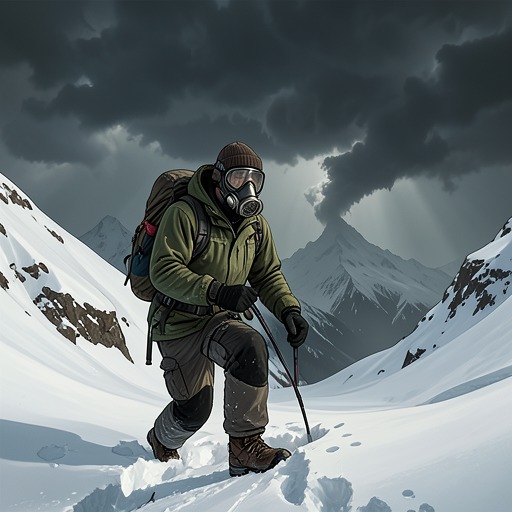
Vinogradski arrived about an hour after the Indonesian members and Boukreev, Bashkirov, and the others reached the camp. He immediately began brewing hot water and continued through the long night. Boukreev and Bashkirov took turns moving an oxygen mask among three exhausted Indonesian summiters, stretching the supply for as long as they could. When a climber was left too long without the bottle, he would cry or pray. Vinogradski’s work with the stove and water was part of the same sustained effort: the men took turns, quietly, and survived by working together.
Morning brought clear weather and no wind. Before beginning the descent, the group brewed one last round of water and gave everyone another drink. They had run out of oxygen, but the Indonesians were moving, slowly, and none had frostbite. The account presents their survival not as a single dramatic rescue but as the result of endurance through the night and cautious movement afterward.
Remembrance of Scott Fischer
Once Boukreev felt the team’s situation was stable enough, he returned to a personal commitment on the mountain: to find and bury Fischer. During the group’s ascent they had passed within thirty meters of Fischer’s body in darkness, but Boukreev had not found him. He had carried a farewell flag inscribed with messages from Fischer’s wife and friends, but left it at the summit when the team’s condition made it uncertain whether he could locate Fischer on the descent.
Boukreev found Fischer almost completely covered by snow and asked Vinogradski to help. Together they covered the body with snow and rocks and marked the place with the shaft of an ice ax they found nearby. The small, concrete acts—covering the body and leaving a marker—made Vinogradski a participant in the expedition’s final duty to a lost companion. Fischer’s farewell flag remained flying from the summit, while Boukreev and Vinogradski’s burial marked the body’s location below.
Testimony and Narrative Significance
The book draws on several kinds of retrospective evidence, including recollections recorded by climbers at the Mountain Madness Everest Base Camp five days after the May 10, 1996 tragedy. The authors’ note identifies the debriefing as a source for details and quotations, and a later discussion describes a May 15 recording as an important contribution to the historical record. Vinogradski’s role at Camp V, however, is conveyed through Boukreev’s first-person account of the expedition rather than through a quoted statement from Vinogradski himself.
That distinction shapes his presence in the narrative: readers see him chiefly through what he does and through Boukreev’s appraisal of his character. A later dispute over accounts of events near the Hillary Step also turns on recollection and language. G. Weston DeWalt argues that Boukreev’s English limitations could help explain testimony described as conflicting by Jon Krakauer; this controversy concerns how Boukreev’s statements were interpreted, not a claim that Vinogradski took part in the disputed exchange. Vinogradski’s own place in the account remains grounded in the expedition record Boukreev gives: a trusted friend whose expertise, calm, and labor helped carry climbers through the night and honor Fischer afterward.