Expedition radios
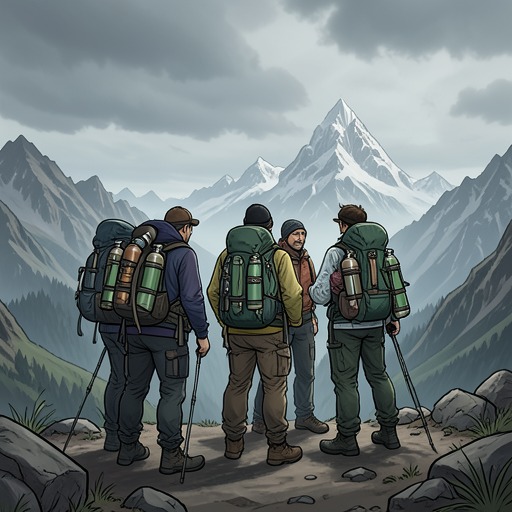
The ClimbExpedition radios were meant to connect climbers on the mountain with their camps, carrying updates about weather, health, equipment, and emergencies. In the 1996 Everest expedition, however, the equipment was antiquated and scarce, while the communication chain depended on several relays. During the summit-day crisis, this made the radios less a reliable lifeline than a fragile network through which urgent information could be delayed, distorted, or fail to reach the person who needed it.
Equipment and distribution
Before the climb, Martin Adams objected to the radios Scott Fischer had brought for the expedition. Adams contrasted them with lightweight modern radios, which he believed every climber could carry, and described Fischer’s models as old, ten-channel units. Fischer’s explanation was that they were all he had. Adams considered the choice a major communications misstep. The equipment problem was not simply that the radios were old: the expedition had no universal arrangement ensuring that each guide or client could contact camp directly.
The summit team’s radio assignments reflected that unevenness. In the post-expedition discussion, Lopsang Jangbu Sherpa identified a small yellow radio as one he had carried, and Sandy Hill Pittman confirmed that it was hers. Scott Fischer also had a small yellow radio. But the yellow units could not communicate with Everest Base Camp on summit day. Lopsang carried a separate black radio, the kind used by Sherpas communicating among Camp IV, Camp II, and Base Camp. Ingrid Hunt confirmed that this black set was the only one capable of reaching the other camps.
The guides were not all equipped to match their responsibilities. Neal Beidleman said that he had no radio. He and Fischer had originally expected to divide the sets between the front and rear of their climbing group, with Lopsang at the front and Fischer at the back, but they had made no specific arrangement for Beidleman to carry one. When Beidleman passed Lopsang high on the mountain, the altitude and circumstances kept him from thinking to take the radio. Anatoli Boukreev likewise had none. The result was a mismatch between the need for coordination across a moving group and the limited number and capability of the devices available.
Communication through relays
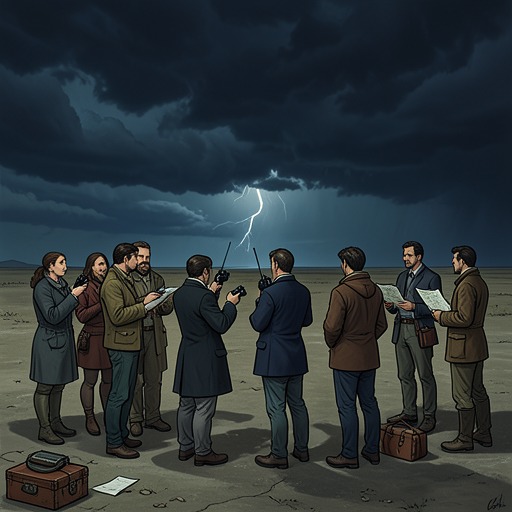
The radios did not create a direct line from Base Camp to every climber. Hunt described messages moving from her through Ngima Sherpa, then in Nepali through Gyalzen Sherpa at Camp II to Pemba Sherpa at Camp IV, and onward to Lopsang or another climber. Messages coming down followed a corresponding chain. This structure made the Sherpas who carried and relayed radios essential communication nodes, but also meant that information passed through several people before reaching its destination.
Hunt said she was not confident that an English message would make it through the chain. She therefore relied on Ngima to convey her messages in Nepali, yet she found his reports inconsistent and believed that some information was being presented in a more favorable light. She repeatedly asked whether there was news, sometimes after hearing Nepali radio traffic herself. The fact that conversation was audible did not mean that its contents were reaching her accurately or promptly.
The chronology of the reports illustrates the uncertainty. At 6:00 a.m. on summit day, Hunt received word that the climbers were approaching the South Summit, although that report was six hours ahead of their actual progress. At 8:00 a.m. she was again told that they had reached it. Later, after Rob Hall’s camp reported that Hall was with a climber collapsed above the Hillary Step, Hunt and the Sherpas tried to arrange for oxygen to be sent up. At 5:45 p.m., Hunt learned that Fischer and Lopsang were below the South Summit, that they were out of oxygen, and that Fischer was very weak. But from then until 10:45 p.m. she could not get further information through to them or reach anyone on the mountain.
When a report finally came at 10:46 p.m., it said that Fischer, Lopsang, Makalu Gau, three Taiwanese Sherpas, and a New Zealand Sherpa were near the South Col. Pemba Sherpa reportedly said that they were flashing headlights and making noise with oxygen bottles to attract the climbers. Hunt had also learned that there was a complete whiteout, leaving her unsure how the reported signals could be seen. The conflicting reports did not resolve the emergency; they made it difficult to know where the climbers were or what help they needed.
Radios during the emergency
At Camp IV, Boukreev was not told about the possible emergency above the Hillary Step. Pemba Sherpa said nothing to him about the radio communication Hunt later recalled from around 4:30 p.m., when she had asked whether he would carry oxygen up the mountain. As the evening continued, Boukreev remained unaware that the situation above was critical. The gap was consequential: the rescue effort depended not only on someone having a radio, but on the message being passed to the person able to act.
The post-expedition discussion further distinguished the radios by their practical limitations. Lopsang said he had listened to a message that three oxygen bottles and tea were being taken up, but his newer radio could not receive or perform as needed until he changed its battery. He did not have a radio contact with Boukreev; Boukreev had no radio, and Lopsang said he had only listened to the transmission. This exchange underscores the difference between information being transmitted somewhere on the mountain and a useful two-way connection between the people coordinating a rescue.
The communication failures also shaped the search for assistance. Lopsang needed help for the climbers and was counting on Boukreev, but Boukreev was already trying to respond to reports of several stranded clients. He went among nearby expedition tents seeking support, including those associated with Rob Hall’s team and the Taiwanese expedition. Those requests and the earlier appeals by Mike Groom did not produce the needed help from Hall’s team. The radios could not by themselves overcome exhaustion, absence, or unwillingness; nor did the available evidence show a dependable system that could coordinate aid across teams.
Significance
The radios exposed a central weakness in the expedition’s infrastructure: communication depended on devices that were not shared evenly, did not all reach the same camps, and could become ineffective through poor reception, battery problems, or relay failures. A small yellow radio could be present without offering a route to Base Camp; the more capable black radio could be carried by a Sherpa while the guides responsible for decisions had none. Even where communication existed, reports could arrive late or conflict with events on the mountain.
Their role in the narrative is therefore practical as well as symbolic. The radios were supposed to turn dispersed climbers into a coordinated expedition, but the crisis revealed how much that coordination rested on fragile links between individuals. The distance between hearing that an emergency existed and knowing where to send help became a defining feature of the night. In this setting, communication equipment was not background gear: its distribution, capability, and operation helped determine what the people at Base Camp could know, what Boukreev was told, and how quickly assistance could be organized.