Fischer rescue attempt
The ClimbThe Fischer rescue attempt was the May 11 effort to reach Scott Fischer on Everest, following the summit-day disaster of May 10, 1996. The book’s chronology records the attempt as a renewed ascent from Camp IV to 8,350 meters, but its evidence also makes clear that accounts of the preceding hours—and of the instructions Fischer gave Anatoli Boukreev—became part of a larger dispute over how the disaster should be understood.
Background and chronology
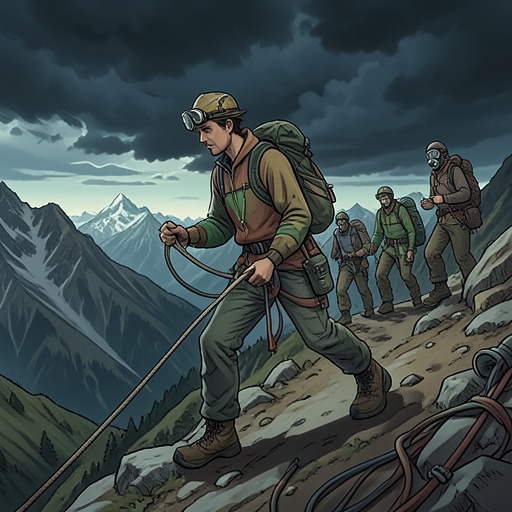
The expedition’s chronology places the attempt on May 11: Boukreev left Camp IV and climbed to 8,350 meters in an effort to reach Fischer. It was not an isolated episode. The previous day, climbers had been caught in deteriorating conditions during their descent, with oxygen, fixed ropes, and communications all shaping what could be done. The May 11 entry marks a further effort after the immediate summit-day crisis, rather than a continuation of the planned summit bid.
The available account does not supply a detailed sequence of the May 11 climb or establish its precise outcome at each point. It does, however, identify the attempt’s destination and altitude, preserving it as a distinct action in the expedition record rather than subsuming it into the general aftermath of the storm.
Conditions shaping the effort
The summit push had already been constrained by a narrow oxygen margin. At Camp IV, Mountain Madness had sixty-two canisters in total: nine heavier Zvesda canisters reserved for sleeping and fifty-three Poisk canisters set aside for the May 10 climb. The Sherpas carried twenty-one bottles up the mountain; the guides and clients carried seventeen. Once thirty-eight Poisk canisters had been taken upward, fifteen full Poisk canisters remained at Camp IV, along with whatever oxygen was left from the night’s Zvesdas. The account describes this as too slim a reserve to support an overnight delay and a second summit bid on May 11. These figures concern the planned summit effort and its contingency limits; they do not by themselves specify what oxygen was available for Boukreev’s later rescue attempt.
Communications were another vulnerability. Martin Adams criticized the expedition’s old, ten-channel radios as antiquated and inadequate compared with lightweight radios that could have been carried by every climber. During the emergency, information also moved through a chain of relays between Base Camp and the mountain, and Dr. Ingrid Hunt believed messages were sometimes incomplete or presented in an overly reassuring form. The book’s account therefore sets the rescue attempt against an expedition in which both equipment and the flow of information could limit coordination.
The disputed descent and its evidence
The dispute over the May 11 attempt is bound to the question of why Boukreev had descended ahead of other climbers on May 10. In later discussion, G. Weston DeWalt revisited Jon Krakauer’s account of an exchange near the Hillary Step. DeWalt checked interview transcripts and spoke at length with Adams, who said that his exchange with Fischer had happened while Adams was looking over the Step, outside Krakauer’s hearing. Adams also confirmed that Boukreev had told Fischer he was going down with him, but said Krakauer had not heard that comment either.
DeWalt further challenged the interpretation of Boukreev’s descriptions of Fischer’s response. Krakauer had characterized Boukreev’s recollections as conflicting: that Fischer had approved the descent in one account and had told Boukreev to go down in another. DeWalt argued that Boukreev’s limited English could explain why he did not distinguish those formulations as contradictory. In DeWalt’s understanding, Fischer’s reported response—agreement coupled with an instruction to descend—could carry both meanings. This is DeWalt’s interpretation of the testimony, not an uncontested transcript of the exchange.
The question of whether Fischer had planned for Boukreev to descend ahead of clients also remained contested. DeWalt cited Fischer’s conversation with Jane Bromet about such a plan and rejected the implication that a plan could not exist unless other members of the expedition knew of it. The May 11 rescue effort thus appears in a narrative still examining the decisions and communications that preceded it, rather than as an episode with a single settled account of responsibility.
Reconstruction and significance
The book presents the disaster through multiple forms of testimony. Five days after the May 10 tragedy, nine climbers sat in a circle at Mountain Madness’s Everest Base Camp and recorded their recollections. Boukreev drew on that taped debriefing, and the book describes the participants’ effort at truth-telling and self-reflection as a contribution to the historical record. DeWalt later explains that he and Boukreev relied heavily on the May 15 recording, while also responding to Krakauer’s criticism that quotations from it had not been independently corroborated.
That evidentiary frame matters to the rescue attempt because its place in the chronology is firmer than a full scene-by-scene account of what happened above Camp IV. The recorded itinerary identifies Boukreev’s May 11 climb to 8,350 meters as an attempt to reach Fischer; the later debate centers more explicitly on what had been agreed or ordered during the previous day’s descent. The result is a record that preserves the rescue effort while leaving the interpretation of the decisions surrounding it open to comparison among recollections, interviews, and published accounts.