Frostbite
The ClimbFrostbite in Into Thin Air is not an abstract hazard of extreme cold: it is a bodily danger that shapes decisions in the Death Zone and remains visible after climbers return from the mountain. The narrative moves from the numbness that makes amputation seem probable during the 1996 storm to the blackened skin on Anatoli Boukreev’s face after the disaster, while a separate rescue account shows how quickly unprotected hands can be injured even during a short exposure.
Definition and Immediate Threat
During the storm on Mount Everest, climbers above 8,000 meters faced subzero temperatures alongside oxygen deprivation. In the white-out, they could see only about an arm’s length; oxygen gauges fell to zero as hypoxia undermined clear thinking. Against that combination, the text describes the numbness preceding frostbite as a warning that the prospect of amputation had shifted from remote to probable. The injury is presented not as an isolated medical complication but as one part of a converging emergency in which cold, darkness, and impaired judgment narrowed the chances of survival.
The account’s language gives the danger a stark bodily measure: a climber bargains away fingers in exchange for life. Frostbite thus marks the point at which survival may entail permanent physical loss. Its significance lies in the uncertainty that surrounds the injury while it is developing: numbness foretells damage, but climbers struggling through the storm cannot readily know how much their bodies have already suffered.
Visible Aftermath on Everest
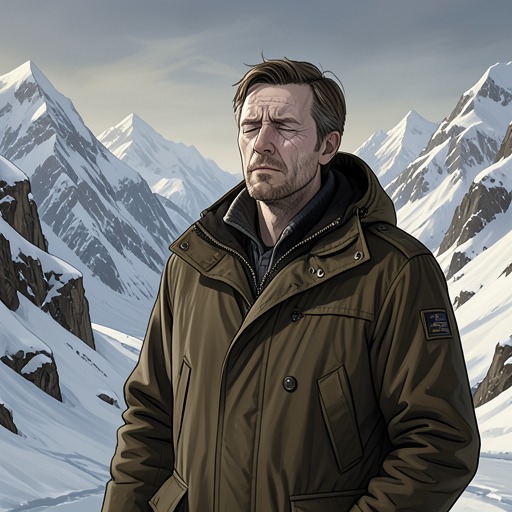
Two weeks after the disaster, Boukreev met G. Weston DeWalt in Santa Fe. DeWalt had imagined him as lean and taut, with a confident smile, from photographs taken before the events on Mount Everest. In person, Boukreev rose slowly from a chair; his eyes were sunken and tired, and the tip of his nose and parts of his lips were crusted black with dead skin identified as a telltale sign of severe frostbite. The contrast between the earlier photographs and this damaged face makes the injury evidence of what the rescue and storm had cost, even when the account does not reduce that cost to a diagnosis or a recovery timeline.
The physical marks also affect how the encounter is narrated. DeWalt associates the hollowness in Boukreev’s expression with a Russian soldier he had seen in Mozambique during the war, whose face had seemed blank as he held an AK-47. The recollection does not equate the two men’s experiences; it conveys the disturbing familiarity DeWalt sensed in Boukreev’s distant appearance after Everest. Frostbite’s visible trace is part of a broader portrait of a survivor who seems, in DeWalt’s description, to have moved out of his body and into a place without an address.
A Short Exposure, Lasting Risk
An earlier account of a rescue on Manaslu shows another route from cold exposure to frostbite. After Boukreev and Shafkat Gataullin found two climbers in the night, they tethered them to Boukreev’s harness and descended through fog in temperatures almost as cold as those before their summit bid. Near Camp III, other Kazakh climbers met them with hot tea. As the rescued climbers drank and relaxed at the sight of the tents, one lost his balance on the ice; the fall dragged the other climber and Boukreev over a fifteen-meter ice wall and down the mountain.
Boukreev was torn from his ice ax while belaying the pair. A rope he had fixed to an anchor stopped the fall after they had slid more than twenty meters. No one was seriously injured, but Boukreev lost his gloves. During the roughly fifteen minutes it took to reach the tents at Camp III, his hands became frostbitten. The short interval mattered: the account says his exposure was limited and he suffered no lasting damage. This episode makes clear that frostbite could follow not only prolonged struggle high on Everest but also a sudden equipment loss during a rescue, with the rope and the time required to reach shelter shaping the outcome.
Cold, Equipment, and Expedition Risk
Frostbite belongs to a wider pattern in the book in which bodily safety depends on conditions and equipment as well as individual endurance. Before the 1996 summit attempt, the Mountain Madness team had sixty-two oxygen canisters at Camp IV, but only fifty-three lighter Poisk canisters were set aside for the May 10 climb. Sherpas and clients carried most of those uphill, leaving fifteen full Poisk canisters, plus whatever remained of the heavier Zvesda canisters used for sleeping, at camp. The limited reserve and the decision to make only one summit attempt reveal how little margin the team had if the climb ran into trouble; frostbite was one of several potentially irreversible consequences of being stranded in the cold.
The same reliance on coordination appears in the planned fixing of ropes above Camp IV. Clients understood that Sherpas from both the Fischer and Hall expeditions would go ahead so they would not have to wait, but neither expedition’s Sherpas had departed early to fix them. Separately, concerns about the expedition’s old two-way radios underline how essential functioning communications were to the movement of information and aid. These details do not make equipment a substitute for the cold itself; they show how failures or shortages in the systems meant to guide, supply, and connect climbers could leave human bodies more exposed to it.
Narrative Significance
Across these episodes, frostbite changes register: first a feared future, then a visible sign of severe injury, and finally a temporary injury brought on by the loss of gloves. The movement from anticipated amputation to Boukreev’s blackened skin and then to hands injured during a fifteen-minute descent prevents the term from remaining a general warning. It carries distinct consequences in distinct circumstances, including the possibility of permanent loss and the possibility of recovery after brief exposure.
The book places these bodily details within a landscape where cold and altitude act together, but it also attends to the practical conditions of exposure: gloves, ropes, oxygen supplies, fixed lines, and communication. Frostbite is therefore both an intimate injury and a measure of how narrow the safety margin can become when a climber is lost, delayed, or separated from essential equipment. The rescue account’s ending—no lasting damage, despite the sudden fall and loss of gloves—stands in sharp contrast to the blackened skin Boukreev carried home from Everest, without making either outcome seem inevitable.