Guide responsibility and climbers’ assumption of risk
The ClimbGuide responsibility and climbers’ assumption of risk is the boundary Anatoli Boukreev draws between professional support and a guarantee of safety in high-altitude mountaineering. The idea takes its clearest form in his negotiations over the Indonesian expedition: he would advise, prepare, and help rescue its climbers, but would not promise a summit or accept responsibility for eliminating the mountain’s dangers. The distinction also frames the 1996 Everest account, where careful plans and rescue intentions met delayed information, uncertain decisions, and conditions no guide could control.
Responsibility Without a Promise
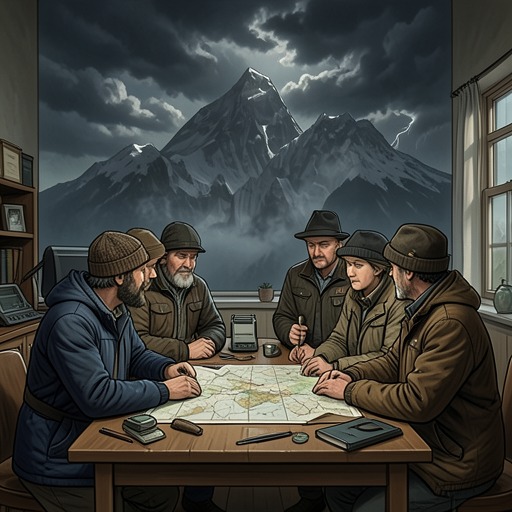
Boukreev presents the guide’s role as consequential but limited. In discussions with General Prabowo Subianto about the Indonesian expedition, he estimated only a 30 percent chance that any one climber would reach the summit and a fifty-fifty chance of losing someone on the mountain. He recommended a year of training on progressively higher peaks; the proposal was rejected. Prabowo said the men were motivated, well conditioned, and committed even if the objective meant risking death. Boukreev found the response shocking but honest, and used it to define the terms on which he could participate.
His objection was not to ambition itself. He described mountaineering as a reasonable sporting endeavor rather than Russian roulette, and held that the death of a team member would outweigh any summit success. Above eight thousand meters, he argued, the margin of safety contracts sharply for amateurs, including fit ones. The Indonesian climbers could draw on his experience, advice, services as lead climbing adviser, and participation in a rescue team; they would still have to bear responsibility for the ambition they pursued in the face of their inexperience.
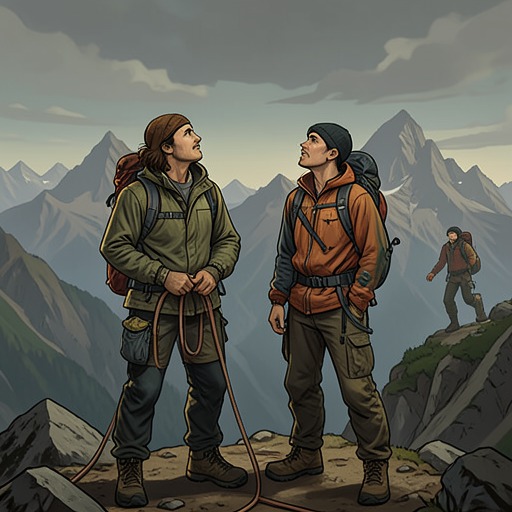
That division shaped his self-appointed role. Boukreev intended to offer the Indonesians the greatest benefit he could from his experience while preserving their independence. The preparation was to include training and conditioning, advisers with technical and high-altitude expertise, and a rescue team that could support the climbers on summit day. He would not guarantee success at any price. Before undertaking the expedition, he required absolute control over the final summit-day decision, including the authority to stop an attempt if the men’s condition or the mountain made a reasonably safe bid impossible. Prabowo understood that even the best rescue team could not ensure an effective rescue above eight thousand meters, and Boukreev accepted that acting as a rescuer might cost him his life.
Preparation and the Limits of Expertise
The same ethic appears in Mountain Madness’s acclimatization plan. Boukreev and Scott Fischer planned four excursions, beginning with a climb to 6,100 meters, the site of Camp I, without an overnight stay. Clients were to carry only personal belongings and equipment to conserve strength; climbing Sherpas working under Lopsang Jangbu Sherpa would carry rope and supplies. The team would return to base camp that day, rest, and be observed before progressing. On a later excursion, clients would sleep at Camp I and climb toward 6,500 meters, where the Sherpas were establishing Camp II, then descend without spending the night there and take several days to recover.
The routine made preparation more than a matter of gaining height. Before the planned Camp III excursion on April 23, Boukreev stressed that time at altitude, and a further gain of two or three hundred meters after a night there, could improve the prospect of succeeding above eight thousand meters. He also emphasized that each excursion depleted strength: a long rest at base camp could not fully compensate for it. In his view, some clients treated acclimatization as a sequence of altitude gains and failed to attend sufficiently to recovery. Preparation could reduce risk, but it could not remove the physical cost of climbing or substitute for judgment about a climber’s condition.
Nor did a plan ensure that its supporting work would occur as scheduled. When Camp III remained unbuilt and the Sherpas were nearing exhaustion after several consecutive days of work, Boukreev and Fischer faced a conflict between letting them rest and contributing to a joint effort to fix ropes between Camps III and IV. Mountain Madness could have withheld its contribution, but risked losing its place among the expeditions expected to make an early summit attempt; May 10 was circulating as a possible date. Boukreev went in place of Sherpas, who needed a day to establish Camp III and recover. His decision was directed toward route safety, yet it also shows how timing and expedition coordination could press against the recovery needs that the acclimatization plan was meant to protect.
Rules, Judgment, and Communication on Everest
The account distinguishes a personal safety rule from an agreed expedition rule. A Seattle Weekly profile described Fischer’s Two O’Clock Rule: if a climber was not on the summit by two, it was time to turn around. But Boukreev’s account says Fischer did not set a definite summit-day cutoff for his clients. Instead, he planned for Lopsang and the guides to alternate at the front while Fischer brought up the rear and turned back stragglers as he passed them. If problems arose, Fischer was expected to communicate with Lopsang, who would be near the front. Neither Boukreev nor Neal Beidleman was issued a radio. Hall’s clients, meanwhile, understood different possible limits—one o’clock, two o’clock, or a decision to be made on the mountain.
The difference between an informal guideline and an operationally shared rule mattered once the climbers were high on the route. At the South Summit, after waiting almost an hour and seeing that no one was fixing the ropes, Boukreev and Beidleman decided to work together on the task. Later, from Camp II, Henry Todd used a radio to ask Hall’s base camp for the turnaround time and was told it was two o’clock; that time had already passed. Todd understood the exhaustion of climbers high on the mountain as a threat to sound judgment: they could cease to think logically and believe they could continue. In this situation, responsibility depended not simply on whether a rule existed in someone’s mind, but on whether the team had communicated it clearly and could act on it in time.
The emergency also exposes the limits of information moving between camps. Dr. Ingrid Hunt’s messages passed through several people: from base camp to Ngima, then in Nepali to Gyalzen at Camp II and Pemba at Camp IV, with reports traveling back through the same chain. Hunt believed she was not receiving accurate or complete information, and that messages could be adjusted to present events more favorably. Radio contact with Pemba was sporadic. She moved between Mountain Madness’s camp and Hall’s, whose camp had better communications, trying repeatedly to obtain news. A rescue responsibility could not be exercised effectively when the condition and location of the people needing help were uncertain.
From Commercial Guide to Adviser
Boukreev’s later distinction between guiding and consulting did not erase his responsibility toward clients; it marked what he believed he could honestly undertake. After the Indonesian expedition, he acknowledged the danger of bringing inexperienced people into high mountains and the difficulty of making a living by other means. He did not want a professional title to suggest that he could assume responsibility for another person’s life or guarantee protection from natural conditions and physical decline at altitude. He was willing to coach, advise, and act as a rescue agent, while insisting that each person remained responsible for the decision to risk a life.
The distinction is deliberately uncomfortable. Boukreev did not claim that a climber’s choice absolved an adviser of obligations: he required control of the final summit decision, organized preparation, and treated rescue as a central expedition function. But neither did he believe that expertise could convert an inherently uncertain ascent into a promised outcome. The climber’s autonomy and the professional’s duty thus remain in tension: preparation and intervention are real responsibilities, while the danger they address cannot be mastered or guaranteed away.
Aftermath and Significance
The aftermath of the 1996 disaster gave this argument a personal and practical weight. Boukreev and Beidleman stayed in Kathmandu after the clients departed to settle expedition business; Beidleman took on most of it because English came more easily to him. Both men were physically and psychologically exhausted and wanted to leave the city and the mountain behind. Boukreev was especially eager to get away from the press gathered around them at the Yak and Yeti Hotel. His reluctance to have the disaster turned into a public story sits beside his insistence that decisions, limits, and rescue responsibilities be examined rather than converted into a simple guarantee of professional control.
For Boukreev, the distinction ultimately placed ambition and duty on both sides of a boundary. A climber could choose to accept risk; a guide or adviser could prepare, warn, decide whether to proceed, and attempt a rescue. None of those acts could ensure survival in the Death Zone. The book’s repeated attention to acclimatization, oxygen, turnaround expectations, and broken communication gives the principle its force: responsibility is not the power to command the mountain, but the obligation to make limits explicit and to act within them, without pretending that either expertise or consent can make the outcome certain.