High-altitude acclimatization
The ClimbHigh-altitude acclimatization is the gradual adjustment of the body to the decreasing oxygen available at elevation. In the Mountain Madness expedition, it was not simply a preliminary phase before the climb: it governed the itinerary, dictated a sequence of rest and increasingly high excursions, and became a point of difference between Anatoli Boukreev’s preferred recovery plan and Scott Fischer’s eventual preparations for a single summit attempt.
Principle and Expedition Plan
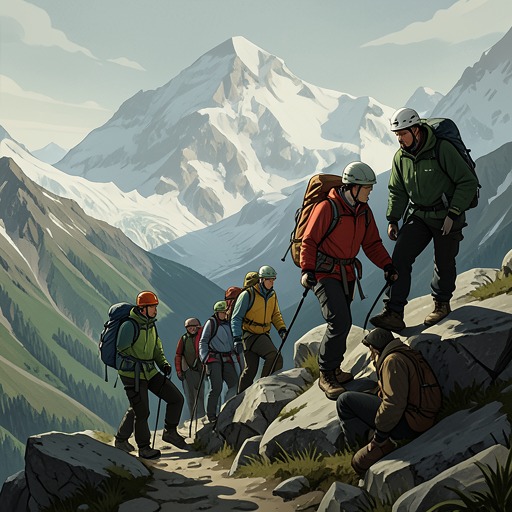
The expedition’s initial itinerary was designed to limit the risk of acute mountain sickness by avoiding rapid gains in elevation. The clients were to leave Los Angeles on March 23, spend time in Kathmandu, and fly to Lukla at 2,850 meters on March 28. Beginning below 3,040 meters and ascending gradually followed a widely recommended high-altitude principle. Shortly before the expedition began, however, Fischer changed the plan: rather than helicoptering the clients to Lukla, he proposed flying them with expedition gear to Syangboche on March 29. The change departed from the conservative starting itinerary, though the later acclimatization program still set out a graduated course of ascent and rest. At Base Camp, Boukreev made formalizing that course an early priority. The premise was that climbers should spend at least a few days at Base Camp before making excursions to progressively higher camps. They would gain altitude, then return to a level to which they had adjusted; the summit bid would involve a brief push to a much higher altitude followed by descent. The Sherpas would establish the higher camps, while clients carried only personal belongings and equipment on the acclimatization excursions, conserving strength for the climb. The first of four planned excursions was to reach 6,100 meters, the site of Camp I, without spending the night there. The group would return to Base Camp the same day, rest, and allow the guides to observe the clients’ condition. On the second excursion, they would again reach Camp I and stay overnight, then climb to 6,500 meters, where the Sherpas were establishing Camp II, before descending without sleeping at that elevation. A further multiday rest would give the clients time to recover and give the guides another opportunity to assess their readiness.
Increasing Altitude and Recovery
After that rest, the third excursion was planned to proceed through Camp I, where the climbers would spend a night, to Camp II for their first overnight there. On the third day they would try to reach 6,800 meters, the height at which the route would move onto the Lhotse Face; Camp III was to be established higher, at 7,300 meters. They would then descend through Camp II and return to Base Camp. The plan thus combined higher exposure with deliberate retreat rather than treating each attained altitude as a permanent advance. Three days of rest were scheduled before the fourth and final acclimatization excursion. This time the clients would travel directly from Base Camp to Camp II, spend the night there, continue to Camp III for another night, and the next day attempt to climb a few hundred meters higher before descending. Boukreev and Fischer agreed that this excursion was mandatory for all members: it would take them to the highest altitude they were to reach before the summit bid, and the team needed to make those adjustments before attempting the final climb. Boukreev regarded adherence to the schedule as a safety matter. Fischer had hired him to bring his experience to bear, and Boukreev understood client safety to be part of his responsibility. He told Fischer that success was possible if the clients used oxygen and circumstances aligned, but emphasized that the team could not compensate for a lack of training or experience by hurrying. Rest and the planned acclimatization were, in his view, the means of improving the clients’ prospects within those limits.
Disagreement over Rest
The central disagreement was not over the four excursions themselves. Fischer accepted their structure, but was not receptive to Boukreev’s proposal for a longer recovery after the highest acclimatization climb. Boukreev recommended descending after the excursion to 7,300 meters and resting for at least a week below Base Camp, around 3,800 meters, in the forest zone. At that lower elevation, he reasoned, the climbers would have more oxygen; time away from the routines of Base Camp could also provide psychological relief. High-altitude stays, in his experience, quickly depleted strength, which short rest intervals at Base Camp could not restore. A climber might feel better as immediate problems eased yet still lack the reserves for the final summit effort. The book does not establish why Fischer rejected the proposed deep descent, and Boukreev himself was uncertain. The distinction matters: the evidence records agreement on the staged acclimatization excursions alongside unresolved disagreement about recovery afterward, not a rejection by Fischer of acclimatization as a whole. Boukreev’s concern was that completing the altitude schedule without adequate recovery could leave clients less prepared for the summit push than the itinerary suggested.
Acclimatization amid Expedition Pressures
The plan depended on more than elevation and rest. Clients arriving at Base Camp were already struggling to adjust, and the team’s physical condition was a recurring concern. Neal Beidleman developed a Khumbu cough soon after arriving; persistent coughing kept him from sleeping, and treatment did not initially help. Because he was responsible for helping get clients to the summit and the expedition had one fewer guide than originally intended, his recovery mattered to the team’s ability to carry out its plan. Acclimatization unfolded amid such individual health problems, not in controlled isolation. The expedition’s equipment and coordination also shaped the conditions under which climbers would ascend and descend. Martin Adams criticized the expedition’s old, ten-channel radios, arguing that every climber should have had a lightweight, simple radio. Yet Boukreev and Beidleman were not issued radios for the summit strategy. Fischer’s planned method was for Lopsang Jangbu Sherpa and the guides to alternate leading while Fischer brought up the rear and turned back stragglers; if problems arose, Fischer expected to contact Lopsang, who was assumed to be near the front. The planned acclimatization could prepare clients for altitude, but it could not itself ensure that guides could communicate reliably or intervene promptly when the summit group became spread out. The mountain’s shared infrastructure introduced further pressures. Mountain Madness agreed with Rob Hall’s Adventure Consultants, Todd Burleson’s Alpine Ascents International, Ian Woodall’s Johannesburg Sunday Times Expedition, and Makalu Gau’s Taiwanese National Expedition to help fix ropes between Camp III and Camp IV on April 26. Although Mountain Madness expected to send Sherpas rather than guides, establishing Camp III and resting the Sherpas would leave no one available for that work. Boukreev therefore went in their place; the team did not want to lose its position among the early expeditions making a summit bid, with May 10 circulating as a possible date. The episode shows the acclimatization schedule operating alongside shared labor and a limited window for the summit attempt.
Summit Preparation and Limits
The planned ascent relied on a finite oxygen supply and a timetable as well as acclimatization. Before the expedition, Fischer and Boukreev agreed that Boukreev would guide without oxygen if properly conditioned and acclimatized. Fischer planned three canisters, or eighteen hours of oxygen, for each client, with a midnight departure on May 10 and an expected return to Camp IV by 6:00 P.M. The reserve was intended to cover the summit climb and descent; if clients had not returned by the deadline, Fischer expected Boukreev to assist them with oxygen, hot drinks, or physical help. At Camp IV, Mountain Madness had sixty-two oxygen canisters: nine heavier Zvesda canisters reserved for sleeping and fifty-three lighter Poisk canisters set aside for the May 10 climb. The Sherpas took twenty-one bottles uphill, while the six clients and the guides carried seventeen between them; Boukreev carried one. After the climbers took thirty-eight Poisk canisters, fifteen full Poisk canisters remained at Camp IV, along with whatever was left from the Zvesda supply. This left little room for an overnight delay and a second summit attempt on May 11. The expedition’s preparation therefore joined gradual altitude exposure to a narrow operational margin: acclimatization might ready climbers for the effort, but it could not extend their oxygen supply or create another attempt. The climbing group also encountered a route that was not ready as clients had expected. The clients understood that Sherpas from Mountain Madness and Adventure Consultants would leave ahead of them to fix the ropes, so they would not have to wait. In practice, neither Lopsang nor Ang Dorje, nor another Sherpa, had departed early to do the work. Lopsang later said that a member of the Montenegrin expedition had told him the ropes were already fixed; Jon Krakauer questioned that account, while the book also notes circumstances that could make it plausible that Fischer had understood the route to be ready. The discrepancy illustrates a limit of any acclimatization plan: physical preparation could not prevent delays or remove the risks created when expedition members held different understandings of route conditions. The summit day exposed the gap between preparation and conditions on the mountain. Fischer had not set a definite turnaround time for his clients, instead relying on the plan for him to bring up the rear and turn back stragglers. At the same time, the expedition had little oxygen in reserve, no second attempt available under its supply plan, and problematic radio communication. As the emergency worsened, messages between Base Camp, Camp II, and Camp IV passed through several Sherpas, and Dr. Ingrid Hunt believed she was not receiving complete or accurate information. Acclimatization was essential to the team’s attempt, but the events show its limits: a carefully staged ascent could not by itself guarantee adequate rest, reliable communication, a prepared route, or enough oxygen when the timetable began to fail.