High-altitude pulmonary edema
The ClimbHigh-altitude pulmonary edema (HAPE) is one of the two severe, potentially deadly forms of acute mountain sickness identified in the book, alongside high-altitude cerebral edema. Its urgency is demonstrated by the April 22 emergency involving Ngawang Topche Sherpa: when his condition was recognized at Camp II, the immediate priority was to get him down, even though reaching a substantially lower elevation meant taking him through the Khumbu Icefall.
Definition and Risk
The book distinguishes moderate acute mountain sickness, which can involve headache, nausea, disturbed sleep, fatigue, shortness of breath, malaise, dizziness, and loss of appetite, from its more serious manifestations, HAPE and high-altitude cerebral edema. HAPE is thus not treated as a routine discomfort of acclimatization but as a potentially deadly condition demanding urgent action.
The account gives a clear practical rule: although the appropriate drug treatment for HAPE remained debated, immediate descent of roughly 610 to 1,220 meters was generally understood to be necessary to save a life. The required drop in elevation shaped the rescue problem. Camp II stood only about 400 meters above Camp I, so moving the patient merely to the next camp would not achieve the descent thought necessary; rescuers would have to carry him into the Khumbu Icefall.
Ngawang Topche Sherpa’s Emergency
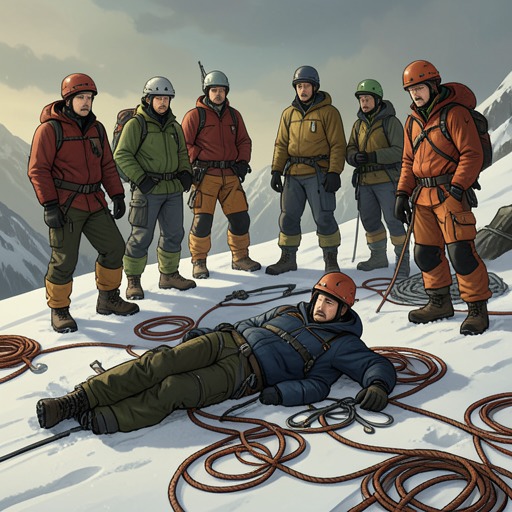
On April 22, a group of Sherpas was carrying supplies from Camp I toward Camp II to advance the route. Ngawang Topche Sherpa, the uncle of Lopsang Jangbu Sherpa, became confused and unwell. Scott Fischer encountered him while descending from Camp II and told him to go down. Fischer continued his own descent, expecting him to follow, but Ngawang Topche Sherpa instead continued upward. The account leaves open whether pride, misunderstanding, or confusion associated with his condition explained that decision.
A radio message from Camp II alerted the expedition at base camp to the trouble. Ngawang Topche Sherpa was found disoriented, and his symptoms led to a rapid diagnosis of HAPE. The situation demanded descent rather than further ascent, but the geography made that lifesaving response difficult: the distance to Camp I was insufficient, and the route onward led into the dangerous icefall.
Rescue and Coordination
Klev Schoening and Tim Madsen were at Camp II to continue their acclimatization and took charge of coordinating the response, since no Mountain Madness guides were there. Fischer had already left Camp II; Anatoli Boukreev and Neal Beidleman were resting at base camp after an earlier acclimatization excursion. Asked for advice, Boukreev emphasized the first actions: get Ngawang Topche Sherpa down as quickly as possible and give him oxygen.
The episode also exposed uncertainty about who would respond when a Sherpa was in danger. The narrator had expected Sherpas at base camp to go up immediately, partly because Ngawang Topche Sherpa, like Lopsang Jangbu Sherpa and several other team members, came from the Rolwaling Valley. They did not go up until later in the day. The narrator does not claim to know why, but draws a distinction between respecting Sherpas’ established skill and assuming that they would undertake any dangerous task outside their assigned work and paid responsibilities.
Significance
The emergency links a medical principle to the realities of expedition logistics. Recognition of HAPE made the need for immediate descent clear, but the elevation difference, route, and distribution of people at the camps complicated the response. The episode also shows how rescue depended on communication and available personnel: a radio report brought the problem to attention, while the absence of guides at Camp II left two acclimatizing climbers to coordinate the effort.
Elsewhere, the expedition account describes limited radio equipment as a serious concern and records how messages on the mountain could pass through several intermediaries. In that context, the HAPE episode stands as an early demonstration that altitude illness was not only a medical danger; responding to it also depended on whether information reached the right people and whether someone could undertake the descent.