Hillary Step
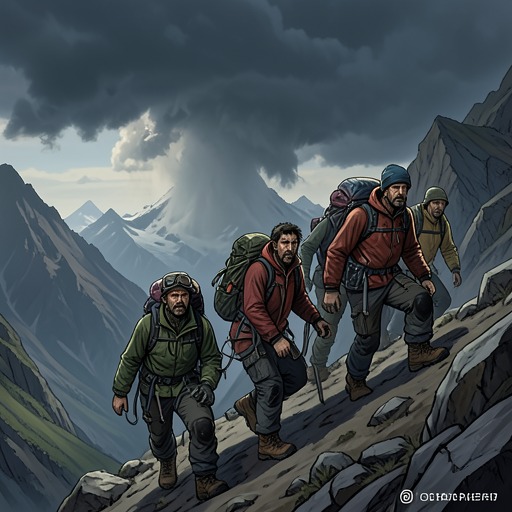
The ClimbThe Hillary Step is a rocky tower about ten meters high on the Southeast Ridge, a formidable obstacle near Everest’s summit where climbers’ strength, route infrastructure, and dwindling oxygen were tested at once. During the May 10, 1996 summit attempt, the Step became more than a technical passage: delays and incomplete rope preparation helped expose climbers to the costs of a late ascent, while distress at and below it drew rescuers into a worsening emergency.
Position and Climbing Challenge
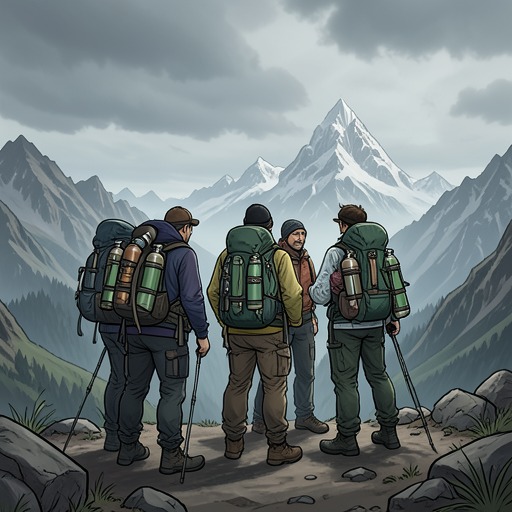
The Step rises from the Southeast Ridge near the summit. After as many as twelve hours of climbing, a mountaineer arriving at its base may be exhausted, taking several breaths for each step. Its imposing presence can discourage an already depleted climber, and it is a common place to turn back. Although only about ten meters high, it is therefore a physical and psychological bottleneck, not merely a short section of rock.
Anatoli Boukreev knew the obstacle from his 1991 ascent of Everest by the same route, when he climbed it alone without fixed ropes. But familiarity did not remove the need to secure the passage for the clients: on the 1996 climb he and Neal Beidleman had to help establish a safer route. On the summit ridge, a rope could make the difference between a protected ascent and a precarious exposed move, but laying it required time and coordination among guides and Sherpas.
Rope Preparation and the Queue
Climbers from the Scott Fischer and Rob Hall expeditions understood that the ropes between Camp IV and the summit were supposed to be fixed before the clients arrived. The climbing sirdars, Lopsang Jangbu Sherpa and Ang Dorje Sherpa, were expected to leave ahead of the groups so climbers would not have to wait. Instead, no Sherpas had gone ahead to fix them. Lopsang later said that a climber from a Montenegrin expedition had told him the route was already fixed; Jon Krakauer questioned that explanation, noting that both sirdars carried rope. The book presents the account as disputed rather than resolving it conclusively.
At the Hillary Step, Boukreev and Beidleman tried to make up for the missing preparation. After waiting nearly an hour on the South Summit without seeing anyone take action, they agreed to work together on the ropes. Boukreev retrieved lengths of old rope from the snow, then moved ahead toward the Step to speed the ascent and left a stretch for the guides and Sherpas following behind. At the Step he tied into anchors left by earlier expeditions while Beidleman belayed him. Once Boukreev reached the top, Beidleman followed, along with Hall’s guide Andy Harris and client Krakauer.
The route was still not fully secured. Boukreev had left a stretch below the Step for those behind him to fix, but Harris moved on with Krakauer without adding rope there. Martin Adams later described the resulting traverse as the climb’s most exposed section, where a slip could be fatal. The gap between the expected fixed route and the route actually available became especially consequential as climbers approached the obstacle tired and behind schedule.
Encounters During the Summit Push
The Step also brought ascending and descending climbers into close contact. As Adams prepared to rappel down its face, he looked over the edge and saw a Sherpa, Makalu Gau, and Fischer coming up. Fischer, advancing his ascender on the fixed rope, called out to Adams as though encouraging him toward the summit; Adams answered that he had already reached it. The exchange marked a striking reversal of direction: Adams was focused on getting down, while Fischer was still laboring upward.
Boukreev met Fischer just above the Step while preparing to descend. In his later account, he said Fischer appeared tired but reported that he was only moving slowly. Boukreev warned that the ascent was taking long enough for descending clients to run out of oxygen, and explained that he wanted to reach Camp IV quickly, warm up, and gather hot drinks and oxygen in case he needed to help them. Fischer approved the plan. The two guides’ exchange placed the Step at the hinge of a contested decision: Boukreev’s descent ahead of clients was, in his account, an agreed rescue precaution rather than an abandonment of them.
The Step was also a point of visible deterioration. On the descent, Adams found Krakauer lying on the traverse below it, holding his ice axe as a self-belay; Krakauer had exhausted his oxygen canister. Boukreev came up behind Adams and urged him to continue rather than stop there. Klev Schoening, arriving moments later, saw Krakauer in distress and wanted to remain until someone acted, but felt unable to help him himself. These encounters show how the same narrow route could serve as ascent, descent, and emergency scene within minutes.
Emergency and the Route Down
At about 4:30 p.m., Base Camp received a report from Hall’s camp that a team member had collapsed above the Hillary Step and that Hall was with him. Dr. Ingrid Hunt tried to arrange for oxygen to be sent up and asked Pemba to keep contacting Lopsang or anyone higher on the mountain. Pemba said the weather was too bad for him to go. Beidleman, who had no radio, continued down and could not respond directly to the call.
The communications chain was indirect and unreliable. Hunt’s messages passed through several Sherpas between Base Camp and Camp IV, and she believed reports were sometimes incomplete or presented in an overly reassuring way. The resulting uncertainty mattered because the reported collapse lay close to a section where climbers were already exhausted and oxygen-deprived. At the Step, the book’s separate threads of route difficulty, delayed descent, and compromised communication converged into an emergency that those at Base Camp struggled to assess and answer.
A later expedition account gives the obstacle another grim significance. During the 1997 Indonesian ascent, Anatoli Boukreev encountered the body of a man entangled in the ropes at the foot of the Hillary Step, obstructing the technical passage. He could identify only the blue down suit. Boukreev was focused on the condition of the Indonesian climbers accompanying him, and acknowledged that he and the others could not attend properly to the dead climber. The Step thus recurs in the book not only as a test on the way up, but as a place where the hazards and accumulated consequences of high-altitude climbing remain on the route for those who follow.
A Bottleneck in the Book’s Account
The Hillary Step concentrates several kinds of vulnerability in one short stretch: climbers must negotiate exposed terrain, depend on ropes being in place, and make decisions while fatigue and oxygen deprivation impair judgment. In 1996, the missing advance rope work created delays; the delayed ascent narrowed the time available for descent; and the crowded route brought struggling climbers face to face with those still moving upward. The Step’s significance lies in this convergence. It is a physical obstacle, but also a narrative threshold where logistical failures and individual limits become immediate, visible, and potentially fatal.