Himalayan Guides
The ClimbHimalayan Guides is a commercial mountaineering company headed by Henry Todd, an Edinburgh-based expedition organizer whose practical reputation and successful 1995 Everest season made him a significant operator on the mountain. The book presents the company not only through summit attempts but through the work that makes them possible: Sherpa employment, route infrastructure, equipment contracts, and the allocation of supplies. Its 1996 presence thus connects the business of guiding to the material and human systems on which high-altitude expeditions depend.
Identity and Record
Henry Todd, a fifty-one-year-old former rugby player, led Himalayan Guides, which was based in Edinburgh, Scotland. By the 1996 season, the company had never lost a client. Todd’s practical approach and good fortune in the mountains, together with his cooperative relationship with Kami Noru Sherpa, had helped establish that record and brought both men success in Himalayan expeditions.
That success had a recent precedent. In spring 1995, Todd took clients to Everest from the Tibetan, or north, side. Eight climbers from the expedition reached the summit, making the climb an unqualified success. Todd and Kami Noru Sherpa were therefore entering the next season with a strong record behind them, though both were anxious about the year ahead rather than simply relying on past results.
Sherpa Labor and Expedition Operations
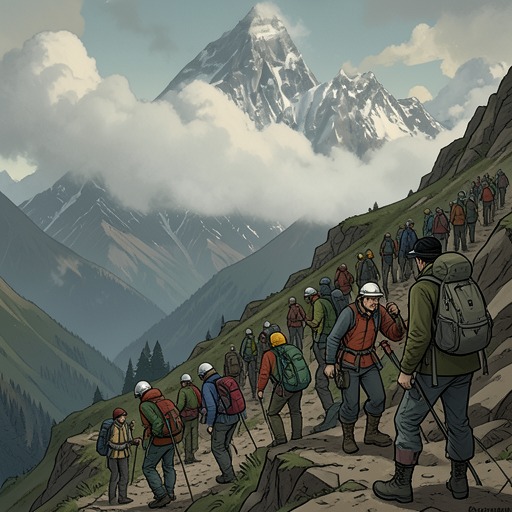
Kami Noru Sherpa, married and the father of three, had served for several years as Himalayan Guides’ sirdar, or manager, on Everest expeditions. His work represented a changing Sherpa livelihood: a generation that had moved from traditional dress toward Gore-Tex parkas and the cash economy of mountaineering. As the 1996 season approached, Kami and other Sherpas would trek from their homes to Everest Base Camp and join the expeditions that had hired them. For daily wages ranging from $2.50 to $50, they established camps, carried loads up the mountain, and cooked for and served climbers.
The company’s operations also depended on route-building work and the contested income it generated. In 1996, with seventeen teams at Base Camp, the fixing of the Khumbu Icefall became the subject of a dispute over who would organize the work and receive payment. Henry Todd and Mal Duff obtained the contract, and Duff and a group of Sherpas hurriedly fixed the route the expeditions would use. The larger arrangement drew criticism because teams used a route built by Sherpas while expedition organizers collected substantial fees from those who had not supplied Sherpa labor.
The book sets this commercial structure against the prospect that Sherpas might eventually control more of the mountain’s infrastructure. It imagines a future in which a team of climbing Sherpas fixes the entire route in advance and expeditions pay them as contractors. That change, however, is described as contested: established organizers benefiting from the existing arrangement would not surrender its returns without maneuvering and protest. The contrast makes clear that Sherpa expertise and labor were indispensable even when economic control and reward remained unequally distributed.
Oxygen Supply and Commercial Leverage
Todd’s commercial influence extended to the equipment required for a summit attempt. After guiding Todd’s successful north-side Everest expedition in 1995, Anatoli Boukreev returned to Kathmandu and resumed conversations about a job with Himalayan Guides. Todd, who was planning a 1996 expedition from the south side by the Southeast Ridge, wanted to secure Boukreev’s services for the coming season.
The oxygen negotiations revealed how supplier access could shape a rival expedition’s planning. In January 1996, Boukreev learned that Todd had made an advance purchase agreement with Poisk on the condition that he be the supplier for Everest, effectively making Himalayan Guides the exclusive distributor of Poisk oxygen. Boukreev was particularly surprised because he had introduced Todd to Poisk factory personnel the year before. With Mountain Madness clients due to leave for Kathmandu in late March and potentially attempt the summit in early May, that team urgently needed oxygen. Boukreev proposed buying from Zvesda in Moscow, where he believed he could secure a better price.
Mountain Madness tried to split its order: Poisk canisters from Todd for the summit push, and heavier Zvesda cylinders for use at lower elevations and by Sherpas. Todd rejected a partial arrangement. In his account of the call with Karen Dickinson, he insisted that the deal included not only Poisk cylinders but masks and regulators, and demanded that Mountain Madness either accept the entire package or lose the supply. Mountain Madness accepted; Dickinson canceled her planned trip to Russia. She later acknowledged that Boukreev had tried hard to improve the offer, but that the team had started too late and Todd had outmaneuvered them.
A confirmation memo recorded the resulting order as 55 three-liter Poisk bottles, 54 four-liter Zvesda cylinders, 14 regulators, and 14 masks. The figures became more than a procurement record: the book notes that they would later attract close scrutiny and painful questions. In the expedition setting, oxygen was both a commodity secured through commercial bargaining and a tightly counted safety resource.
Equipment, Planning, and the Summit Push
The consequences of those supply arrangements were visible at Camp IV on the night of the May 10 summit attempt. The Mountain Madness climbers had sixty-two canisters there: nine heavier Zvesda cylinders and fifty-three lighter Poisk bottles. By volume, only 51 percent of the oxygen purchased from Todd was available for the summit bid; most of the remainder had already been used, chiefly by Pete Schoening and Ngawang Topche Sherpa, while a small amount remained at Base Camp for medical emergencies.
The team had assigned the heavier Zvesda canisters to sleeping at Camp IV and reserved the Poisk bottles for the climb. Six Sherpas were climbing with the expedition; five planned to use oxygen, while the climbing sirdar, Lopsang Jangbu Sherpa, climbed without it. Lopsang carried one emergency bottle. Each of the other five Sherpas carried two bottles for personal use and two more for clients and guides, making twenty-one bottles carried by Sherpas. The six clients, Scott Fischer, and Neal Beidleman carried two bottles apiece; Boukreev carried one. Together, clients and guides carried seventeen bottles.
Once thirty-eight Poisk bottles had gone up the mountain, fifteen full bottles remained at Camp IV, along with whatever oxygen remained in the Zvesda cylinders used overnight. The margin did not allow the team to stay high and make a second attempt on May 11 if complications disrupted the first. The plan had become, in practical terms, one attempt or none.
Todd had advised that a Poisk canister flowing at two to two-and-a-half liters per minute should last six hours. On that calculation, two bottles would supply twelve hours—enough, under favorable conditions, to reach the summit from Camp IV and descend to the South Summit, where climbers were meant to collect a third cached bottle. The projected ten-to-eleven-hour ascent would leave an hour or two of oxygen at the summit; with the additional bottle, climbers were expected to have enough to return to Camp IV. The arithmetic depended on the weather holding and the route proceeding without delays. It appeared secure on paper, but its narrow reserves made the plan vulnerable when those assumptions failed.
Presence on the Mountain and Narrative Significance
Himalayan Guides’ presence intersected with the other expeditions not only through supply contracts but through people and communications. Near the upper end of the Khumbu Icefall on May 7, Todd met Scott Fischer on the fixed ropes and was surprised that the two were moving uphill at the same pace, since Fischer was usually much faster. Todd noticed him coughing. Fischer explained that he had taken Dale Kruse down because Kruse was distressed, and that he had not wanted to send him with Boukreev, Beidleman, or a Sherpa. The encounter showed the personal responsibilities of expedition leadership at the same time that it placed Todd’s team in close physical proximity to a rival operation.
On summit day, Lhakpa Galgen Sherpa, a climbing Sherpa from Himalayan Guides, was establishing a camp for Todd when Boukreev reached Camp IV at about five in the afternoon. Boukreev greeted him, then met Pemba Sherpa, who brought hot tea. Expecting other climbers to follow, Boukreev asked Pemba to prepare more. He did not know that Pemba had been in Camp IV throughout the day, and Pemba did not tell him about an earlier radio exchange concerning the possibility of carrying oxygen uphill or an emergency above the Hillary Step. At the same time, communication between Base Camp and the mountain was proving difficult: messages passed through several Sherpas, and Dr. Hunt feared that reports reaching her were incomplete or presented in an overly reassuring form.
The company’s significance in the book lies in the way ordinary commercial decisions become part of the mountain’s safety architecture. Hiring, route contracts, oxygen purchases, cylinder capacities, and the movement of information were not separate from climbing risk: they determined who did the labor, what resources were available, and how much flexibility an expedition retained. Himalayan Guides appears both as a successful commercial operator and as a participant in a wider system where the rewards of organizing an expedition and the risks of carrying it out were distributed unevenly.