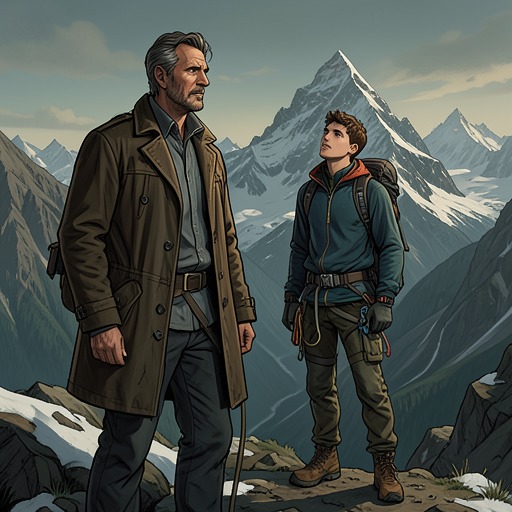
K2
The ClimbK2, the world’s second-highest mountain, is portrayed as a defining test of high-altitude skill and judgment. Its severe upper slopes make it more than a setting: the accounts associated with it connect rescue and survival to the risks of commercial expeditions and to questions about who performs and benefits from the work of climbing.
Mountain and climbing challenge
The book distinguishes K2 from Everest by emphasizing the difficulty of its routes and the height at which its hardest climbing takes place. Its pyramidal mass places demanding terrain high on its flanks, while the history of attempts to reach its summit includes numerous tragedies. For Anatoli Boukreev, those conditions made K2 an especially clear example of why high-altitude guiding required qualified climbers, careful client selection, and self-reliance rather than the close supervision possible on lower mountains.
Rescue and the mountain’s history
K2’s significance is embodied in two rescue accounts. In August 1992, after reaching the summit, Scott Fischer descended at night through a snowstorm despite exhaustion and a shoulder injury. He helped bring Gary Ball, who was unable to descend under his own power, down the mountain; Ball was a New Zealand climber and a business partner of Rob Hall. Fischer’s earlier experience on K2 thus joined the mountain’s dangers to the capacity for decisive assistance under them.
A second account reaches back to August 10, 1953, when Pete Schoening and seven other Americans abandoned their summit attempt to help a teammate whose condition threatened his life. During the descent in a snowstorm, Schoening’s belay arrested a fall that had pulled four climbers off the mountain. His ice ax, wedged behind a boulder, anchored the rope; the climbers came to a stop, one more than 150 feet below him. The episode established Schoening’s reputation as a rescuer and helps explain why Fischer greatly respected him and trusted his climbing ability.
Commercial ambition and expedition labor
K2 also appears in Fischer’s plans for Mountain Madness. While discussing future high-altitude guiding with Boukreev, Fischer considered a commercial expedition to the mountain and imagined recruiting experienced guides, potentially including Russian climbers. The idea followed his belief that a successful Everest business could improve Mountain Madness’s financial prospects and support a broader schedule of major expeditions. K2 was therefore both a formidable objective and part of the commercial future Fischer hoped to build.
The book sets such ambitions against the labor and economics of Himalayan expeditions. Sherpas were paid between $2.50 and $50 a day to establish camps, carry loads, and cook for and serve climbers. In a later reflection on expedition organization, Boukreev criticized a system in which expedition leaders could collect substantial payments for access to a route fixed by Sherpas whose work was underpaid. He anticipated that climbing Sherpas might eventually contract to prepare the route themselves, with Nepalis exercising greater control over the mountain’s infrastructure. K2’s commercial appeal belongs to this wider context: high-altitude objectives depend not only on clients and guides but also on the often less visible labor that makes an expedition possible.
Risk, judgment, and remembered evidence
The K2 episodes sharpen the book’s contrast between summit success and responsibility to other climbers. Schoening’s team gave up its attempt in order to help a teammate; Fischer’s descent after summiting likewise became a story of risk taken on behalf of someone else. These accounts present rescue not as an incidental episode but as a measure of judgment on a mountain where mistakes can have grave consequences.
The book’s account of climbing history also depends on recollection rather than a single, uncontested record. Participants in the 1996 Everest expedition recorded their memories in a debriefing five days after the disaster, and the authors used those tapes as a historical source. Elsewhere, competing memories of an encounter on Everest—including disagreement over whom a climber had seen—illustrate the limits of recollection at altitude. The K2 stories are presented as part of this larger inquiry into how climbers act under pressure and how accounts of those actions become historical evidence.