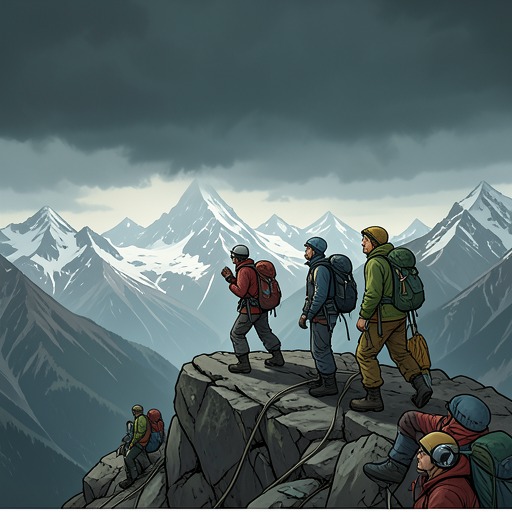
Lou Kasischke’s turnaround
The ClimbLou Kasischke’s turnaround on May 10, 1996, was a decision to give up the summit while there was still time to descend. Delayed in a fixed-rope logjam below the South Summit, he recognized that dehydration, frostbitten fingers, fatigue, and changing weather made getting back alive uncertain. Stuart Hutchison and John Taske also turned around; when Kasischke encountered Scott Fischer on the way down, Fischer told him he had made a good decision.
The Bottleneck Below the South Summit
Kasischke was among the Hall clients climbing near the back of a crowded rope line below the South Summit. The Taiwanese climbers ahead were moving slowly, and the congestion prevented those behind them from making steady progress. The delay had broader stakes: climbers and Sherpas carrying additional oxygen were scattered between the South Summit and the Balcony, while some climbers were already on their second canister. Hall’s one o’clock turnaround time made every stalled minute consequential.
The delay was not an abstract concern for Kasischke. Around 11:30 A.M., he was moving one step at a time, drawing on his experience as a long-distance runner and endurance athlete. But the habit of tuning everything out, which helped him endure hardship, also risked keeping him from noticing how depleted he had become. When the queue stopped below the South Summit, he dropped to his knees and clipped into the rope to rest.
The Decision to Turn Back
Kasischke was severely dehydrated. His water had frozen solid in his backpack, so he removed a glove and scooped up snow; when he took off the other glove, he found that all his fingers were frostbitten. He already knew about the frostbite, but had been prepared to continue because reaching Everest’s summit mattered so much to him. Resting in the queue became a wake-up call: he began to take stock of his fatigue and of the conditions around him.
The view had changed as well. The spectacular sights he had seen at the Balcony were gone, and visibility down the mountain was poor. He did not describe the weather as yet horrendous, but it was changing. When he asked the Sherpa Lhakpa how much farther they had to go, Lhakpa estimated two hours and placed them at 8,700 meters. Kasischke could not readily translate that altitude into the feet he usually used to think about distance. The two-hour estimate made him recognize that the question was not whether he could keep climbing to the top; it was whether he could get back down.
For several minutes, two competing arguments occupied him. One urged him to go on: two more hours seemed manageable, and the summit was close. The other warned that he might die on the descent or lose his fingers even if he survived it. Kasischke told Lhakpa to go and inform Rob Hall that he had decided to return. He later recalled that the decision took four or five minutes, and that Hutchison’s earlier warning about the late hour may also have influenced him. But he understood the choice as his own judgment that he could not make the round trip alive, or at least without serious injury.
A Different Measure of the Summit
Earlier, Hutchison had come back down the line and spoken with Kasischke. He believed the congestion made it impossible to get back by the one o’clock turnaround time and expected Hall to turn everyone around. Kasischke had answered that he was not ready yet, then continued upward. That brief exchange placed the decision in view before Kasischke himself reached it: the summit remained the immediate goal, but the delay was already making the descent deadline doubtful.
Kasischke described himself as wanting the summit intensely, but not as being governed by the same pressures he associated with some other expedition members. He lived in Detroit, where people might not know where Everest was or might mistake his achievement for an earlier climb; he did not expect newspapers, fame, fortune, or records to make the summit indispensable. His ambition mattered, but he said it did not suffocate every other thought. The distinction did not make turning back painless. It did give him room to weigh the summit against the chance of returning with his life and fingers intact.
Hutchison, Taske, and Fischer
At about 11:40 A.M., Kasischke headed down. Hutchison and Taske also turned back, ending their summit attempts. Their decisions followed the same logjam, though the evidence presents Kasischke’s internal reckoning in particular detail: Hutchison had already anticipated that the one o’clock limit could not be met, while Kasischke’s decision came through his assessment of his own physical condition and ability to descend.
Around noon, Kasischke encountered Fischer and told him that returning seemed the smart choice. Fischer looked directly at him and agreed. Kasischke remembered the encounter not as a formal exchange but as a brief moment of recognition: Fischer had snow in his hair and his familiar, bright-eyed expression; the two men stood together for perhaps thirty seconds before continuing in opposite directions. Fischer’s approval gave the decision an immediate human acknowledgment, but it did not alter its basis: Kasischke had turned back because he believed survival on the descent was at stake.
The Turnaround’s Significance
The episode reverses the usual measure of progress on a summit push. Kasischke was close enough to imagine reaching the top and believed he could make the remaining ascent, yet the bottleneck, the frozen water, the frostbite, and the worsening visibility forced him to judge the mountain by the return journey. His choice was not a rejection of ambition; it was a limit placed on ambition when continuing threatened the possibility of getting down.
The book makes that change of judgment concrete rather than abstract. Kasischke first persists through the queue, then kneels to rest, discovers again the full extent of his frostbite, asks how much climbing remains, and finally tells Lhakpa to send word to Hall. The movement from forward motion to deliberate retreat takes only minutes, but it replaces the summit as the decisive objective with the prospect of returning alive and, if possible, in one piece.