Martin Adams
The ClimbMartin Adams, a retired Wall Street bond trader and determined climber, joined Mountain Madness’s 1996 Everest expedition after paying $52,000 for a place and placing particular trust in guide Anatoli Boukreev. He reached the summit after a difficult, delayed ascent, then descended alone through darkness and storm, encountering crevasses and other climbers in distress. His account also became part of the contested record of the disaster: the book sets his recollections beside conflicting memories, showing how a participant’s observations could clarify events while remaining subject to uncertainty at altitude.
Background and Decision to Climb
Adams was forty-seven and had retired after a successful career selling and trading bonds on Wall Street. Before Everest, he had climbed classic routes in the Alps and Rockies, as well as Aconcagua, Mount McKinley, and Kilimanjaro, but had not summited an 8,000-meter peak. He turned back at 7,000 meters on Broad Peak in 1993 and reached 7,400 meters on Makalu the following year before retreating. Those unfinished attempts did not end his ambition; they made his assessment of the Everest opportunity more deliberate.
When Adams learned that Boukreev would be among Mountain Madness’s guides, he decided to join and negotiated a $52,000 fee. He valued Boukreev’s direct manner and experience, and understood that Everest was no easy excursion. His confidence was not a claim that the mountain was safe: he believed his chances of summiting would be substantially better with Boukreev on the team. Boukreev, who already knew Adams from the Makalu expedition, regarded him as determined and highly motivated and promised his best help and advice.
Acclimatization and Concerns About the Expedition
Adams was attentive to the distinction Boukreev drew between gaining altitude and preserving the strength needed for a summit attempt. During a rest-day conversation, he described how a series of acclimatization climbs on Makalu had left him feeling depleted after a night at Makalu-La Pass and the descent to Base Camp. Rest had not restored his desire to attempt the summit. Boukreev attributed that exhaustion in part to the quick succession of Adams’s earlier excursions and advised him to acclimatize with as few high-altitude nights as possible, then recover through rest, proper food, and a descent to the lower, more oxygen-rich forest zone. Adams was an exception among clients in taking the recovery question seriously.
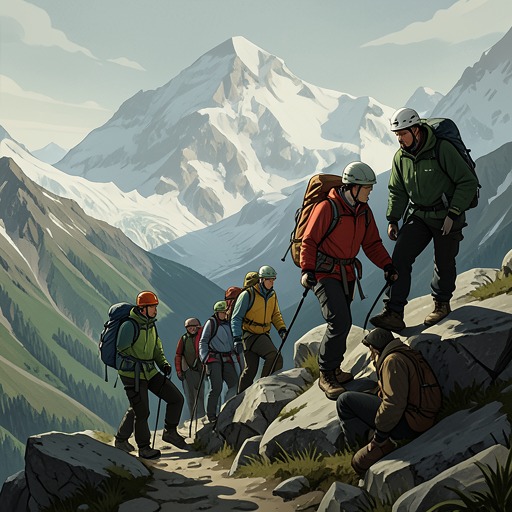
At Camp II, however, Adams grew frustrated with the expedition’s pace and management. He believed that logging on seemed to receive more attention than logistics, and that the slow progress threatened his chance to advance on schedule. Camp III had not yet been established, preventing him from spending the planned night there as part of his acclimatization routine. A compromise allowed clients to climb the fixed ropes to 7,000 meters while Boukreev and Scott Fischer went higher to select and prepare the Camp III site. When Boukreev later reached Camp III, Adams was among five of Fischer’s eight clients who had arrived in his absence; Boukreev thought the group looked strong but remained mindful that conditions could change quickly at altitude.
Adams’s judgment about the team extended beyond his own progress. He worried that Fischer was allowing Dale Kruse and Pete Schoening to continue toward a summit bid despite signs that they were unwell. Adams told Neal Beidleman that they had no business going higher and warned that a fatal outcome would bring worse publicity than turning clients around. His concern sharpened a central tension in the expedition: clients wanted to climb, while guides had to decide when ambition had become a danger. Adams could not directly intervene in Fischer’s decisions, but he was willing to state plainly what he believed the risks required.
Summit Day and the Delay on the Route
On May 10, Beidleman reached the South Summit at 9:58 a.m.; Adams followed about thirty minutes later. The two spent an hour and a half to two hours there, waiting as climbers jammed the fixed ropes. Adams recalled that slower clients from Rob Hall’s team had moved ahead of Fischer’s group and could not pass. The bottleneck delayed the ascent while climbers and Sherpas carrying additional oxygen remained strung out between the South Summit and the Balcony. By then, the oxygen supply available to climbers was becoming an immediate concern.
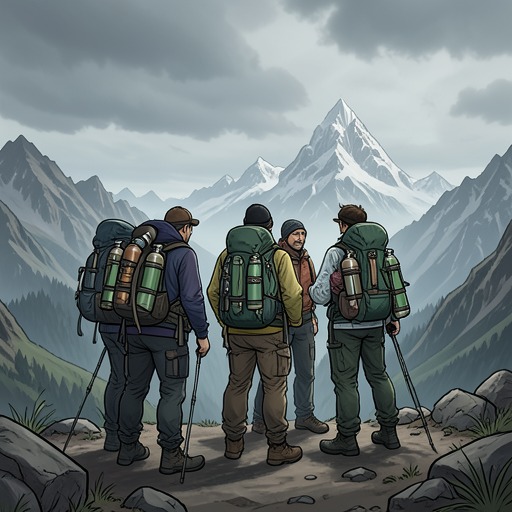
At the South Summit, Adams sat with Beidleman, offered him water, and noticed that Beidleman’s supply had frozen. After about twenty minutes they moved into a natural alcove somewhat more protected from the wind. Beidleman asked how much oxygen Adams had left; Adams checked the gauge on his canister and found five pounds. Beidleman also had five pounds, but carried a full bottle from Boukreev. Adams proposed that they use the remaining oxygen and continue, but Beidleman refused to give him the full bottle. They agreed that Adams could take Beidleman’s remaining supply, yet they did not set off immediately. The exchange captures Adams’s impatience with the stalled climb and his awareness that continuing would mean spending his last oxygen reserve.
Adams eventually summited. On the descent near the Hillary Step, he encountered Jon Krakauer slumped in the snow, holding on to his ice axe; Krakauer had exhausted his oxygen. Boukreev was immediately behind Adams and urged him to keep moving rather than delay. This moment later became part of a disagreement over who had been present and what Adams had seen. Adams’s own recollection placed Krakauer at that spot, while Krakauer questioned whether Adams might have mistaken another climber for him. The book leaves the discrepancy visible instead of treating recollection under exhaustion as infallible.
Descent Through the Storm
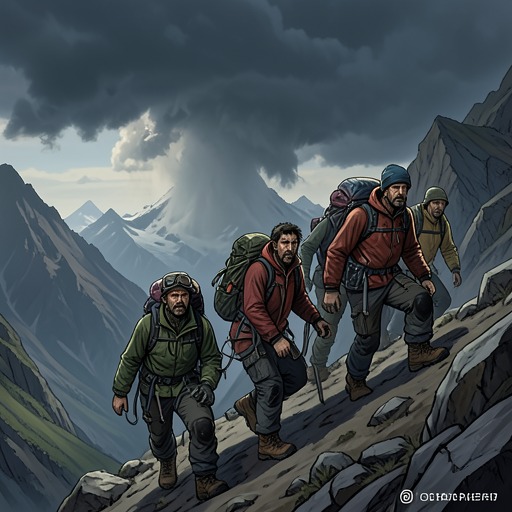
After glissading down the route, Adams reached the fixed ropes below the Balcony, around 8,350 meters, and followed them to their end at about 8,200 meters. By then Boukreev had completed his first search into the storm. Adams saw no other climbers along the rope and was alone. Crossing the South Col, he fell into a narrow crevasse, pulled himself out, and then fell into a second. Unable to see clearly in the darkness, he used his ice axe to gain purchase on a patch of blue ice and lever himself free before continuing down.
Near Camp IV, Adams came upon a climber sitting in the dark and asked where the tents were. Neither man recognized the other in their debilitated condition: the stranger was Krakauer. Adams thought he had encountered someone from an expedition waiting to climb, rather than a fellow summit climber. Krakauer directed him toward the tents and warned that the slope was steeper than it appeared, advising him to get a rope and screws. The brief encounter underscores how darkness, exhaustion, and impaired recognition could make even familiar people seem unknown.
The timing of Adams’s return became consequential in later accounts of the rescue. During the May 15 debriefing, he said that he reached Camp IV at about nine. Ingrid Hunt recalled that the first word of his arrival came at 8:30 p.m. Boukreev later accepted Adams’s recollection as reasonably accurate while acknowledging that he had not recorded the time himself and had begun to lose track of it during his own search. The discrepancy is presented as a problem of memory and observation in a storm, not as a simple resolution of who kept the better clock.
Recollections and Narrative Significance
Adams’s testimony was drawn from the Mountain Madness debriefing recorded at Everest Base Camp on May 15, five days after the disaster, and from later interviews. The recording brought nine climbers together to state what they remembered; its participants’ efforts at truth-telling and self-reflection became part of the historical record. Adams’s recollections supply concrete details—the logjam, the oxygen gauges, his descent alone, and the encounter near Camp IV—while the book also identifies where those details conflict with other accounts.
One dispute concerned an exchange between Adams and Fischer near the Hillary Step. Jon Krakauer’s account placed the conversation within his hearing, but Adams later told G. Weston DeWalt that Krakauer had been out of earshot. According to Adams, Fischer asked whether he could summit while Adams peered over the Step, and Adams replied that he had already done so. Adams also confirmed that Boukreev told Fischer he was going down with Adams, but said Krakauer had not heard that comment. The book uses this correction to distinguish what a witness personally heard from what a later narrative placed within the scene.
Adams’s place in the story is therefore larger than that of a client who reached the summit. His earlier turnarounds and careful attention to recovery inform his approach to the climb; his protests about vulnerable clients expose a conflict between ambition and judgment; and his summit-day account provides evidence about delays, oxygen, and the descent. Yet the narrative does not make his memory a final authority. It treats him as a valuable witness whose position and recollection matter, while preserving the uncertainty that made the disaster’s reconstruction contested.