May 10, 1996 Everest summit attempt
The ClimbThe May 10, 1996 Everest summit attempt was a joint, increasingly delayed push by Mountain Madness, Adventure Consultants, and Taiwanese climbers up Mount Everest’s Southeast Ridge. Its decisive significance lies in the widening gap between the plan and the climb as it unfolded: climbers expected fixed ropes to be ready, but instead encountered a bottleneck that forced guides to stop and install rope while oxygen and daylight dwindled. The summit was reached, but success at the top came late and did not resolve the danger of getting everyone back down.
Preparation and the ascent
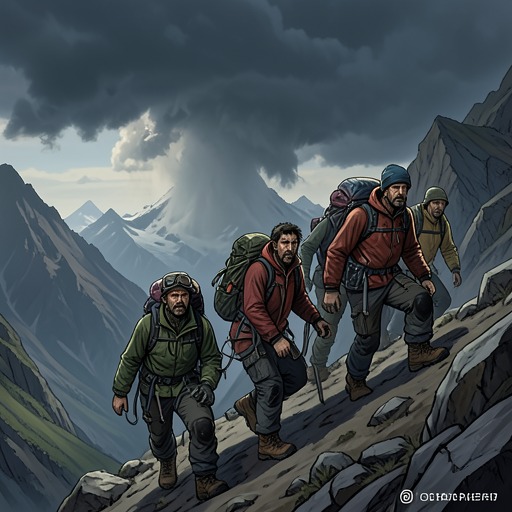
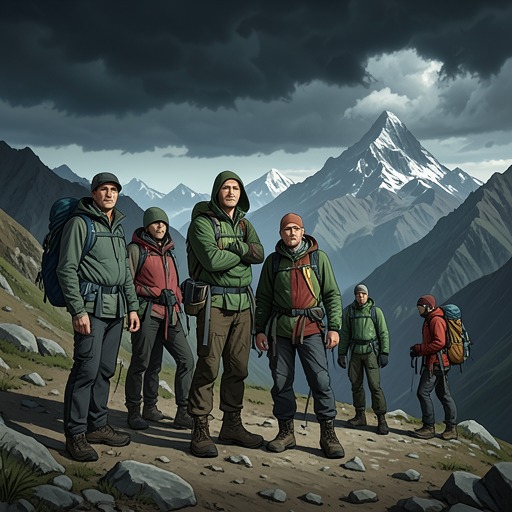
Adventure Consultants left Camp IV thirty minutes before Mountain Madness. Rob Hall’s party included fifteen people: Hall, two other guides, eight clients, and four Sherpas, among them Ang Dorje Sherpa, the climbing sirdar who had worked with Anatoli Boukreev on fixed ropes. The staggered start did not keep the teams separate. Within two to three hours, Mountain Madness climbers began passing Hall’s group; by 4:00 A.M., the parties were thoroughly mixed with one another and with three climbers from the Taiwanese National Expedition, including expedition leader Makalu Gau. The Taiwanese climbers had joined the wake of the larger parties, apparently relying on them to break trail and fix ropes.
The mixture created a human traffic problem as well as a logistical one. Lene Gammelgaard considered Hall’s group strong but slow, and one Mountain Madness climber thought starting behind Hall and then mingling with his party on the fixed ropes had cost the teams a couple of hours. At the same time, Hall’s rule against allowing climbers to get more than one hundred meters apart during the first part of the summit day repeatedly brought the lead climbers to a halt. Jon Krakauer and Ang Dorje reached the Balcony, at about 8,500 meters, at 5:30 A.M. after stop-and-go progress that had cost them more than an hour; Krakauer and other climbers recalled that Hall’s spacing instruction contributed to the pauses.
At the Balcony, a small resting ledge, climbers changed from their first oxygen canister to their second, drank, and tried to recover before continuing into the Death Zone. Mountain Madness clients understood that the ropes from Camp IV toward the summit would already have been fixed by the Sherpas of both expeditions, who were expected to leave around 10:00 P.M., well before the clients’ midnight departure. That arrangement was not carried out: no Sherpas had gone ahead to fix the route. The explanations later differed, but the immediate consequence was plain on the mountain—the clients reached a high, exposed bottleneck without the prepared line they expected.
Ropes, delays, and dwindling supplies
At about 8,600 meters, where a succession of rock steps required fixed ropes to reach the South Summit at 8,748 meters, climbers had already been waiting for more than an hour. Neal Beidleman told Boukreev he would go ahead to help with the ropes. Boukreev agreed and gave him the oxygen canister he had been carrying, reasoning that Beidleman would need it for the hard work. Beidleman went over a bulge with Klev Schoening behind him and found Lopsang Jangbu Sherpa bent over and vomiting. Lopsang was in no condition to do the labor, so Beidleman took rope from his pack and, with Ang Dorje’s assistance, began fixing the route. They could trust some old ropes; elsewhere, new rope had to be threaded into place.
The work resolved a practical obstacle but consumed more of the schedule. At the South Summit, Beidleman arrived at 9:58 A.M.; Martin Adams followed about thirty minutes later. They waited there for roughly an hour and a half to two hours while climbers jammed the fixed ropes below. Some of Hall’s slower clients had moved ahead of Mountain Madness climbers and could not be passed. By 10:30 A.M., Hall’s seven remaining clients were scattered between the Balcony and just below the South Summit among Fischer’s clients and the Taiwanese climbers. At the recommended oxygen flow rate, many climbers were on their second canister with only one to two hours’ oxygen left, while their third and last canister had not yet reached the South Summit. The Sherpas carrying the extra oxygen were themselves strung out along the congested route.
The Mountain Madness oxygen reserve had little capacity for delay. The team had sixty-two canisters at Camp IV: nine heavier Zvesda canisters, reserved for sleeping, and fifty-three lighter Poisk canisters set aside for the summit climb. Five of the six climbing Sherpas planned to use oxygen and each carried two canisters for personal use plus two for clients and guides; Lopsang climbed without oxygen but carried one emergency canister. In total, the Sherpas took twenty-one bottles up the mountain. The six clients, Scott Fischer, and Beidleman carried two each, while Boukreev carried one. Together, guides and clients carried seventeen bottles; all climbers carried thirty-eight Poisk canisters, leaving fifteen full ones at Camp IV, in addition to whatever remained from the Zvesdas. There was not enough reserve to absorb a failed attempt and an overnight stay before trying again the next day.
The summit and the missed deadline
The congestion also made the decision to turn around harder to enact. Lou Kasischke recalled meeting Stuart Hutchison near the back of the jam. Hutchison believed Hall would turn everyone around because the bottleneck made it unlikely they could return by the understood 1:00 P.M. deadline; Kasischke, not yet ready to quit, moved on, but made little progress. The teams did not have one shared, clearly communicated standard: Hall’s clients variously understood the turnaround time to be 1:00 P.M., 2:00 P.M., or a decision to be made on the mountain. Fischer, by contrast, had not set a fixed summit-day turnaround time. His plan was for Lopsang and the guides to alternate leading while Fischer brought up the rear and turned back stragglers as he caught them. Neither Boukreev nor Beidleman had been issued a radio.
After nearly an hour of waiting on the South Summit, Boukreev and Beidleman decided to work together on the route toward the summit. Boukreev removed old rope from the snow, then went ahead toward the Hillary Step to speed the ascent, leaving that section for guides and Sherpas behind him. When Jon Krakauer worried about his oxygen supply, he asked Beidleman whether he could hurry toward the summit while Beidleman continued fixing rope. Beidleman agreed. He and Adams paid out rope, but it caught in the rocks; after they freed it, Beidleman tied it to a snow stake and found no further anchor. He threw the unanchored length toward Tibet rather than leave it where a climber might mistake it for a secured line. Less than half the intended route had been fixed.
Boukreev reached the summit at 1:07 P.M., later than he had hoped, but judged that clients who followed quickly could still return to Camp IV under oxygen. Krakauer arrived at 1:12 P.M., followed shortly by Andy Harris. Beidleman and Adams reached the summit at about 1:25 P.M.; Adams had turned up Beidleman’s oxygen as Beidleman struggled on the ascent. Concerned about his own supply, Krakauer descended quickly, still on his second bottle. At about 1:45 P.M., Klev Schoening came over the final rise. Boukreev photographed him approaching the aluminum tripod marking the true summit, arms raised in celebration; Schoening soon wept.
After Schoening arrived, summit traffic stopped. By 2:00 P.M., no one else had appeared, and Boukreev began wondering where the remaining clients were. From Camp II, Ed Viesturs of the IMAX/IWERKS Expedition and others could see climbers still moving slowly above the South Summit as streamer clouds crossed the top. Their view sharpened the danger: climbers had a finite oxygen supply and still faced the descent. The missed schedule was no longer merely a matter of a late summit; every additional minute reduced the time and oxygen available for the return.
Late arrivals and the turn downhill
Adams spent about ten or fifteen minutes on the summit, took photographs with Boukreev’s camera, and posed with Beidleman and a Kazakhstan flag. He then started down, saying he was leaving. Boukreev followed, then Schoening. Boukreev had no radio, and neither did Beidleman, so they had no direct account of events below them. Boukreev suspected there might be trouble at the Hillary Step and decided to descend. As he left, he stooped to collect rocks as souvenirs and noticed a five-rupee Indian coin, which he put in his pocket for luck.
The summit was not yet empty. Between 2:15 and 2:30 P.M., Martin Adams and Boukreev passed four Mountain Madness clients—Tim Madsen, Charlotte Fox, Lene Gammelgaard, and Sandy Hill Pittman—as well as Lopsang, who were still climbing. Pittman was close to the summit when the last of the oxygen in her third bottle ran out. Lopsang noticed her distress, retrieved the emergency bottle he had carried from Camp IV, and connected her to it. That intervention got her through the final yards, but it also showed how little margin remained even for a climber nearing the top.
By 2:30 P.M., every client who had begun the ascent had reached the summit. Fischer had not turned any clients back during the day: after Gammelgaard parted from him early in the climb, he had not made contact with the clients. Yet no one left the summit until 3:10 P.M. The group spent forty minutes celebrating, taking photographs, crying, congratulating one another, and exchanging backslaps. Those moments of achievement consumed forty minutes of oxygen and daylight. When Fischer finally cleared the Hillary Step at 2:35 P.M., Adams recalled, Fischer wanted to clip on and descend; before going, he offered Harris and Krakauer the chance to descend first because they had reached the step before him.
Communication and the attempt’s meaning
As the emergency above the Hillary Step worsened, information moved through an unreliable chain rather than directly to everyone who needed it. Dr. Ingrid Hunt at Base Camp said messages passed through Ngima, Gyalzen at Camp II, and Pemba at Camp IV, then back through the same intermediaries. Hunt felt that information from Ngima was incomplete or presented in a more reassuring light, and communication with Pemba was sporadic. She went between Mountain Madness and Hall’s camp because Hall’s camp had better communications, while continuing to ask Ngima for news. Boukreev, meanwhile, arrived at Camp IV expecting that other climbers might soon follow, asked Pemba to make more tea, and received no warning from him about the radio exchanges or the emergency above.
The material systems of the climb—fixed ropes, oxygen canisters, radios, and the relay between camps—were not incidental equipment. They set the conditions under which climbers could move, wait, learn what was happening, or offer help. The missing prepared ropes helped turn the route into a jam; limited oxygen made the delay costly; the lack of radios for Boukreev and Beidleman left key guides without direct information; and the indirect radio chain slowed the flow of urgent news. The summit attempt therefore unfolded not as a single failure of timing but as a succession of constraints that reinforced one another.
The expedition had expected to climb a prepared route, keep clients moving, and bring them back with oxygen before nightfall. Instead, several teams converged on the same narrow line, the guides improvised rope work, and climbers reached the top after the stated or understood turnaround times had passed. The ascent’s achievement and its danger were inseparable: every client reached the summit, but the crowded route and late departure from the top left the return exposed to precisely the shortages of time, oxygen, and coordination that the plan was supposed to prevent.