Mike Groom
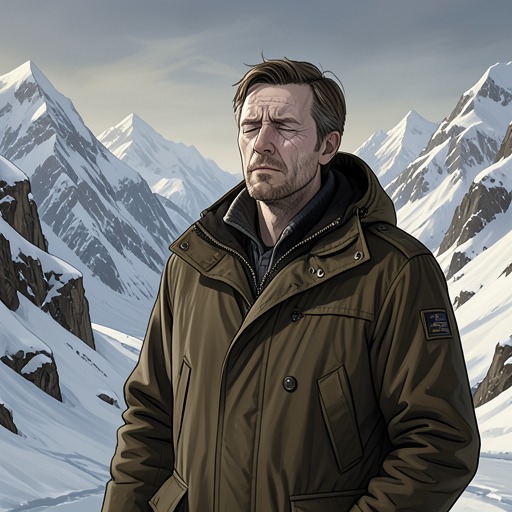
The ClimbMike Groom, a guide with Rob Hall’s Adventure Consultants expedition, occupies the narrowing space between assistance and helplessness in the 1996 Everest storm. He gives up his oxygen to Jon Krakauer, tethers Beck Weathers and starts him down, and tries to move Yasuko Namba through the fixed ropes; when the group becomes lost in the blizzard, Groom goes on alone to seek help, leaving others behind because he cannot bring them all to camp. His actions make the rescue’s central predicament concrete: people could still help one another, but none had enough strength, oxygen, or visibility to make every rescue possible.
Identity and Role
Groom was one of Hall’s guides on the summit attempt, part of the Adventure Consultants team whose climbers became intermingled with Scott Fischer’s Mountain Madness party on the route. On the descent he was among the guides and clients dealing with depleted oxygen, failing strength, and a storm that erased the route back to Camp IV. His position did not give him control over the scattered climbers; it repeatedly put him close enough to intervene while leaving him subject to the same physical limits as the people he was trying to help.
The account also situates Groom within the commercial expedition’s structure. He was a professional guide responsible for clients on the mountain, yet at Camp IV his own calls for assistance from members of Hall’s team went unanswered. The gap between formal responsibility and the practical ability to act becomes one of his defining circumstances: he can tether Weathers, guide Namba down the ropes, and carry news to camp, but he cannot command the resources or strength needed to bring everyone in.
Summit Descent and Oxygen
On the descent, Groom gave his oxygen canister to Krakauer, who had run out. Krakauer accepted it and soon reached the South Summit, where he took another canister from the oxygen supply Hall’s climbing Sherpas had placed there. The handoff was brief but consequential: Groom surrendered an immediately useful resource to a fellow climber, while the available cache made it possible for Krakauer to continue down after the transfer.
Groom then encountered Weathers on the Balcony, where Hall had told him to wait for assistance. Weathers was still there, nearly frozen in place. Groom tethered him to his climbing harness and began moving him down. That decision converted waiting into movement, but it did not solve the larger problem of keeping the descent together. Namba, who had apparently been climbing earlier with Groom, could not keep pace with him and Weathers and was left behind.
Namba and the Storm
Namba was later found struggling alone on the fixed ropes above Camp IV. Neal Beidleman recognized her as the Japanese climber from Hall’s group and tried to explain how to descend faster. When she could not manage the instructions or physically help herself, he took hold of her harness and moved her down by sliding, standing, or rolling with her according to the terrain. Tim Madsen helped at points, including when she hesitated at crevasses. Groom was not the person who brought her down that section; the narrative places him earlier with Weathers and then separates Namba’s descent from his.
By the time the climbers reached the bottom of the fixed ropes, the storm had intensified and Camp IV’s light disappeared. A larger group formed without a clear leader, its members buffeted by the wind and often following whoever had a headlamp ahead. Groom was among those in the disorganized descent and later appeared in the group Beidleman remembered gathering in the storm. When the party became lost, the climbers were divided between those who could attempt the dash toward camp and those who could not keep moving.
Madsen stayed with Charlotte Fox and Namba, then went back for the Japanese climber after hearing her moan. Weathers was also struggling, still tethered to Groom. Madsen told Groom, whom he presumed remained functional, to go to camp and get help. The group’s plan was to remain huddled together, stay awake, and try to keep warm while awaiting a return. The episode makes Groom’s departure a painful practical choice rather than a clean rescue: he left three depleted clients and Madsen in the storm because someone had to reach camp, and the people with him could not carry the others there.
The Search for Help
Groom’s effort to get assistance did not begin with his solitary departure into the night. After returning to Camp IV with Beidleman, Klev Schoening, and Lene Gammelgaard, he pleaded with members of the Adventure Consultants team to attempt a rescue of Weathers and Namba. No one responded with help. Later, when Anatoli Boukreev needed assistance for clients reported stranded in the storm, he also sought support from Hall’s expedition, without success. Groom’s earlier appeal and Boukreev’s later one mark two moments when the camp’s potential rescuers failed to mobilize.
Alone, Groom walked into darkness and a heavy gale carrying high-velocity ice particles, unsure where he was going. He wandered for what seemed like hours, growing lethargic as his body temperature fell critically. During a temporary break in the weather he caught sight of Camp IV, stumbled into it, passed one tent, and stopped at the tent of Stuart Hutchison and Krakauer. He tried to communicate the urgency and the location of those stranded on the South Col, hoping the information would bring rescuers together. Groom later understood that Hutchison went out into the storm, but that the blizzard’s ferocity prevented a rescue effort.
The consequences of this failed appeal were stark. Namba and Weathers remained exposed, and the subsequent efforts did not have the strength to reach everyone. Boukreev later found the stranded group and brought Charlotte Fox and Sandy Hill Pittman back in separate trips, with Madsen following; Groom’s arrival at camp had supplied information, not an available rescue party. The distinction matters: getting the alarm through was an achievement, but it could not overcome the conditions or guarantee that those left behind would be found in time.
Relationships and Narrative Significance
Groom’s actions connect him to several climbers through specific acts of care. He relinquished oxygen to Krakauer; secured Weathers to his harness and began the descent; and, when he could not keep the group intact, became the person Madsen sent to seek help. His relationship to Namba is more difficult to read as a single act: he had climbed with her earlier, but she fell behind while he was moving Weathers. Beidleman and Madsen later worked to get her off the fixed ropes and keep her with the others, yet she was ultimately among those for whom help did not arrive in time.
Groom’s own retrospective testimony complicates the account without resolving every uncertainty. The book notes that he recalled hoping he had given accurate directions and instructions to help rescuers find Weathers, Namba, and the others. It also reports that his understanding was that Hutchison had gone back out, but that the storm defeated the attempt. The narration preserves the difference between what Groom experienced, what he hoped his words would accomplish, and what he later understood had happened; it does not present his arrival at camp as the successful completion of a rescue.
His part in the storm also enters the book’s later argument over how the disaster should be told. Jon Krakauer criticized the authors for not interviewing Groom, whom he considered important to an account of the Everest tragedy. The authors respond that Anatoli Boukreev wanted their book to remain a personal account rather than a definitive explanation, and that Groom’s absence was not simply a matter of neglect: G. Weston DeWalt says he requested an on-the-record interview with Beidleman, while the passage identifies Groom as another figure Krakauer regarded as essential. Groom thus stands both in the rescue narrative and in the dispute about which testimony should shape its reconstruction.
The episodes do not cast Groom as an omnipotent rescuer or as a detached observer. Each intervention has a limit: the oxygen handoff does not keep the descent safe for all; Weathers can be moved, but Namba falls behind; an appeal at camp brings no rescuers; and Groom’s solitary arrival communicates danger without producing a team able to answer it. His story gives the storm’s moral and physical pressure its human scale, showing how responsibility persisted even when the means to fulfill it had nearly disappeared.