Mountain Madness
The ClimbMountain Madness was Scott Fischer’s West Seattle adventure company and, in 1996, the commercial Everest expedition through which he sought to turn his climbing reputation into a larger guiding business. Its story joins ambition and entrepreneurial risk to the practical dependence of commercial climbing on clients, Sherpa labor, equipment, and coordination. The team set out with an acclimatization plan and a division of guiding responsibilities, but reached summit day with limited oxygen, unresolved rope-fixing arrangements, and a communications system that proved unreliable during the emergency.
Company and Commercial Ambition
Fischer ran Mountain Madness as an extension of his ambition to climb mountains around the world while enjoying the life around climbing. By the time he turned to Everest guiding, the business had been developing since the early 1980s but had not consistently provided a steady income. A successful Everest season promised more than a summit: at a fee comparable to Rob Hall’s asking price of $65,000 per client, enough customers and a successful schedule of major expeditions could improve the company’s finances and give Fischer room to change his role in the business and public life.
The move into Everest guiding was also a response to the market. Former general manager Karen Dickinson described a demand among existing clients that the company wanted to serve rather than lose to competitors, while acknowledging the high financial stakes: the expedition could be lucrative, but the company could also lose heavily. Fischer had already established himself as a climber and guide, yet those around him saw a gap between his accomplishments and his international visibility. A conspicuous Everest success offered a way to raise his profile and attract the higher-paying clients and sponsors who might not have been drawn to his established image as an adventurous, freewheeling climber.
Mountain Madness marketed the expedition with a sustained campaign from its West Seattle office. Fischer, Dickinson, and staff worked the phones and mailed hundreds of two-color brochures. The offer promised a staged sequence of camps supplied from below, with guides and high-altitude Sherpa staff fixing rope, establishing and stocking camps, and providing leadership for summit attempts. Clients, the brochure said, would carry light loads to conserve their strength. The company’s materials lacked the visual polish of Hall’s advertising, but the team was recruiting in a market where Hall already had a record of successful Everest clients and where Fischer was a newcomer to commercial Everest leadership.
Clients, Costs, and Recruitment
By February 29, Mountain Madness had signed eight climbers. Fischer wrote to them that the team looked strong and that its members seemed compatible. The roster did not, however, translate into eight full-price customers: apart from Sandy Hill Pittman, no client had paid the full $65,000 asking price. Pittman’s total costs were higher after additional arrangements, including having her father accompany her on the trek and hiring extra Sherpas to transport gear.
Dale Kruse, a dentist and Fischer’s friend of more than twenty years, had been the first client to sign. He paid far in advance, at a substantial discount, and Dickinson described his money as seed funding that helped launch the expedition. His role illustrates how the team’s commercial undertaking rested not only on advertised fees but also on early financial backing and personal relationships. At the same time, Lene Gammelgaard’s fundraising had not reached the fee Fischer had requested. He reassured her that he wanted her on the team and that they would work out the shortfall.
Recruitment remained a financial pressure as departure approached. Outside’s decision to assign Jon Krakauer to Hall’s team left Mountain Madness with an open slot. A last-minute client paying full price could have brought in $65,000 and helped offset overhead, but the company doubted it could sell such a place with less than a month remaining. Bills were accumulating, including an oxygen charge of more than $30,000 from Henry Todd. Team members generally considered the roster strong, although Gammelgaard questioned whether Kruse could manage altitude, based on his earlier failure to summit Broad Peak and his tendency to become ill above 4,000 meters. Her assessment exposed a difficult intersection of personal loyalty, client selection, and the need for expedition revenue; the evidence records her concern, not a formal decision to remove him.
Sherpa Labor and Expedition Planning
The commercial structure extended well beyond the clients and guides. Sherpas hired for Everest left their homes for the base camp and worked for daily pay ranging from $2.50 to $50, carrying loads, establishing camps, and serving and cooking for climbers. The larger growth of Everest expeditions intensified that labor system: the spring base camp, once small enough to fit in a Paris metro car, had more than four hundred people in 1996. The book places Mountain Madness within a crowded commercial scene whose scale depended on support workers and whose benefits and risks were not evenly distributed.
The expedition’s acclimatization plan was designed to increase altitude gradually while conserving client strength. On the first excursion, the team planned to reach 6,100 meters, the site of Camp I, return the same day, and rest. On the next, clients would sleep at Camp I and climb to 6,500 meters for training, without spending the night at that higher elevation. Sherpas working under climbing sirdar Lopsang Jangbu Sherpa were to carry rope and supplies, while guides observed the clients’ condition during rest periods. The plan treated acclimatization as both a physical progression and an opportunity to identify emerging problems before the summit attempt.
A separate staffing problem arose when Mountain Madness’s Sherpas were needed to establish Camp III and rest before contributing to a shared rope-fixing effort between Camps III and IV. Several expeditions, including Mountain Madness, Rob Hall’s Adventure Consultants, Alpine Ascents, the Johannesburg Sunday Times Expedition, and the Taiwanese National Expedition, had agreed to cooperate on the route. Mountain Madness chose to send Anatoli Boukreev in place of its Sherpas, partly because the team wanted to retain its place among the early summit attempts. The decision connected an operational shortage to competitive scheduling: contributing to route preparation helped preserve access to the planned summit window.
The book also sets the expedition against disputes over who controlled route work and received its proceeds. In a later account of a different Everest season, Boukreev criticized the system in which organizers could collect substantial payments for fixing the Icefall while other teams used the route without contributing Sherpa labor. He anticipated a model in which Sherpas fixed the route as contractors and were paid directly. That reflection does not describe Mountain Madness’s 1996 arrangements in full, but it places the company’s reliance on Sherpa work within a wider debate over compensation, control, and the distribution of commercial returns.
Summit Preparations and Operational Strains
At Camp IV, Mountain Madness had sixty-two oxygen canisters: nine heavier Zvesda canisters and fifty-three lighter Poisk canisters. This represented 51 percent by volume of the oxygen bought from Henry Todd; most of the remainder had already been used, with the largest amounts consumed by Pete Schoening and Ngawang Topche Sherpa, while a small reserve remained at base camp for medical emergencies. The Zvesda canisters were reserved for sleeping before the summit attempt, and the Poisk supply was allocated to the climb. Six Sherpas were going up with the expedition. Five planned to use oxygen, while Lopsang intended to climb without it but carried one emergency canister; the others carried supplies for themselves and additional bottles for clients and guides.
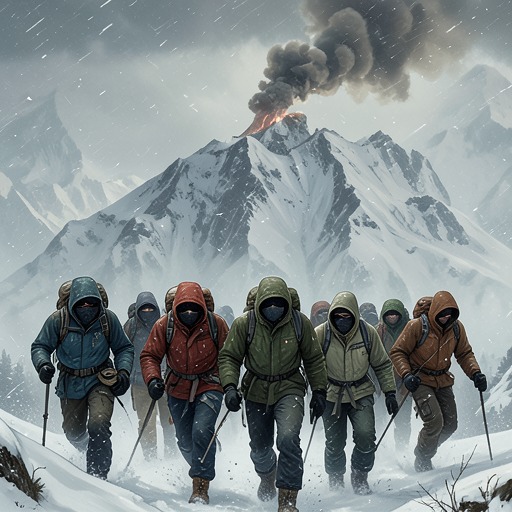
The summit group did not climb in isolation. Hall’s team had left Camp IV thirty minutes earlier, and the two groups began to intermingle as they moved upward. By 4:00 a.m., they were joined by members of the Taiwanese National Expedition, including its leader Makalu Gau and two Sherpas. At the Balcony, climbers gathered to change oxygen canisters, drink, and rest. There they were in the Death Zone, where oxygen deprivation and cold made prolonged delay increasingly dangerous.
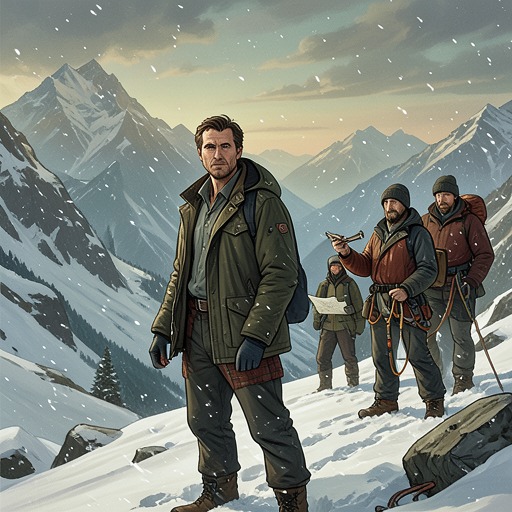
A critical mismatch emerged between what clients understood about fixed ropes and what had actually been arranged. Members of both Mountain Madness and Hall’s expedition expected Lopsang and Hall’s climbing sirdar, Ang Dorje, to leave ahead of the clients and fix the route so the climbers would not have to wait. Neither sirdar nor other Sherpas had gone ahead. Lopsang later said he had been told by a member of a Montenegrin expedition that the ropes were already fixed, while Jon Krakauer questioned that explanation, pointing to the rope carried by the two sirdars. The book presents the accounts as disputed, and notes that Fischer arrived at Camp IV tired and may have believed a report that left him thinking the route was ready. What is clear is that the expected advance preparation had not taken place, and the groups encountered a route-fixing problem during the ascent.
Mountain Madness also lacked a definite summit-day turnaround time. Fischer had discussed a system with Boukreev and Neal Beidleman in which Lopsang and the guides would take turns leading, Fischer would bring up the rear and turn back stragglers, and he would contact Lopsang by radio if problems arose. Neither Boukreev nor Beidleman had a radio. This arrangement differed from a fixed deadline that clients could use to judge when to abandon the summit attempt; the team’s members did not share a clear, pre-agreed cutoff. The distinction mattered as a practical weakness in a plan that depended on communication and on Fischer’s ability to assess climbers spread along the route.
Emergency, Retreat, and Significance
The communications chain failed to provide a reliable picture of events above the camps. Dr. Ingrid Hunt relayed messages through several Sherpas between base camp and Camp IV, and she believed the information reaching her was incomplete or presented in an overly reassuring way. As the situation grew more serious, she moved between the Mountain Madness and Hall camps to obtain better radio access. This relay structure complicated the team’s ability to understand the emergency and to coordinate action while climbers were separated on the mountain.
On the morning of May 11, with Mountain Madness’s oxygen depleted, Beidleman and the clients decided to retreat. The IMAX/IWERKS expedition supplied oxygen to clients who needed it for the descent. Two Mountain Madness Sherpas and a Sherpa from the Taiwanese expedition climbed toward the Balcony carrying oxygen and hot tea for Fischer, who had bivouacked overnight with Makalu Gau. Boukreev stayed behind rather than descend before learning Fischer’s condition. The retreat thus involved both a collective decision by the clients and guides to leave the mountain and a continuing effort to reach the expedition leader above them.
The account presents Mountain Madness neither as a single commercial success story nor as a simple failure of individual judgment. Its advertised system promised that guides and Sherpas would establish camps, fix ropes, and lead summit bids, while its actual operation depended on constrained staffing, contested route work, limited oxygen, uncertain deadlines, and indirect communications. Those pressures accumulated across the expedition. The company’s commercial ambition opened the door to Everest for clients and gave Fischer a route to broader recognition, but its emergency exposed how much that ambition relied on coordination and labor that could not be made secure by brochures or plans alone. In another Everest expedition discussed later in the book, Boukreev likewise stressed that Sherpa teams required years of repeated ascents and consistent financial support to develop; his observation frames the organizational limits beneath Mountain Madness’s carefully described summit preparations.