Mountaineering Fixed Rope
The ClimbFixed ropes were the mountain’s temporary handrails: installed for a climbing season across unstable ice and steep slopes, they made dangerous passages traversable while binding the expedition’s progress to the timing and coordination of the people who laid them. In 1996, the ropes supported acclimatization and camp construction, but the gap between plans and what was actually fixed became consequential on the route toward the summit.
Construction and use
Each season, Sherpa teams threaded the Khumbu Icefall, coordinating the placement of more than seventy aluminum ladders in 1996. The ladders bridged crevasses—sometimes by overlapping and tying together three or four—and climbers crossed them clipped to seasonal ropes that served as handrails. The route traversed two thousand vertical feet in slightly more than a mile, through seracs and fissures that could exceed three hundred feet in depth. The ice was continually shifting; creaks and splintering sounds were reminders that neither a ladder crossing nor the terrain beneath it was fixed in any lasting sense.
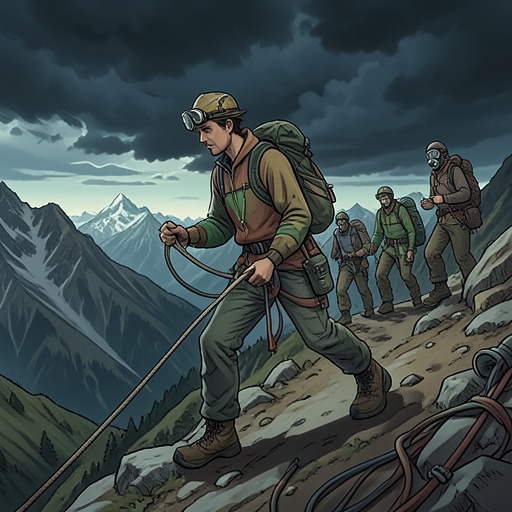
Climbers attached themselves to a rope with a carabiner secured to a short length of rope on the harness, opening and closing the metal link to move between sections. On steeper ascents, they could use a jumar: as it was pushed upward, the rope fed through; when pulled toward the climber or loaded by a backward fall, its cam gripped the rope. This push-pull method, called jugging, made the fixed line both a route marker and a means of holding position on steep ground.
Scott Fischer made crossing the Icefall a qualification for going higher: clients had to complete it from bottom to top in under four hours. That threshold made the ropes more than equipment. It was an explicit test of whether a client could move through a fundamental hazard quickly enough to continue the expedition.
Acclimatization and route preparation
The Mountain Madness acclimatization plan depended on progressive excursions, with clients carrying only personal belongings and equipment while Sherpas working under Lopsang Jangbu Sherpa bore ropes and supplies. After an initial trip to the planned first camp at 6,100 meters, the clients were to return to Base Camp the same day, rest, and have their condition observed. A later excursion would include an overnight at that height and a training climb to 6,500 meters; subsequent stages were intended to carry the team higher. The route’s ropes were thus part of a carefully staged schedule: climbers could acclimatize on the mountain only if the route and camps were ready for them.
When the route above Camp II remained incomplete, Scott Fischer and Anatoli Boukreev arranged a compromise: clients would ascend the fixed ropes to 7,000 meters, while the two guides would continue to 7,300 meters to select and prepare the Camp III site. Boukreev had already advanced the line above the Sherpas’ stopping point. After Neal Beidleman turned back with the clients, Boukreev climbed with crampons, harness, jumar, and rope; he extended the fixed route by more than two hundred meters, reaching 7,100 meters. He descended before dark, aiming to prevent delays when the clients resumed their acclimatization and advanced toward Camp III.
The next planned push showed how vulnerable that schedule was to weather and labor. Boukreev set out carrying high-altitude clothing and a tent, but, in worsening snow, wind, and near-zero visibility, found the Sherpas descending before they had prepared the Camp III site or erected tents. He continued to the end of the fixed ropes, stashed the tent where the loads had been left, and descended the Lhotse Face. The clients, who had not reached their target altitude, wisely turned back when the weather changed. Camp III remained unbuilt, while the Sherpas were nearing exhaustion after several days of work.
Shared work and competing schedules
The unfinished route also shaped cooperation among expeditions. Fischer and Boukreev faced a choice: direct Sherpas to establish Camp III, then send them down to rest, or preserve Mountain Madness’s contribution to a joint effort to fix ropes between Camps III and IV. Other expedition leaders had agreed to cooperate on that work on April 26. Contributing Sherpas would have left them unavailable for Camp III construction and rest, so Boukreev was assigned to join the rope-fixing effort instead. The decision protected Mountain Madness’s place among the early teams expected to make a summit bid, with May 10 circulating as a possible date, but it made the route’s readiness dependent on a guide taking on work otherwise assigned to Sherpas.
On April 25, Boukreev rested at Camp II, gathered supplies, and discussed dividing the next day’s work with Ang Dorje Sherpa, the climbing sirdar of Rob Hall’s Adventure Consultants expedition. Before dawn, he climbed with Sherpas from Hall’s and the Taiwanese National Expedition. They reached the Camp III site after about three and a half hours, as morning light fell on two tents the Sherpas had put up the previous day. The ropes between Camps III and IV required laborious, time-consuming work; Boukreev wanted the route to be in place and safe before the summit attempt.
The summit route and its gaps
The same dependence on fixed lines continued higher. At the Balcony, climbers from three expeditions gathered to rest, change oxygen canisters, drink, and prepare to continue in the Death Zone. Mountain Madness clients understood that ropes above Camp IV were supposed to be fixed before they arrived, so that they would not have to wait. In practice, no Sherpas had left Camp IV early to do the work: neither Lopsang Jangbu Sherpa nor Ang Dorje Sherpa, nor another Sherpa, had gone ahead to fix the route.
Lopsang later said that a member of a Montenegrin expedition, after its failed May 9 summit bid, had told him the ropes were already fixed. Jon Krakauer questioned that account, noting that Lopsang and Ang Dorje carried three hundred feet of rope when they left Camp IV. The book presents the explanation as disputed rather than settled, and also notes that Scott Fischer arrived at Camp IV late and extremely tired, conditions under which he may have believed a report that one part of the preparations was complete. Whatever the source of the misunderstanding, the planned separation between early rope-fixers and the clients did not occur.
The fixed route’s importance extended beyond ascent. On May 10, after waiting almost an hour on the South Summit, Boukreev and Beidleman decided to work together to fix ropes toward the summit. Boukreev retrieved lengths of old rope from the snow, then moved on toward the Hillary Step to speed the ascent, leaving the remaining section to guides and Sherpas behind him. The lines were therefore not a completed backdrop to the climb: they remained work in progress, assembled under pressure as climbers reached the terrain they were meant to secure.
Infrastructure, communication, and risk
The ropes operated within an expedition system whose other links were also fragile. Martin Adams objected to the expedition’s old, ten-channel radios, describing them as a major misstep; the radios were meant to connect Base Camp with climbers and transmit information about weather, equipment, medical issues, and emergencies. On summit day, Fischer’s plan relied on him keeping in radio contact with Lopsang near the front, but neither Boukreev nor Beidleman had been issued a radio. Fixed ropes could make a physical route legible without ensuring that those using it shared reliable information about conditions or delays.
This dependence persisted during the rescue effort. Base Camp doctor Ingrid Hunt said messages passed through several intermediaries between her and the mountain, and she felt that reports reaching her were incomplete or made to sound more favorable. With radio contact to Pemba at Camp IV sporadic, she went between the Mountain Madness and Adventure Consultants camps to obtain information. Meanwhile, Boukreev, facing reports of five clients down, sought help from nearby expeditions. The ropes provided a path on the mountain, but they could not themselves supply oxygen, convey accurate reports, or guarantee that assistance would follow a request.
In the account of 1996, fixed ropes are both practical infrastructure and a measure of collective readiness. They could carry climbers across crevasses, support acclimatization, and extend a route toward higher camps; their safety and usefulness depended on advance work, rested labor, adequate equipment, and coordination among separate teams. When those conditions slipped, a line that promised passage could instead mark the point where plans, resources, and communication had failed to keep pace with the climb.