Poisk
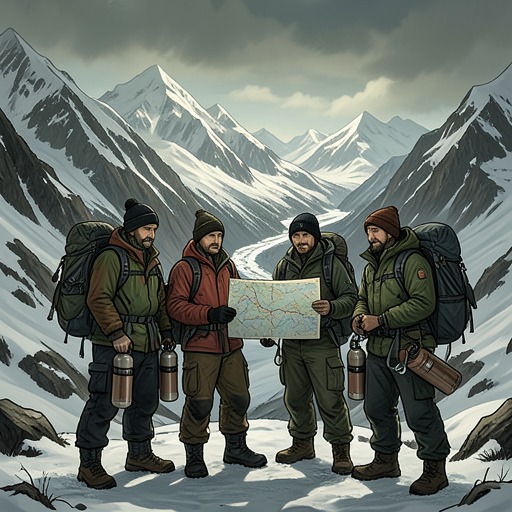
The ClimbPoisk was the St. Petersburg oxygen supplier whose lightweight titanium canisters became a consequential part of Mountain Madness’s preparations for the 1996 Everest expedition. The attempt to secure its equipment exposes the commercial bargaining behind expedition logistics; the bottles later carried toward the summit made that bargaining tangible as a carefully apportioned, limited supply of oxygen.
Supplier and expedition planning
When Scott Fischer hired Anatoli Boukreev, he was already looking for a way to reduce the weight his clients would carry. He had heard that Poisk offered a new titanium canister, at least half a kilogram lighter than the usual three-liter bottle used on the mountain. Boukreev had contacts at the factory, and the two agreed that he would negotiate with Poisk after returning from Manaslu. The proposed purchase tied Boukreev’s Russian connections to a specific operational aim: limiting load at altitude while equipping the Mountain Madness climbers.
By late January, however, there was still no agreement. Poisk representatives told Boukreev that Henry Todd of Himalayan Guides, with whom Boukreev had climbed on Everest in 1995, had made an advance purchase agreement in exchange for becoming the supplier’s sole distributor for Everest. Boukreev was particularly frustrated because he had introduced Todd to Poisk’s factory personnel the previous year. The arrangement turned a supplier he had helped open to Todd into a bottleneck for the expedition he was now helping equip.
The delay carried a deadline. Mountain Madness’s clients were due to leave for Kathmandu in late March and might make their summit attempt in the first week of May; they needed oxygen, and the team had none secured. Boukreev proposed shifting some business to Zvesda in Moscow, where he believed he could obtain a better price. He kept negotiating with Poisk at the same time, hoping the original supplier would offer a deal that could save Mountain Madness nearly a third of Todd’s price and possibly earn Boukreev a small commission. If Poisk agreed, the transaction would require cash up front, so Karen Dickinson prepared to travel with the funds.
The compromise and its limits
Fischer’s preference for light equipment shaped the compromise. Mountain Madness would buy enough Poisk canisters through Todd for the clients’ summit push, while ordering the balance of its oxygen from Zvesda for use at lower elevations and by the Sherpas. Zvesda’s cylinders held four liters rather than Poisk’s three, but were proportionally heavier. The compromise therefore divided supplies by function: lighter bottles for the summit bid, heavier bottles for other expedition needs.
Todd rejected the proposed split. He told Dickinson that Poisk would deal only through him and that the masks and regulators were part of the package; Mountain Madness could accept his terms or abandon the purchase. With the expedition’s departure approaching, the team capitulated, signed the order, and Dickinson canceled her planned trip to Russia. She later credited Boukreev with trying hard to secure a better arrangement, but judged that the negotiations had begun too late and Todd had outmaneuvered them. The final order comprised 55 three-liter Poisk bottles, 54 four-liter Zvesda cylinders, 14 regulators, and 14 masks. Those figures became more than an invoice: the book notes that they would later face close scrutiny and painful questions.
From procurement to summit-day allocation
The equipment’s significance becomes clearest at Camp IV. On the night before the May 10 summit attempt, Mountain Madness had 62 canisters there: nine Zvesda cylinders and 53 of the lighter Poisk bottles. By volume, 51 percent of the oxygen purchased from Todd was at Camp IV. Most of the rest had already been used, especially by Pete Schoening and Ngawang Topche Sherpa; a small amount was retained at Base Camp for medical emergencies.
The nine heavier Zvesda cylinders were reserved for sleeping before the climb. The 53 Poisk bottles were set aside for May 10. Five of the expedition’s six climbing Sherpas planned to use oxygen; Lopsang Jangbu Sherpa climbed without it but carried one bottle for emergencies. Each of the other five Sherpas carried two bottles for personal use and two for the clients and guides, bringing the Sherpas’ load to 21 bottles. The six clients, Fischer, and Neal Beidleman carried two each, while Boukreev carried one. Together, the guides and clients took 17 bottles uphill; all climbers carried 38 Poisk canisters, leaving 15 full ones at Camp IV, in addition to whatever Zvesda oxygen remained from the night.
That remainder allowed little room for an interrupted attempt. It was not enough to support an overnight stay and a second summit bid on May 11 if complications delayed the climbers. The plan depended on returning to Camp IV within the available oxygen supply: May 10 was the only attempt. The decision to purchase lighter bottles had answered one problem—weight on the summit route—but it could not erase the scarcity created by the quantities and the fixed schedule.
Equipment within a fragile system
Poisk’s role was part of a wider logistical system in which equipment and coordination depended on one another. Mountain Madness’s radios, for example, were criticized by Martin Adams as antiquated, limiting the communications capacity that could connect the mountain to Base Camp. On summit day, messages from the mountain passed through a chain of Sherpas between Dr. Ingrid Hunt and the climbers; Hunt later described communications as sporadic and the information incomplete or embellished. Oxygen bottles could be counted and assigned, but the ability to respond to an emergency also depended on whether people could communicate where help was needed.
The fixed-rope plan presented another contrast between preparation and execution. Climbers expected the Sherpas of Mountain Madness and Adventure Consultants to leave Camp IV ahead of the clients and secure the route, but neither Lopsang nor Ang Dorje nor another Sherpa had departed early to do so. These failures do not make Poisk responsible for the expedition’s wider difficulties. They do show why the supplier’s bottles matter beyond the procurement story: they were one part of a system whose limited supplies, communications, and route preparations shaped what climbers could attempt and what margin remained when events went wrong.