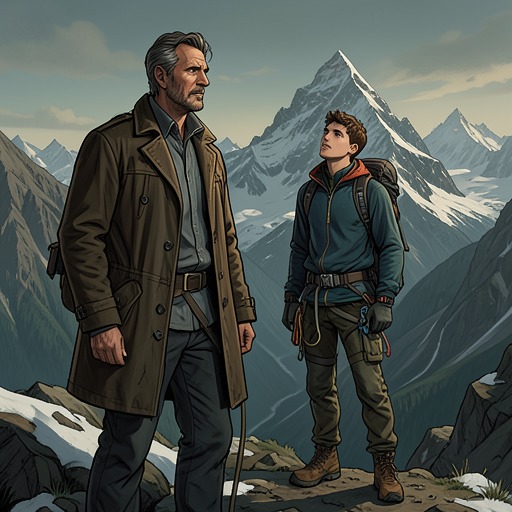
Schoening's belay
The ClimbSchoening's belay was the decisive intervention in a 1953 K2 descent: as five climbers were pulled down an ice slope, Pete Schoening held the rope by anchoring it to an ice axe wedged behind a boulder. The fall stopped, and the climbers survived. The episode became one of high-altitude climbing’s most celebrated rescues and a measure of the experience and steadiness that Scott Fischer valued in Schoening decades later.
The K2 descent
On August 10, 1953, Schoening and seven other Americans abandoned their attempt to summit K2, then still unconquered, to help a teammate whose blood clot in one leg threatened his life. During their descent in a driving snowstorm, Schoening belayed the stricken climber while five other members of the roped party moved down an ice slope below him.
One climber lost his balance, and the fall pulled four others off the mountain in succession. Schoening had tied his end of the rope to his ice axe and wedged the axe behind a boulder. As the rope ran over his shoulders, friction and his anchoring skill arrested the fall. The five climbers came to a stop, one more than 150 feet below him.
A rescue that shaped Schoening’s reputation
The account presents the rescue as a technical achievement under extreme pressure: the team had turned away from its summit objective to protect a climber in danger, and Schoening’s belay then prevented the descending party from being swept away. It was described as a textbook save and one of the greatest mountain rescues of all time. Its significance rests not on reaching a summit but on the skill that kept the climbers alive during retreat.
Fischer’s regard and the Everest expedition
For Scott Fischer, who knew the danger and severity of K2 firsthand, the episode was central to his high regard for Schoening. Fischer called him an exceptionally strong person and climber and said he was confident in Schoening’s ability to climb Everest. In 1996, Schoening joined Fischer’s Mountain Madness expedition at the age of sixty-eight, with the possibility of becoming the oldest person to summit Everest. The earlier rescue thus formed part of the experience and reputation Schoening brought to the expedition, though it did not itself establish what would happen on Everest.
The episode against Everest’s logistical background
The book’s account of the later expedition also sets Schoening’s celebrated past beside the practical conditions of the Everest climb. Mountain Madness had 62 oxygen canisters at Camp IV, but only 38 Poisk canisters were carried upward by the climbers; the remaining 15 full Poisk canisters and the small remainder of the Zvesda supply stayed at camp. Five of the six climbing Sherpas planned to use oxygen, while climbing sirdar Lopsang Jangbu Sherpa climbed without it, carrying one canister for emergencies. These details do not alter the outcome of the K2 rescue, but they distinguish the earlier story of a single climber arresting a fall from the later expedition’s dependence on equipment, coordination, and limited supplies.