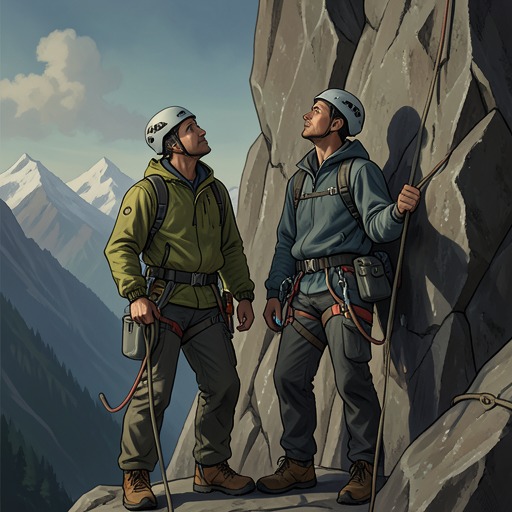
Scott Fischer and Anatoli Boukreev's collaboration
The ClimbScott Fischer and Anatoli Boukreev’s partnership brought an experienced high-altitude climber into Fischer’s Everest expedition, with Boukreev expected to help protect clients and prepare the route. Its central tension emerged not over the dangers of altitude, which both men understood, but over the work of guiding: Boukreev prioritized acclimatization and expedition readiness, while Fischer also expected guides to attend closely to clients’ comfort and needs.
Recruitment and the bargain
Fischer approached Boukreev with a specific offer: he needed a lead climber with Boukreev’s experience to join him on Everest, with possible future work on K2 alongside a Russian guiding team and in the Tien Shan. The invitation followed a history that gave their discussions real weight. After summiting K2 in 1992, Fischer had descended at night through a snowstorm while lowering the incapacitated Gary Ball, who was attached to his harness. Boukreev had warned Fischer that Everest, like K2, allowed no room for mistakes and required good weather, qualified guides, carefully screened clients, and climbers trained in self-reliance. He stressed that guiding Everest could not simply follow the model of guiding Mount Rainier or Mount McKinley.
The offer came while Boukreev was also considering a tentative proposal from Henry Todd of Himalayan Guides. He was reluctant to abandon that possibility, invoking a Russian saying about not changing horses while crossing a stream. Fischer laughed and asked what Todd was offering; on hearing the amount, he pointed out that Boukreev had not signed a contract and offered nearly twice as much. Boukreev, still unwilling to accept immediately, asked for $5,000 more than Fischer’s offer, partly hoping that a higher figure would make his eventual choice easier for Todd to understand. Fischer rejected the request outright. The negotiation shows both the practical competition for Boukreev’s services and the care he took over leaving an existing professional prospect.
A role defined by experience
The agreement gave Boukreev a welcome opening. Fischer advanced money against his contract, so Boukreev would not have to sell his ice ax or other equipment to afford a ticket home. For Fischer, hiring him secured the services of one of the Himalaya’s strongest climbers. Fischer later described the purpose of the hire in terms of what Boukreev could do if the expedition ran into trouble: he would be there to get the team off the mountain. Karen Dickinson likewise recalled Fischer’s excitement about having a climber of Boukreev’s strength alongside the expedition, particularly because of the uncertain dangers ahead.
Their preparation gave the partnership a practical, material shape. Fischer was concerned about ordering supplemental oxygen for his clients and was interested in Poisk, a St. Petersburg supplier whose lightweight titanium canisters weighed at least half a kilogram less than the usual three-liter cylinders used on the mountain. Boukreev had contacts at the factory and agreed to begin negotiations after returning from Manaslu. He also showed Fischer high-altitude tents made in the Urals, which Georgian climbers had used on Dhaulagiri and which had proved their quality in severe winds. Fischer bought one and asked Boukreev to arrange another made to his specifications. The oxygen and tent arrangements placed Boukreev’s contacts and expedition experience at the service of Fischer’s effort to equip the clients while managing weight and high-altitude conditions.
Preparation and competing expectations
Boukreev treated the expedition’s acclimatization plan as a central safety obligation. The planned progression included excursions through Camp I and Camp II, then a climb toward 6,800 meters before establishing Camp III at 7,300 meters. After rest, the final acclimatization outing would take the team from Base Camp to Camp II, onward to Camp III, and higher before descending; participation was mandatory because the clients would not climb higher before their summit attempt. Boukreev believed the routines needed to be followed strictly, and he told Fischer that success depended on oxygen, favorable circumstances, adequate rest, and a disciplined plan. Training and experience could not be supplied at the last moment, he argued, but careful preparation could improve the clients’ chances.
He also warned that time spent high on the mountain quickly depleted strength, which short rests at Base Camp could not restore. Feeling better during successive climbs could be misleading: a climber might appear to tolerate the altitude yet lack the strength for the final summit effort. After the excursion to 7,300 meters, Boukreev therefore favored a week or more of rest below Base Camp, around 3,800 meters in the forest zone, where greater oxygen availability and a change of surroundings might help both physical recovery and the clients’ morale. This approach made his idea of guiding concrete: protect the summit attempt by limiting high-altitude exposure, preserving strength, and ensuring that the acclimatization steps were completed.
The first disagreement
On April 20, after a day of expedition work and acclimatization, Fischer confronted Boukreev with the blunt assessment that he had done his work poorly on the previous excursion. Fischer said he had heard that Boukreev was not attentive enough to the clients and had failed to help them set up their tents at Camp II. Boukreev was surprised: before the clients arrived, he had been helping the Sherpas establish the mess tent, then rested. He had not assisted the clients because he saw no evident need and believed his work on the route would aid their acclimatization. Fischer interpreted the situation differently.
The criticism exposed a mismatch in their understanding of the job. Boukreev had believed Fischer chiefly wanted his high-altitude experience applied to client safety, route preparation, and the prevention of problems that could jeopardize a summit bid. He now understood that Fischer also expected guides to talk with clients and attend to their personal satisfaction—perhaps as much as, or more than, the technical and logistical work Boukreev had prioritized. Boukreev recognized that American guides with less high-altitude experience might be better suited to that service role.
Seeking advice, Boukreev discussed the criticism with Neal Beidleman. Beidleman explained that many expedition members were at high altitude for the first time and expected guides to walk them through ordinary tasks. Boukreev rejected the idea that guides should hold clients’ hands through everything; he believed they needed to cultivate self-reliance. He also maintained that fixing ropes and preparing the route were important responsibilities, not work that could simply be left to the Sherpas. Beidleman disagreed, reasoning that there were enough Sherpas for those tasks. Their exchange sharpened the practical stakes of the disagreement: Boukreev feared that the expedition was falling behind in establishing high-altitude camps and that its acclimatization routine could be compromised, while Fischer’s criticism had made clear that client care also formed part of his expectation of a guide.
Partnership under strain
The relationship therefore began with mutual professional confidence but did not rest on identical assumptions. Fischer valued Boukreev’s strength and experience as a safeguard in a crisis; Boukreev accepted the post believing that those same qualities would chiefly be used to prepare the route, manage high-altitude risk, and help clients reach the summit safely. Their early logistical cooperation and Fischer’s financial advance gave the arrangement a concrete foundation, yet the Camp II rebuke showed that the meaning of the hire remained unsettled once the expedition was under way.
That tension was consequential because it concerned how limited effort should be spent during acclimatization: on technical preparation and camp progress, or on direct assistance and reassurance for clients. The evidence presents no simple rupture. Instead, the partnership’s defining friction appears in the gap between Fischer’s service expectations and Boukreev’s emphasis on preparation and self-reliance. Both were working toward a successful, safe expedition, but they differed over which actions most directly served that aim.