South Col blizzard dogpile
The ClimbThe South Col blizzard dogpile was the desperate night-long effort by a group of climbers to survive after the May 10, 1996 summit descent on Everest became a disorienting struggle through wind, snow, and darkness. Lost near Camp IV and close to the Kangshung Face, they formed a human huddle to resist the cold, keep one another awake, and wait for enough visibility to find their way. The episode also exposed the limits of leadership and equipment in the storm: Neal Beidleman tried to guide the group without a headlamp, while Klev Schoening later found the direction to camp and helped some climbers move out.
From the Fixed Ropes into the Storm
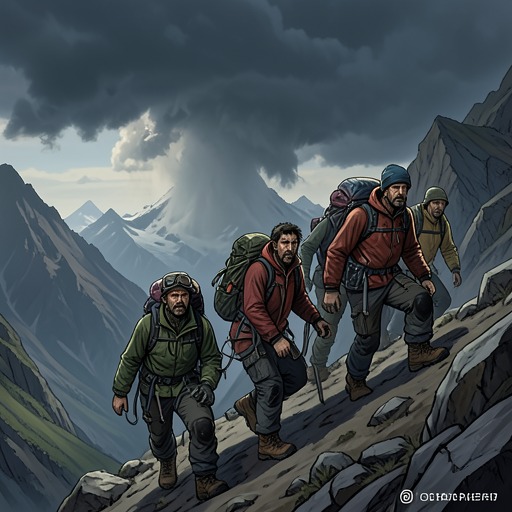
As the descending climbers reached the bottom of the fixed ropes, Camp IV’s lights were still visible. The storm intensified sharply: Beidleman recalled strong wind, heavy snow, and one final glimpse of camp before it vanished. The climbers had spent between forty and fifty-five minutes on the summit before beginning their descent, time they would later recognize as consequential. Darkness and the worsening weather made it difficult even to speak; instructions had to be shouted, and those upwind might not hear them.
Beidleman was holding Yasuko Namba by the arm and had not yet taken his headlamp from his pack. Lene Gammelgaard and Klev Schoening, initially bearing to the right toward what they thought was camp, saw a large mass of lights to their left and turned toward it, believing they would find other climbers. That choice brought them into the gathering group rather than toward the camp. Beck Weathers, Charlotte Fox, Tim Madsen, Sandy Hill Pittman, Mike Groom, Namba, Beidleman, Schoening, Gammelgaard, and two or three Sherpas were among those assembled at its largest point. Although guides were present, no settled chain of command emerged: people were buffeted by the wind and tended to follow whichever headlamp was ahead.
Losing Orientation
Beidleman tried to impose a direction and keep the party away from the Lhotse Face and its precipice. Before the storm had closed in, he had studied the terrain and judged that the eastern side of the South Col offered a less steep route. He wanted to reach a distinctive band of rock and then turn downhill toward the tents. But he could not get to the front while supporting Namba, had no headlamp out, and believed the group side-hilled too far. Once they lost that traverse, he no longer knew which way they were moving.
For what Beidleman estimated might have been about an hour, the climbers wandered slowly, trying to remain together while people drifted from front to back. Their oxygen was depleted or running out, and their ability to interpret terrain and direction was failing. Beidleman thought they might have reached the Tibetan side of the South Col. He described the conditions as being inside a milk bottle: wind and snow erased usable landmarks, while gusts he estimated at forty miles an hour or more—possibly reaching eighty—sometimes knocked people off their feet. Iced faces, difficult ground, and protruding rock compounded the danger.
At one point Beidleman reached a rise and saw—or sensed—terrain that seemed wholly unsafe and inconsistent with the South Col. Frightened, he returned to the group and urged everyone to stay together. He proposed huddling until the weather gave them a brief chance to see stars or the surrounding mountains and recover their bearings. He remembered that a similar storm had eased before the summit departure the previous night, and hoped for another temporary opening.
The Human Huddle
The climbers formed a dogpile with their backs to the wind. They lay across one another’s laps, shouted, beat each other’s backs, checked fingers and consciousness, and tried to keep moving and awake. Beidleman recalled the effort as collective: people participated in trying to preserve warmth and alertness, even as he felt close to falling asleep and not waking. The huddle was not a route out of danger but a means of enduring the storm while the group remained unable to navigate.
The snow eased briefly more than once, though the wind did not. During one opening, Beidleman saw a few stars; on another, he recognized the Big Dipper and the North Star. Someone identified Everest, but Beidleman could not tell whether the mountain they saw was Everest or Lhotse. The fleeting visibility offered hope without immediately resolving their position. The group was less than twenty metres from the Kangshung Face and about four hundred metres from Camp IV. In clear weather, the camp was only a ten-to-fifteen-minute walk away; in the blizzard, it remained unreachable by sight or reliable orientation.
A Break for Camp
As the storm continued, Gammelgaard, Schoening, Beidleman, and Madsen considered making a dash for Camp IV but could not agree on the direction. Gammelgaard increasingly relied on Schoening, believing Beidleman was lost and might not find camp without Schoening’s help. During a brief lull, Schoening became confident that he had established the correct direction. Beidleman remembered him taking the initiative and understanding which mountain was which; the route he indicated was uphill and opposite the direction the group had been travelling. Once they began moving, the party divided between those able to walk and those who could not.
Schoening tried different ways to assist the less mobile climbers. He initially attempted to manage both Fox and Namba, but found that he could not keep them moving while repeatedly dropping to his knees. Madsen took Fox, while Beidleman tried to help Pittman stand. When she could not walk, Beidleman urged her to crawl, and she did so until she lost sight of the headlamp ahead. She called out and found Madsen by another light. The episode made survival depend not on one orderly evacuation but on improvised pairings, moment-to-moment decisions, and each climber’s remaining ability to move.
Those Left Behind
Madsen, though capable of moving toward camp, stayed with Fox. He also went back for Namba after hearing her moan nearby. Groom was still tethered to Weathers, who was struggling to walk, and Madsen told Groom to go to camp and get help, assuming he was still functional. Madsen, Pittman, Fox, Namba, and Weathers then formed a smaller group. They sat together, huddled to stay warm, and tried to remain awake while hoping someone would return for them.
The dogpile thus split into a group that attempted to reach camp and a group whose members were too impaired to continue unsupported. Its defining achievement was limited but immediate: the climbers stayed together long enough to endure a night in which the camp was nearby yet invisible, and in which cold, oxygen depletion, and disorientation narrowed the choices available. The storm turned distance into uncertainty; shared warmth and mutual assistance became the fragile substitute for a clear route or effective command.