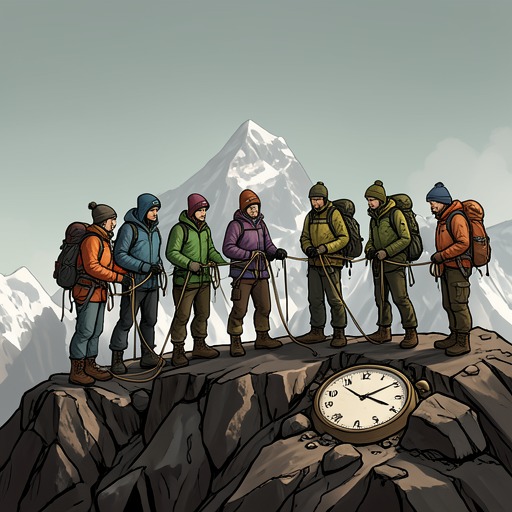
Summit turnaround-time rule
The ClimbThe Summit turnaround-time rule is the safety principle of turning climbers back when they reach a predetermined limit on time or progress. On the 1996 summit attempt, its absence from Mountain Madness’s plan mattered as much as the delays on the route: Fischer expected to make individual decisions while moving through the group, but the climbers did not share a definite cutoff, and the responsibility for enforcing one was unclear.
Purpose and Expedition Planning
A turnaround limit was meant to constrain the summit bid before exhaustion, darkness, or dwindling oxygen made descent increasingly dangerous. The need for advance planning was already apparent in Mountain Madness’s acclimatization program. Fischer and Boukreev planned four excursions, with the clients carrying only personal equipment while Sherpas carried ropes and supplies; after the first excursion to 6,100 meters, the group would return to Base Camp the same day and rest. The plan treated strength and observation of climbers’ condition as resources to protect, not incidental concerns.
The expedition’s timetable was also shaped by coordination between teams. When Camp III remained unfinished and Sherpas were nearing exhaustion, Mountain Madness agreed to contribute Boukreev to the joint effort to fix ropes between Camps III and IV on April 26. May 10 was circulating as a proposed summit date, and the team did not want to lose its place among the first expeditions to make a bid. The rope work was arduous, and Boukreev wanted the route made ready and safe. These preparations show the rule’s setting: a summit schedule depended on shared infrastructure, labor, and limited opportunities, while delays could make the planned margin for safety harder to preserve.
No Shared Summit-Day Cutoff
The climbers’ understanding of a cutoff was inconsistent. Gammelgaard said she had never heard of a summit-day turnaround time, although she would have followed a rule established in advance. A Seattle Weekly profile had described Fischer’s personal Two O’Clock Rule: if a climber was not on top by two, it was time to turn around. But the book distinguishes that personal guideline from an instruction to the team. Fischer never set a definite summit-day time or progress point at which his clients were to turn back.
Instead, Fischer’s strategy relied on the leaders’ positions within the group. He, Beidleman, and Boukreev had discussed taking turns leading: Lopsang and the guides would alternate at the front, while Fischer brought up the rear and turned back stragglers as he caught them. If a problem arose, Fischer expected to contact Lopsang, who was assumed to be near the front. Beidleman and Boukreev were not issued radios. That arrangement made the decision contingent on where the leaders happened to be and what information reached them, rather than on a common, explicit cutoff understood by every climber.
Hall’s team also lacked a single shared understanding. Some of his clients thought the turnaround time was one o’clock, some thought it was two, and others believed the decision would be made on the mountain. The contrast is significant: a rule can guide action only if those expected to follow it know what it requires and who is responsible for enforcing it. Here, even the stated time varied between climbers, while Mountain Madness had no definite team-wide deadline at all.
Pressure on the Route
The summit route’s hazards made the absence of a clear limit consequential. At the Balcony, climbers from three expeditions bunched together to change oxygen canisters, drink, and rest in the Death Zone. Many Mountain Madness and Adventure Consultants clients believed the ropes above Camp IV would already have been fixed by the Sherpas, allowing the clients to advance without waiting. In fact, neither Lopsang nor Ang Dorje, nor other Sherpas, had left early to fix them. The resulting discrepancy between expectation and reality added delay at a point where time at altitude was costly.
The account also records pressure to maintain the expedition’s place in the climbing sequence: Mountain Madness could have declined the joint rope-fixing effort below, but risked losing priority for its summit bid. On summit day, the same tension between progress and safety took a more immediate form. Beidleman recalled reaching the South Summit at 9:58 A.M., near the cutoff he remembered for Hall’s team, and waiting there and below it while the route toward the summit remained unfinished. He and Boukreev eventually took a long Perlon rope and moved out across the ridge. Beidleman understood that Fischer, as leader and sweep, was to make the hard decisions about who could continue; he did not feel comfortable turning clients around himself. The rule’s practical weakness was therefore also a division-of-responsibility problem: the person who believed he should advance the route did not believe he owned the decision to stop others.
Consequences and Significance
The consequences of continuing were not abstract. Fischer and Boukreev had agreed that Boukreev would guide without supplemental oxygen if properly conditioned and acclimatized, while each client would have three canisters, planned to provide eighteen hours of oxygen. Clients were expected to leave Camp IV at midnight, reach the summit, and return by 6:00 P.M., before nightfall and before their supplies ran out. Fischer had hired Boukreev in part to bring help—oxygen, hot drinks, or physical assistance—to descending clients if they needed it. The schedule thus depended on a safe return window as well as an ascent plan.
That plan met a deteriorating situation on the mountain. When Fischer reached the Hillary Step at 2:35 P.M., he saw only Adams and Boukreev among his clients and guides; five clients, Beidleman, and Lopsang were still higher on the route. If they had followed the recommended oxygen flow rates, they had about three and a half hours of oxygen remaining. The question of whether to continue or descend had become inseparable from the time needed to find the rest of the group and bring them back.
The account does not reduce the tragedy to a single missed deadline. It emphasizes that Fischer set no definite summit-day cutoff, that climbers held different expectations about turnaround times, that communications and rope preparation were imperfect, and that leaders’ responsibilities were distributed in ways that left critical judgments to the mountain. Hall’s decision to let Hansen continue also drew Lopsang and Harris’s attention toward the summit pair and away from other developing problems. In this context, the turnaround rule represents more than a clock time: it is a test of whether a safety boundary has been made explicit, communicated, and assigned to someone able to enforce it when ambition, delay, and deteriorating conditions converge.