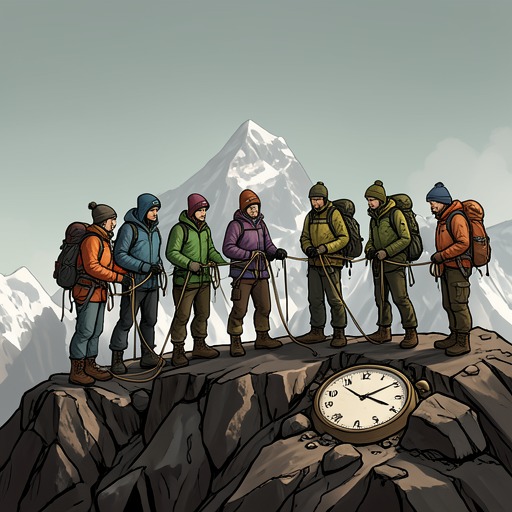
Summit-day turnaround rule
The ClimbThe Summit-day turnaround rule was meant to set a boundary between reaching the summit of Mount Everest and preserving enough time and strength to descend. On May 10, 1996, however, it did not operate as a clear, shared command: Scott Fischer had a personal Two O’Clock Rule but no definite deadline for his clients, while Rob Hall’s clients understood different times. The resulting uncertainty mattered as climbers waited in a high-altitude logjam, their oxygen supplies dwindling and the weather changing; for Lou Kasischke, the decisive limit became not whether he could reach the top, but whether he could get back down alive.
A personal rule, not a team deadline
Fischer’s Two O’Clock Rule was a personal guideline: if a climber had not reached the summit by two in the afternoon, it was time to turn around, because darkness was dangerous. Yet Fischer never converted that principle into a specific deadline for his clients. He had instead worked out a flexible leadership arrangement with Lopsang Jangbu Sherpa, Anatoli Boukreev, and Neal Beidleman. They would take turns leading; Fischer would bring up the rear and turn back stragglers as he caught up with them. If problems arose, Fischer was expected to contact Lopsang, who would be at or near the front. Neither Boukreev nor Beidleman had been issued a radio.
This arrangement depended on Fischer being able to reach climbers and make decisions as the ascent unfolded. It was not equivalent to telling the team in advance that everyone must turn around at a stated time or place. The distinction between a guide’s own rule and an announced team rule would become consequential once the climbers were spread out along the route.
Hall’s clients receive conflicting times
Hall’s instructions were also unclear. Some of his clients understood the turnaround time to be one o’clock; others believed it was two; still others thought either time might apply, with the final decision to be made on the mountain. The uncertainty surfaced in a practical way near the back of the logjam. At about 11:30 a.m., Stuart Hutchison told Kasischke that he expected Hall to turn everyone around because the bottleneck made it unlikely they could return by one, which Hutchison understood to be their deadline. Kasischke, still intent on summiting, moved on, but not far.
At approximately 10:30 a.m., climbers from Hall’s and Fischer’s teams and the Taiwanese expedition were scattered between the Balcony and just below the South Summit. At the oxygen flow rate Henry Todd had recommended, climbers were on their second canisters, with only one to two hours of oxygen remaining; their third and final canisters had not yet reached the South Summit. The Sherpas carrying those reserves were themselves strung out between the South Summit and the Balcony. The physical separation of climbers, guides, and oxygen supplies made a single, promptly enforced turnaround decision harder to carry out.
The decision in the logjam
Near the back of the queue, Kasischke encountered Hutchison returning down the route. Hutchison was convinced that the one o’clock limit could not be met amid the congestion. Kasischke continued climbing, relying on his experience managing fatigue as a long-distance runner and concentrating on one step at a time. The crowd stopped him below the South Summit. He clipped into the rope and knelt to rest; because the water in his pack had frozen, he scooped snow with a bare hand. He realized that all his fingers were frostbitten, a condition he already suspected but had largely ignored because reaching the summit mattered so much to him.
The pause forced him to attend to his exhaustion and to the worsening visibility. The views he had seen from the Balcony were gone behind poor visibility; he did not describe the weather as yet horrendous, but recognized that it was changing. He asked Lhakpa how much farther the summit was. Told that the climb would take two hours and that they were at 8,700 meters, Kasischke could not readily translate the altitude into the feet his mind normally used. The time estimate, rather than the measurement, made the danger plain: he believed he could reach the summit, but began to doubt his ability to descend.
Kasischke later described two competing impulses: one urged him to continue because another two hours seemed manageable; the other warned that he might die on the descent or lose his fingers. After several minutes, he decided to turn around and asked Lhakpa to tell Hall. He attributed the choice to his assessment that he could not make the summit and return alive, or at least intact. Hutchison’s concern about the deadline may have influenced him, but Kasischke distinguished that influence from the basis of his decision: his own physical condition and judgment.
The deadline after two o’clock
The uncertainty was not resolved before the deadline. From Camp II, Henry Todd and others watched the climbers above the South Summit. Todd recalled that Sherpas were alarmed by what they saw in the sky and repeatedly said the situation was not good. He radioed Hall’s Base Camp to ask what the turnaround time was. The response was two o’clock. By then, two o’clock had come and gone.
Todd’s observation supplied a firm answer to a question that had remained unsettled among climbers on the mountain, but it arrived too late to function as an effective advance limit. The contrast is central to the rule’s significance: a turnaround time can guide action only if it is communicated clearly, understood consistently, and applied while turning back remains feasible. Here, conflicting understandings, the spread-out team, congestion, and the delayed confirmation left climbers to make consequential judgments in deteriorating circumstances. Kasischke’s decision shows the rule’s practical limit as well as its purpose: the crucial threshold became his own recognition that the summit was still reachable, but a safe return was no longer assured.