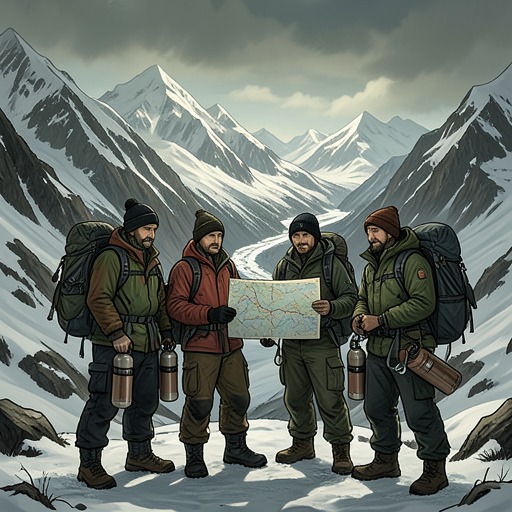
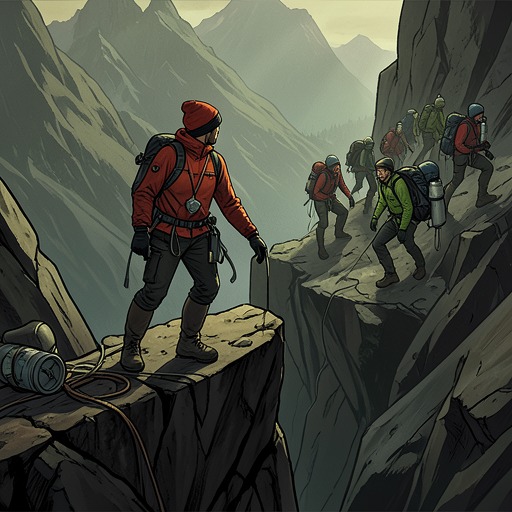
Supplementary oxygen bottles
The ClimbSupplementary oxygen bottles were not merely equipment on Mount Everest; they were a finite, carefully allocated reserve whose location and remaining contents shaped the summit schedule, the margin for delay, and the possibilities for rescue. Across the book’s accounts of the 1996 Mountain Madness climb and the later Indonesian expedition, the bottles shift from inventory to lifeline: planned for specific climbers and stages, then rationed, passed between exhausted people, or sought in a storm when a bottle’s presence might determine whether help was possible.
Inventory and Allocation
At Camp IV, the Mountain Madness expedition had sixty-two oxygen canisters: nine heavier Zvesda bottles and fifty-three lighter Poisk bottles. Only about 51 percent by volume of the oxygen purchased from Henry Todd was available for the summit attempt; most of the remainder had already been consumed, particularly by Pete Schoening and Ngawang Topche Sherpa, while a small quantity was held at Base Camp for medical emergencies. The division of the stock reflected distinct uses. The nine Zvesda bottles were reserved for sleeping on the night before the climb, and the Poisk bottles were assigned to May 10.
The climbing Sherpas carried twenty-one bottles up from Camp IV. Five of the six Sherpas planned to use oxygen, while Lopsang Jangbu Sherpa climbed without it but carried a bottle for emergencies. Each of the other five carried two bottles for personal use and two more for the clients and guides. The six clients, Scott Fischer, and Neal Beidleman each carried two bottles; Anatoli Boukreev carried one. Together the guides and clients had seventeen bottles, and all climbers carried thirty-eight Poisk bottles. That left fifteen full Poisk bottles at Camp IV, in addition to whatever remained of the Zvesda oxygen used the previous night.
This arithmetic defined the expedition’s safety margin. There was not enough oxygen left at Camp IV to support an overnight delay followed by a second summit attempt on May 11. The climbers had been told the attempt was one shot, no more: the plan’s reserves could not absorb a major complication without changing the choices available to the team.
The Summit Plan and Its Dependencies
The schedule depended on estimates of how long each bottle would last. Henry Todd advised that a Poisk bottle would provide about six hours at a flow rate of two to two and a half liters per minute. On that basis, two bottles were expected to provide twelve hours—enough, in the plan, to climb from Camp IV to the summit and descend to the South Summit, where a third bottle would be waiting in a cache. With that additional supply, climbers were expected to have enough oxygen to return to Camp IV if the climb and descent proceeded without complications.
The plan’s apparent sufficiency rested on several linked assumptions: that the climbers would leave at midnight, reach the summit in roughly ten or eleven hours, descend to the South Summit in under an hour, find the cached bottles, and keep to the recommended flow rate. The third bottle was not simply spare stock; it occupied a particular place on the route and completed the planned supply chain. The book’s account of the cache identifies the rock alcove below the South Summit as the site of the Mountain Madness and Adventure Consultants oxygen supplies. A bottle’s usefulness therefore depended not only on its existence but on its being carried to the right location and reached at the right time.
The contrast between planned and actual conditions makes the bottles’ role especially consequential. The expedition’s oxygen calculation looked robust on paper, but the remaining reserve at Camp IV was too small to support a second attempt, and the summit schedule left limited room for delay. Oxygen capacity and route timing were interdependent: a slower ascent or descent could consume the supply before a climber reached the next cache or returned to camp. The bottles turned a timetable into a material constraint.
Decisions About Oxygen and Rescue
Anatoli Boukreev’s decision to climb without using supplemental oxygen formed part of an agreed division of labor, not an absence of oxygen from his equipment. He carried one bottle, a mask, and a regulator as a precaution. At 8,500 meters, after assessing his own condition and becoming concerned about Neal Beidleman’s supply, he gave Beidleman his bottle. Boukreev later pointed to Beidleman’s ability to continue helping clients descend as evidence that the transfer had been the right choice.
The account frames Boukreev’s early descent in relation to the clients’ oxygen dependence. Before the expedition, he and Fischer had agreed that Boukreev would guide without using oxygen if he were properly conditioned and acclimatized, while Fischer’s plan provided three canisters, or eighteen hours of oxygen, for each client. The clients were expected back at Camp IV by 6:00 p.m., before nightfall and before their supplies ran out. If they were not back by then, Fischer expected Boukreev to be available to carry oxygen, hot drinks, and physical assistance to descending climbers. In this arrangement, Boukreev’s bottle was a reserve, while his capacity to move and return to help was itself part of the rescue plan.
The distinction between carrying a bottle and using one mattered again in the storm. Boukreev’s account says that after he reached Camp IV and began searching for stranded climbers, he could provide oxygen as well as hot tea and physical support. A photograph’s caption identifies the area where he found Sandy Hill Pittman, Yasuko Namba, Charlotte Fox, and Tim Madsen; another marks Beck Weathers’s location in the early hours of May 11. The bottles were thus part of a wider rescue effort, but their availability did not erase the dangers of darkness, poor visibility, exhaustion, or failed communication. At Camp IV, radio messages passed indirectly through several Sherpas, and the information reaching the camp was sporadic and, in Dr. Hunt’s view, sometimes incomplete. Oxygen and communication were both essential infrastructure, but they could not substitute for one another.
Storm, Search, and Material Traces
During his return through worsening weather, Boukreev used discarded oxygen bottles to help orient himself. With visibility reduced to only a few meters, he encountered the bottles after turning back from the Kangshung Face, then recognized the route toward the tents. Their role had changed from measured supply to traces on the ground: no longer only a planned dose of oxygen, they helped him locate camp in the storm. He eventually heard voices, found Beck Weathers alone in a tent, and, too depleted to assist him at that moment, crawled into his own tent and slept.
Boukreev’s account of finding Scott Fischer describes a different use of empty bottles. Unable to help Fischer, he covered him with Fischer’s pack, wrapped it around his face to keep birds away, and placed four or five empty oxygen bottles on his body as covering. In the same sequence, he describes the storm strengthening, visibility disappearing around 8,200 meters, and his descent becoming a navigation problem governed by memory, intuition, and the objects he came across. The bottles could not revive Fischer, but their physical presence became part of the last care Boukreev could offer before descending.
Emergency Rationing and Aftermath
The Indonesian expedition’s 1997 summit push presents a contrasting allocation. Its members planned to carry two bottles each, using oxygen continuously at two liters per minute, while the Sherpas were to carry three extra bottles for each climber. The team also planned for its Sherpas to use oxygen. These reserves were set against deep snow, difficult trail-breaking, a shortage of functioning Sherpas, and the work of establishing an emergency camp at 8,500 meters. The expedition’s leader, Vladimir Bashkirov, judged that the supplies did not comfortably match the work required and that the climbers would need to conserve oxygen and be prepared to work without it.
At the emergency camp, the oxygen reserve became a shared resource rather than an individual allotment. The tent was damaged, missing two sections of its poles, and six climbers crowded inside with a stove, pots, gas, a sleeping mat, and two full bottles. Bashkirov and Anatoli Boukreev took turns moving the mask among three exhausted Indonesian summiters, stretching the supply through the night; left too long without the bottle, a climber would cry or pray. Evgeny Vinogradski kept brewing hot water. The night’s survival depended on coordinated rationing and care, not on any climber possessing an uninterrupted supply.
By morning, the bottles were gone. The team gave everyone one last drink, then began descending without oxygen. The account emphasizes that the Indonesians were moving slowly but could move, their acclimatization and the gradual withdrawal from the bottle having eased their dependence. Here the planned equipment did not accompany the team all the way back to Base Camp; its remaining use was concentrated in the emergency night, and the descent became possible only after the group had managed the transition away from it. Across these episodes, oxygen bottles register the narrow boundary between provision and shortage: a number counted at camp, a cache on the route, a bottle transferred between climbers, a marker in a storm, and, at the emergency tent, a shared supply rationed one maskful at a time.